
Birkenau Russian Graveyard for POW’s: End of the Tour
This Birkenau Russian Graveyard is where many of about 15,000 Soviet POWs who were brought to Auschwitz are buried, only 92 remained alive at the last roll call. In the video, this field beyond the monument is where some 10,000 Soviet prisoners of war are buried.
We started the Tour in Auschwitz I, entering the first gate with the Arbeit Macht Frei sign, seemingly a work camp. And now at the end, the headstones in this graveyard are the end of this process. Because any tour of Auschwitz is a process, personal and historical.
← PREVIOUS
Birkenau Judenrampe
The Russian POWs and Block 11
The Nazis treated the Soviet POW’S more horribly than troops of any other nationality, Hitler having deemed the war a racial struggle for survival over the Slavs and Communism. Often POW’s would be surrounded by barbed wire and left to their own resources with no food, water or housing.
“Police operational groups—Einsatzgruppen—were supposed to seek out and kill the commissars and communists from among the soldiers. These Einsatzgruppen were set up before the attack on the USSR to “cleanse” areas near the front of “dangerous elements,” such as communists, partisans, Jews, and Roma. Later, the search was extended to POW camps in the depths of the Reich. Executions would take place in the nearest concentration camp.
One such group of about 600 Soviet POWs was brought to Auschwitz in the first days of September 1941 and taken to the cellars of block 11. About 250 Polish prisoners selected from the camp hospital were also taken there, after which SS men in gas masks dumped Zyklon B in the cellar rooms, causing the death of the POWs and prisoners there in the course of two days. This was the largest group to be murdered during the tests of Zyklon B, which was used later in the mass extermination of the Jews.” Source: Auschwitz Museum
Russian POWs Graveyard
Out of the first 10,000 Russian POWs brought to work at Auschwitz in 1941, 9,000 died in the first 6 months.
This field beyond the monument is where some 10,000 Soviet prisoners of war are buried, the Birkenau Russian Graveyard.The Nazis were very hard on Russian POW’s, many of whom were so starved they resorted to cannibalism.
At first, the Soviet POWs were held in a separate part of the camp (Auschwitz I).
Later, the SS transferred the Soviet POWs to Auschwitz II Birkenau.

Russian POWs drawing by survivor Wladyslaw Siwek
Reproduction courtesy of Auschwitz Museum Archive, 1980
Alan Jacobs: The Photographer was a Psychotherapist & Transactional Analyst
Alan Jacobs went back to Auschwitz many times over 25 years. What you see in the videos, and his original work which we are reconstructing, is this personal draw to the place, the subject, and what it means. If you are looking at academic psychology handbooks or journals, he was known as a prominent psychotherapist and author who spent decades specializing in transactional analysis, Gestalt, and psychodrama. [LinkedIn]
- Contributions to the Field: He is heavily recognized for his work on the misuse and abuse of power, autocratic systems, and comparative genocide studies. He won the prestigious Eric Berne Memorial Award in 1996 for his transactional analysis theories explaining the “Master/Follower” dynamic and autocratic power. [1]
He was also a photographer who worked with Remember.org for decades, and on his first visit to Auschwitz-Birkenau, here is what he saw, and wrote, about the end of his tour. Journals capture the moments that sparked 25 years of photos, collaborations, and the Virtual Tour of Auschwitz you just went through.
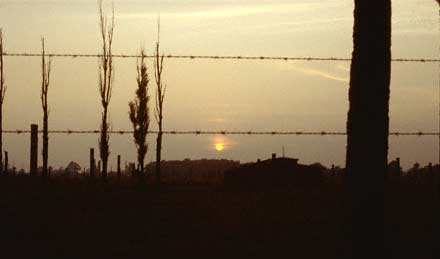
The Sun Sets in the West
Even here the sun finds its accustomed resting place, just there, past the wire, over the ruins of Krematoria, II and III. All life comes from the sun, from the fires of creation.
But just over there where it is setting, there were other flames, reaching high into the night sky, after the sun had set. Yes there was a sun in this night, but it didn’t come from the sky.
Now all is quiet here, and in the light of peace there is more… the silence.
← PREVIOUS
Birkenau Judenrampe
CREDITS AND COPYRIGHT
The Virtual Tour of Auschwitz photos by Alan Jacobs.
This exhibition was prepared by invitation from
Auschwitz-Birkenau State Museum, Oswiecim, Poland
Photographs taken in Auschwitz and Birkenau in the years 2003-2004.
They were then converted into one of the first VR tours by Krysia Jacobs.
Updated in 2022 to a video-based Virtual Tour of Auschwitz.
© 2003, 2004 Alan Jacobs all rights reserved
All artist reproductions courtesy of Auschwitz Museum Archive.
Please contact us with questions related to this exhibit.