
Birkenau Ramp
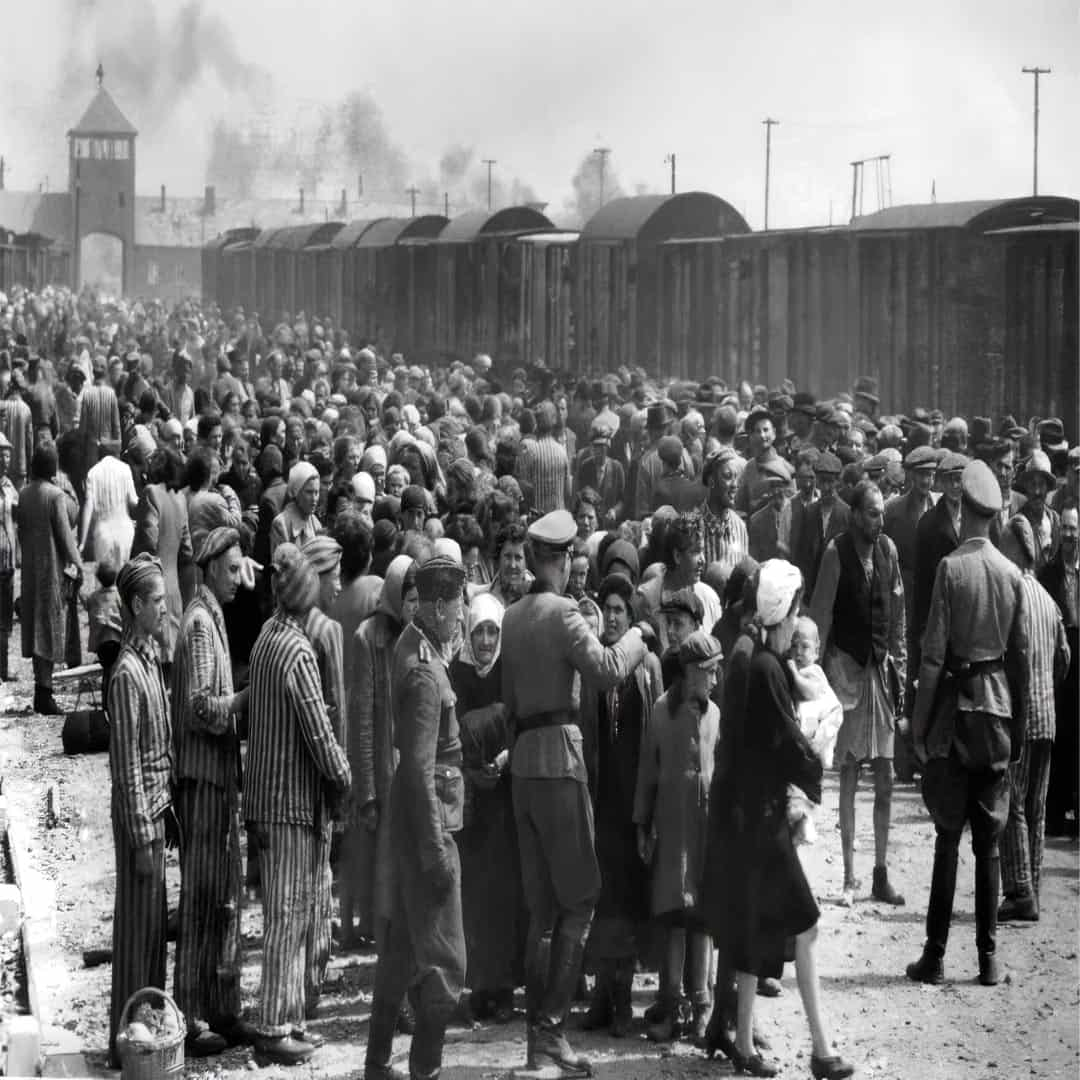
Hungarian Jews being “selected” from the trains. You see the Ramp next.
Visitors often report that the vast, desolate expanse, and the railway ramp where selections occurred, are gut-wrenching.
Photo by SS Officer Bernhard Walter Jews undergoing selection on the ramp. Public Domain, Link — Photo from the Auschwitz Album (May 1944)
“He stands there on the ramp watching after a vanished life; his family gone. What will the SS do to them?
He fights off the terrible images. They have been together through everything and now, at what seems the last place, they are separated, torn apart without being given even a few moments to say goodbye.
Perhaps this is because they will see each other soon enough. The officer did say tomorrow, didn’t he?” Processing — Alan Jacobs
The photo is real. So are the mixture of feelings that arise when visiting the same spot where this happened.
← PREVIOUS
Auschwitz Birkenau Death Gate
NEXT →
Birkenau Barracks
“It was the Nazi view of all women as cell-bearers that condemned the Jewish ones. Even within the lowest life-form–the anti race–women ranked lower still, for spawning it. In Hitler’s cliche, “Every child that a woman brings into the world is a battle, a battle waged for the existence of her people.”
Because women in their biology held history, one gestating Jewish mother posed a greater threat than any fighting man. To be father to a child had no impact on selection. To be a mother in fact or in future–that was the final sentence. Genocide is the act of putting women and children first. Of all the deceptions a death camp settled on, this one went down deepest. This was the hardcore of the Holocaust.”
Felstiner, Mary Lowenthal. To Paint Her Life. New York: Harper Collins, 1994.
The Birkenau Unloading Ramp
The virtual tour opens for the Birkenau Ramp to a view of a brick building – in use to delouse prisoner’s uniforms as louse-born diseases ran rampant. On the right is the “Mittelstrasse” road that runs the entire width of the camp. Continuing to scroll left you come to the women’s camp, BIa to the right of the ramp. and then the camp entrance.
All one need do to glimpse the scope and vastness of the Nazi plan for extermination is stand at this spot and look round in all directions. As you scroll left the SS orderly room on the Birkenau Ramp comes into view.
Scroll to the left and notice the vast expanse of the BII with its many sub-camps, first BIIf, e, d, the other part of the Mittelstrasse, and then BIIc, b, a (see map). BII – including 7 separate camps – those for men, women, and two “family camps”.
A bit further on to the far end of the ramp are ruins of Krematorium II, the Memorial and Krematorium III which are all hard to view here.
Along its length, the road to the left leading to the two largest gas chambers and crematoria in any camp, KII, KIII. As you scroll left the SS orderly room on the Ramp comes into view.
Birkenau Camp Remembered in Oil

Immediately after disembarking from the trains, prisoners lined up in two columns: women and children in one, and men in the other. Next, SS physicians separate the strong and healthy people from the elderly, the sick, pregnant women, and children.
Those fit for labor are sent to the camp. The others, usually 70-75% of each transport, sent to their deaths in the gas chambers.
← PREVIOUS
Auschwitz Birkenau Death Gate
NEXT →
Birkenau Barracks
CREDITS AND COPYRIGHT
The Virtual Tour of Auschwitz photos by Alan Jacobs.
This exhibition was prepared by invitation from
Auschwitz-Birkenau State Museum, Oswiecim, Poland
Photographs taken in Auschwitz and Birkenau in the years 2003-2004.
They were then converted into one of the first VR tours by Krysia Jacobs.
Updated in 2022 to a video-based Virtual Tour of Auschwitz.
© 2003, 2004 Alan Jacobs all rights reserved
All artist reproductions courtesy of Auschwitz Museum Archive.
Please contact us with questions related to this exhibit.