
Day-to-Day Prisoner Life and Auschwitz Camp Photos: Then and Now Part 2
A day in the life of an Auschwitz prisoner varied with the weather and the mood of the guards, and commanders. Survivor memory brings us paintings and drawings of the daily drudge work, selections, and sudden acts of violence. Only a survivor could remember what it’s like.
Auschwitz Prisoner Life – Part 2
Part 1: Auschwitz I & Birkenau | Part 2: Auschwitz Prisoner Life | Part 3: Auschwitz Barracks
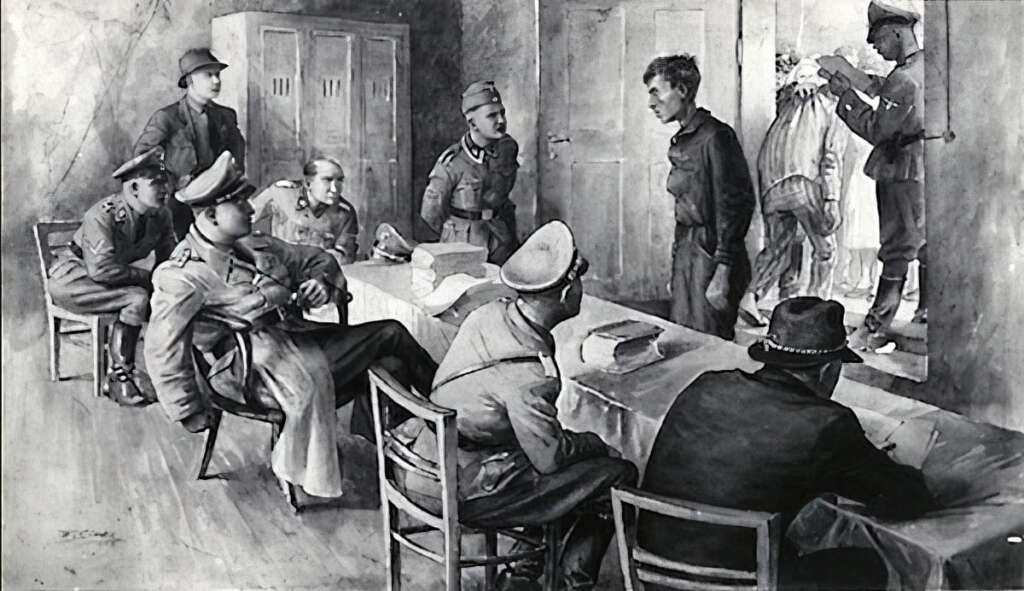
Block 11 Questioning and Judgment
Survivor Wladyslaw Siwek’s painting. A man is being questioned by 7 others. Almost all who came here were sent to a hold room, then out to the Block 11 courtyard, and shot against the killing wall.
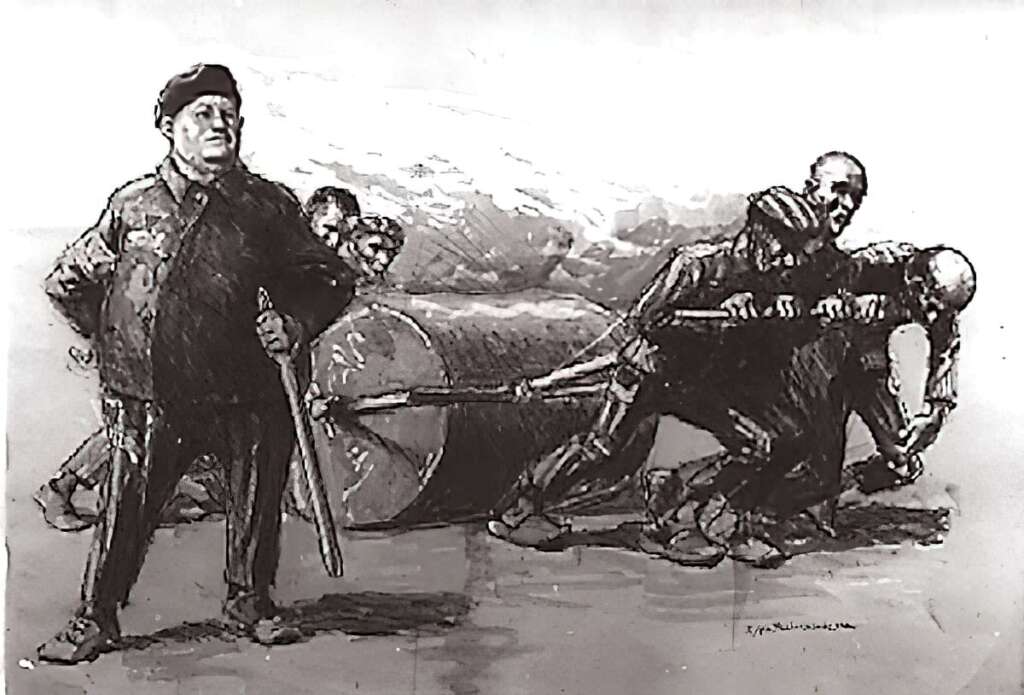
Survivor Mieczyslaw Koscielniak painted this memory. The concrete roller was used to compact the dirt street in Auschwitz I. Human beings were used like draft animals.
Lucille Eichengreen recounted her first days at Auschwitz:
In the morning they would round us up and we would stand for a spell and they would count us and recount us for hours and hours. It was freezing cold, at five in the morning or whatever, and by noon it was boiling hot, my whole scalp was full of blisters from the sun, the ears.
.
A Day in the Life of an Auschwitz Prisoner
Tap on the Then and Now tabs to switch between Then images and Now photos.
7. Birkenau Panorama
The humming death factory of Birkenau in full operation, survivor Mieczyslaw Koscielniak memory takes flight, into a panorama of his experience. The rigid order of the barracks behind the electrified fence. Women marching to work, while the ramp arrivals began the rapid process of selection; work or die.

Reproduction courtesy of Auschwitz Museum Archive, 1980
Left: Women prisoners on the left are being marched to work from their barracks on the left in the women’s camp, either BIa, or b.
Rear: In the background, 3/4 km. from the front, are the smokestacks of Krematoria II, and III where men, women and children were gassed, their bodies burned, and their ashes dumped into huge pits, or in the river Sola. These were the largest Krematoria in the entire Nazi system. Originally built to exterminate the Jewish people, many “Gypsies” (more accurately named Sinti and Roma) were also murdered here.
Center: Unloading of prisoners ringed by armed SS guards, and selection for either slave labor or, more probably the gas.
Right: On the right are the men’s camps: BII-a, b, c, d, e, f, g. Each of these barracks has about 1,000 people crammed into impossible living conditions. At the peak in 1944, about 100,000 people were imprisoned here, almost all of them merely because of their different culture, ethnicity, and religion. In the right foreground a men’s Kommando, or work unit, watched by armed SS, are carrying poles into the camp. In the extreme foreground is a prisoner foremen, or Kapo, who had the power of life and death over his charges.

For panoramic map see: Birkenau Panoramic Map
8. The Roller
Repetitive work grinds people down physically and mentally. Pushing the roller back and forth on the endless paths where people walk, some to hard labor and others to the gas. Overseeing it all a Kapo, well fed and assured of living another day, something the workers were not.
Reproduction courtesy of Auschwitz Museum Archive, 1980
The concrete roller was used to compact the dirt street in Auschwitz I. Human beings were used like draft animals. The obese Kapo illustrates the contrast in prisoner hierarchy created by the SS; “prominenti” with more than enough to eat, ordinary prisoners starved. Most of the early prisoner functionaries, Kapos and Blockeltesta (Work foremen and Block leaders) were criminals from German prisons; the worst types the SS could find.
As the camp grew others were chosen to fill these roles. Some of them were decent human beings who did what they could for their charges, occasionally beating someone when the SS were watching. It was difficult to balance one’s actions in this moral schism.

Similar roller in camp today.
“When I was in Auschwitz about two or three days, I had asked a Nazi lady, I said, “Where’s my mother?” And she being all heart, pointed to the chimney. She said, “You see that smoke coming out? That’s probably her.”
And that’s, that was a really the first time that it hit. This is where we are. This is what is happening.
*Helen Lazar Testimony, San Francisco, California – February 13, 1989. Copyright 1989 Holocaust Oral History Project.
9. The Arrival of the Soviet POW’s
Out of the first 10,000 Russian POWs brought to work at Auschwitz in 1941, 9,000 died in the first 6 months. Often surrounded by barbed wire and left to their own resources with no food, water or housing. At first, they were held in a separate part of the camp (Auschwitz I).
Later, the SS transferred the Soviet POWs to Auschwitz II Birkenau.

Reproduction courtesy of Auschwitz Museum Archive, 1980
They were starved almost to the breaking point and in some instances started eating each other. Here, prisoners in stripes help the near-dead soldiers off the carts at the entrance to the camp. The smoke stacks of the camp kitchen are only yards away.
The saying above the front gate is Arbeit Macht Frei (Works Makes Freedom), the cynical joke adorning the entrance to many camps in Poland and Germany. The Nazis treated the Soviet POW’S more brutally than troops of any other nationality, Hitler having deemed the war a racial and political struggle for survival over the Slavs and Communism. Often Soviet POW’s would be surrounded by barbed wire and left to their own resources with no food, water or housing.
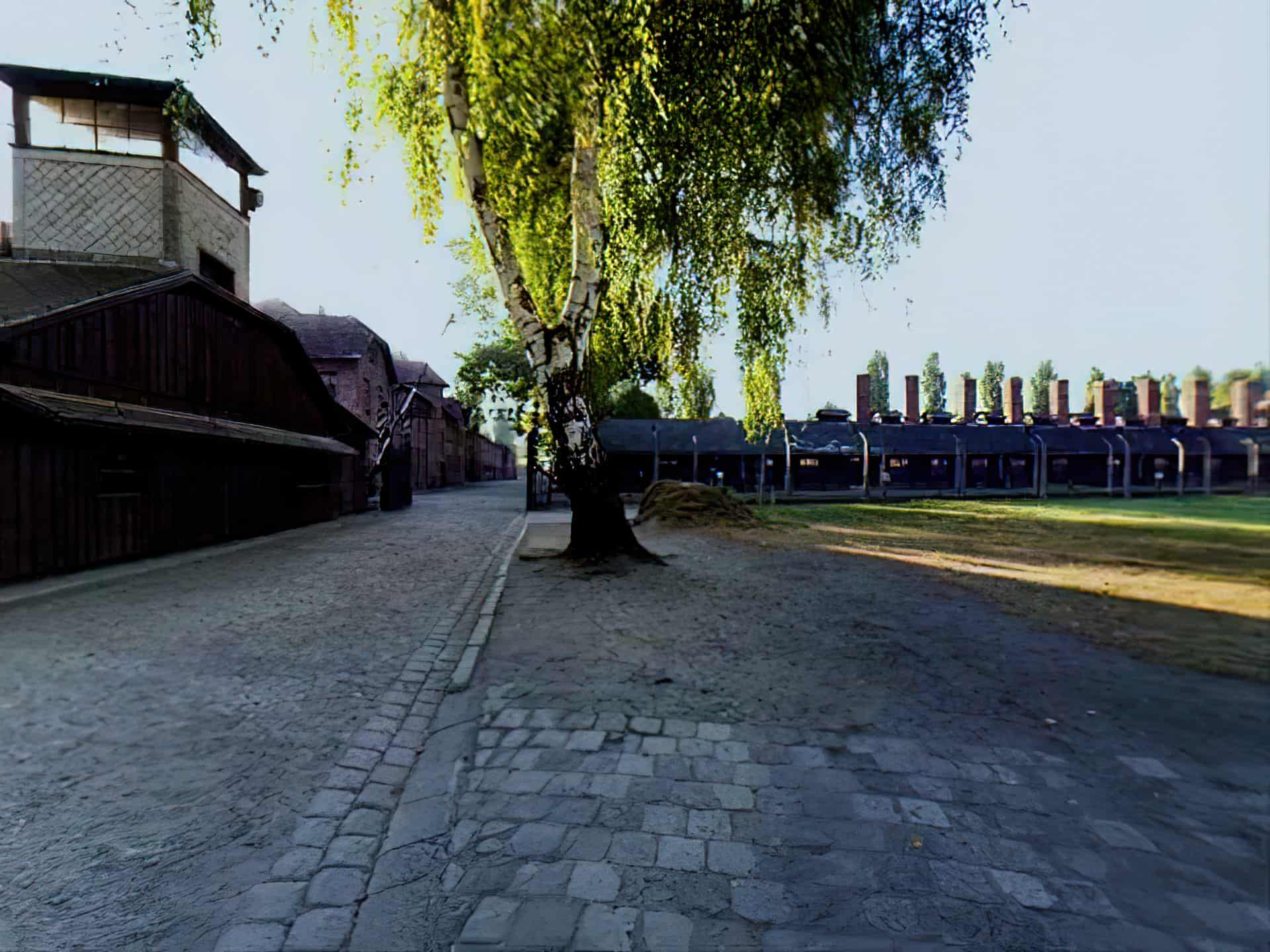
Entrance to the main camp, Auschwitz I. One sees the scene today, hears the terrible stories, and finds it hard to picture these things in their mind’s eye. Art by survivor-witness-artists, help a great deal.
“At almost each block, beside the men standing in line, bodies of three, four persons are lying. These are the victims of the night that have not lived to see the day. Even yesterday they were standing members of the roll-call and today they lie, lifeless, motionless.
Life is not important at the roll call. Numbers are important. Numbers tally…”
*Gradowski, S. in “Amidst a Nightmare of Crime: Notes of Prisoners of Sonderkommando Found at Auschwitz”, p.p.104 -105, Oswiecim: State Museum at Auschwitz.
10. Selection at Appel [Roll call]
Roll call was part of daily life, sometimes twice a day for many prisoners. While the numbers had to be counted, standing in the extreme cold and heat for hours on end, people collapsed. Later the Nazis eliminated roll call for laborers, since that took away from them working.

Reproduction courtesy of Auschwitz Museum Archive, 1980
Capo selecting some prisoners possibly for a work detail, or perhaps punishment. Every morning and evening the roll call was required as all prisoners, living and dead, had to be counted precisely. Later this policy was adapted for specific groups who didn’t have Roll Call, like laborers who spent that time working. The Appel could be a time of great suffering as prisoners were often left standing at attention after an escape, usually in the evening after the days work, in both hot summer and bitter winter. They did not have adequate winter clothing.
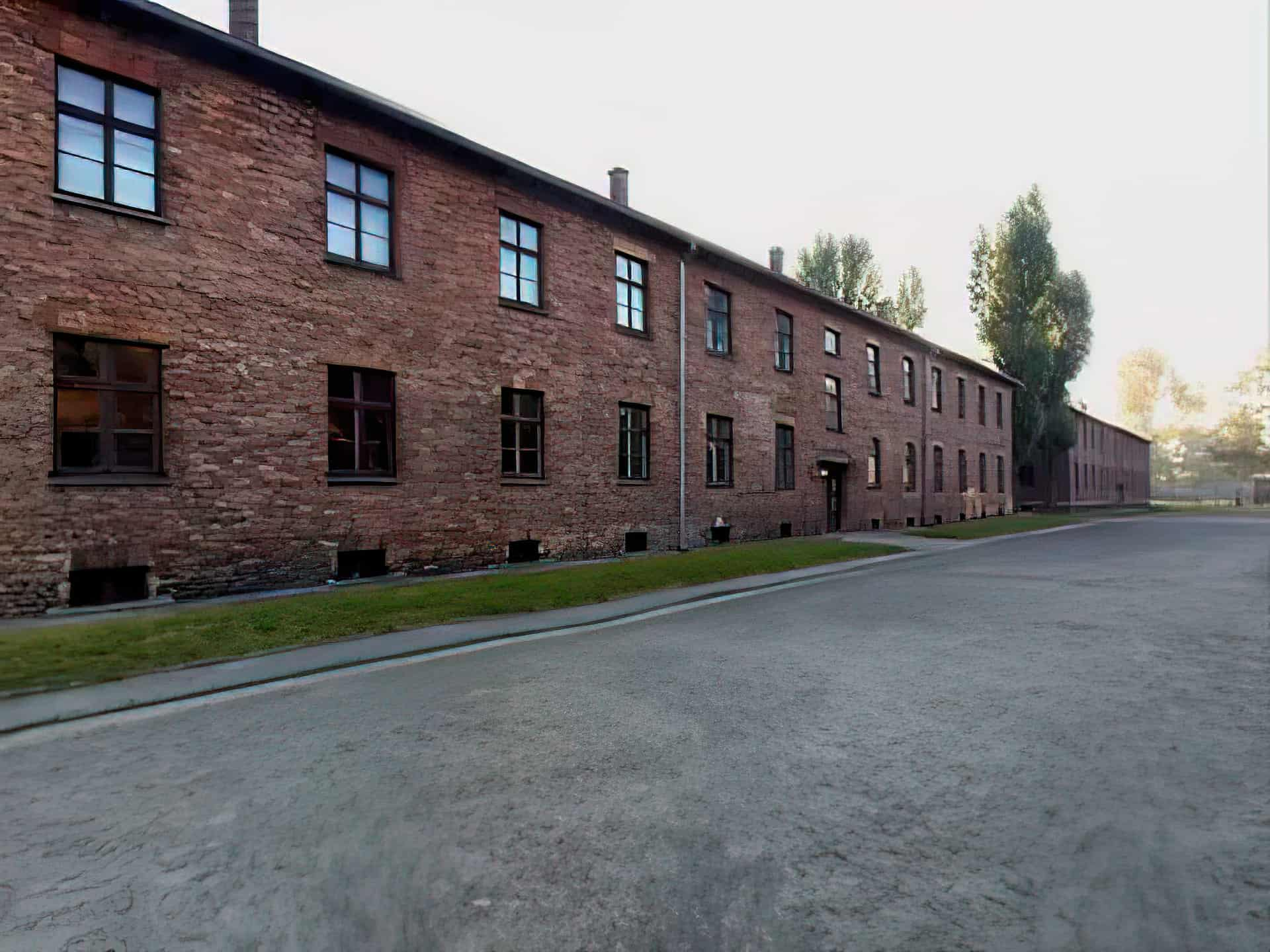
Front of barracks where roll call occurred..
11. Introduction into Block 11
What do you call a prison within a concentration camp? Block 11. Simple, cold, and efficient, the exterior brick housed a series of cells, used for their own unique forms of pain. Suffocation and standup cells, piling people in and making them stand for hours and hours. Once inside the prison, many never returned.
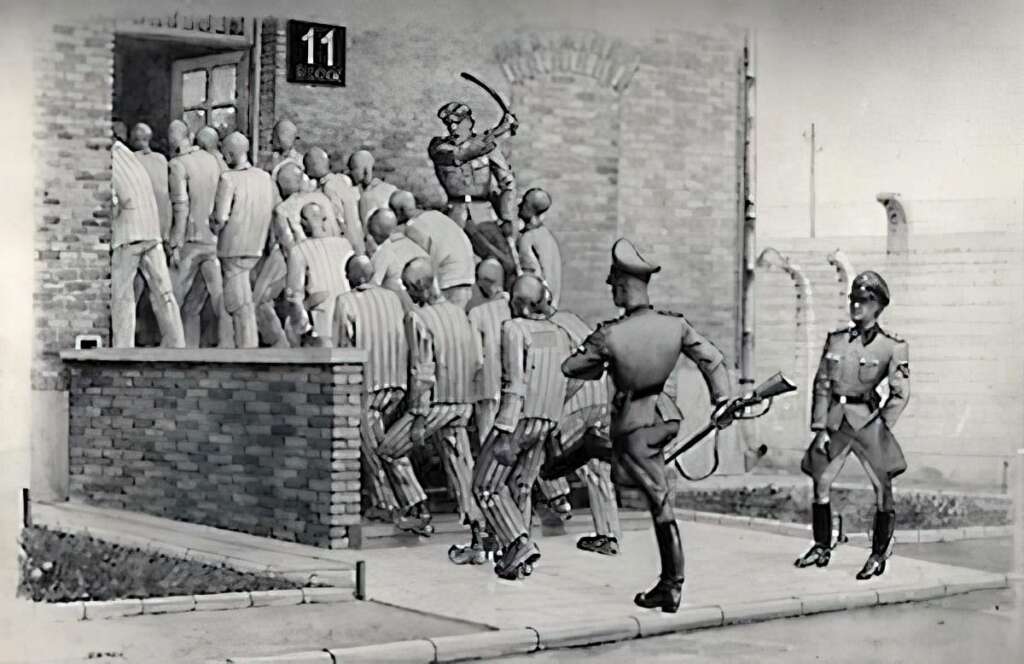
Reproduction courtesy of Auschwitz Museum Archive, 1980
This is the main entrance to Block 11, the prison inside the Auschwitz I. This notorious building was used for summary court martials (shown in next frame); really just mock trials instituted to create an impression of legality.
The basement of this block, shown in an earlier painting by the same artist, contained the Stehbunker, or standup cells, where people were forced to crawl into a small door at the floor and then stand in an impossibly small space for one man, let alone the three of four that were sometimes in them.
There were also suffocation cells where groups of as many as twenty men, were crammed with only a small opening permitting enough oxygen for perhaps one or two.
There were starvation cells here as well. Sadism is not so much about inflicting pain, but about having the power to do so. The less powerful a person feels, the more grotesque the tortures invented.
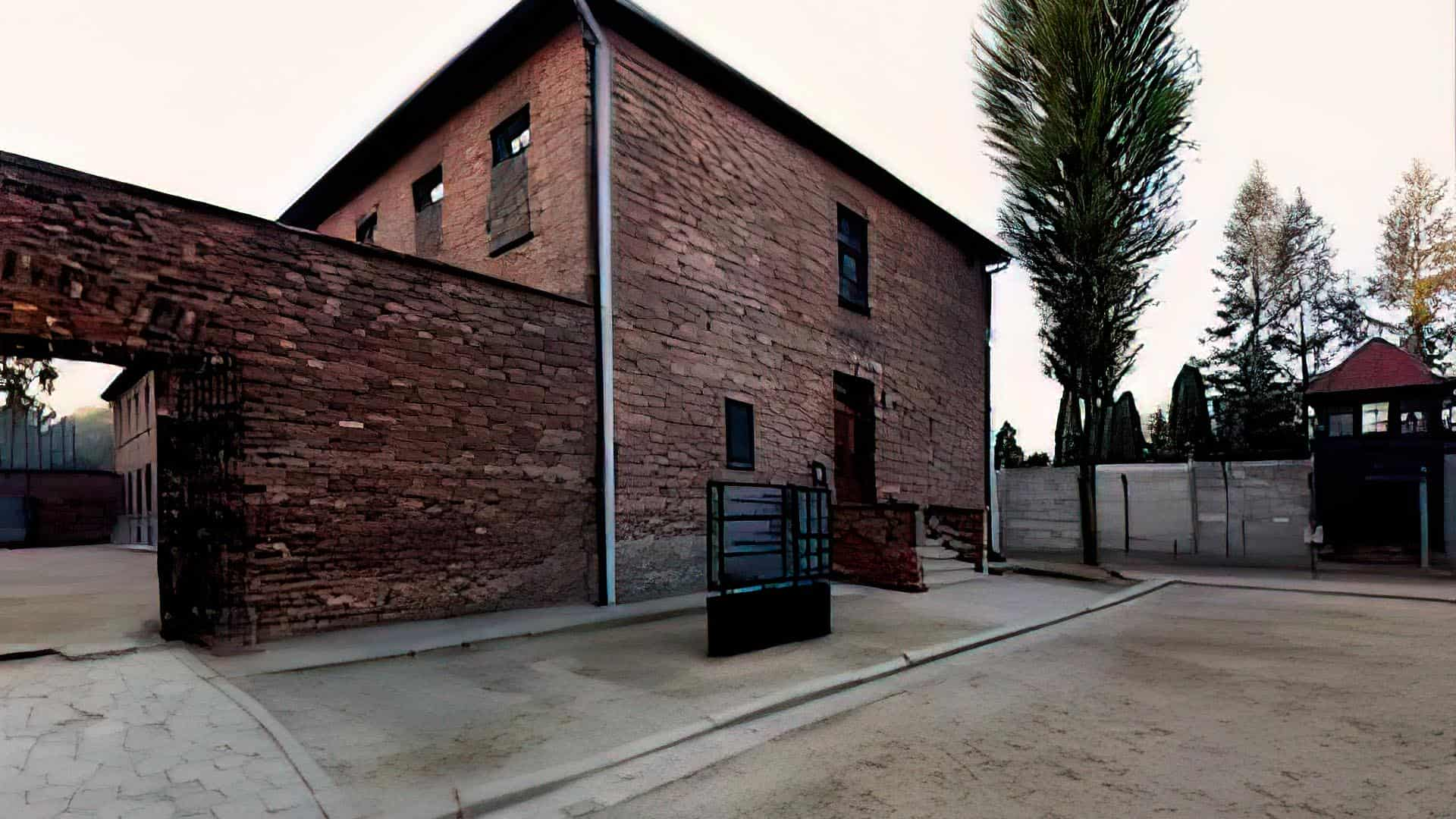
Entrance to Block 11, connected by two fenced walls surrounding a prisoner yard to Block 10.
12. Summary Court Martial – Block 11
The man leaning back in his chair is Maximilian Grabner, responsible for the fight against the resistance movement in the camp, as well as for the prevention of escapes and all contact with the outside world. The man in front stares as 6 others stare intently at him. The trial was decided before he entered.
Reproduction courtesy of Auschwitz Museum Archive, 1980
Room in Block 11, the prison within the camp, was used to hear cases against prisoners.
The man with his chair turned toward us and is arm over it, is SS second lieutenant Maximilian Grabner, Director of the Political Department (camp Gestapo), and Criminal Clerk. Others are not known. He was responsible for the deaths of many thousands of people and was convicted of war crimes in Krakow in 1947 and executed.
In this scene, a man is being questioned. Almost all who came before this were soon taken to a hold room and then out to the courtyard of Block 11 and shot against the killing wall, shot in the back of the head or in the neck.
People were sometimes executed for minor infractions like stealing bread, or clothes.
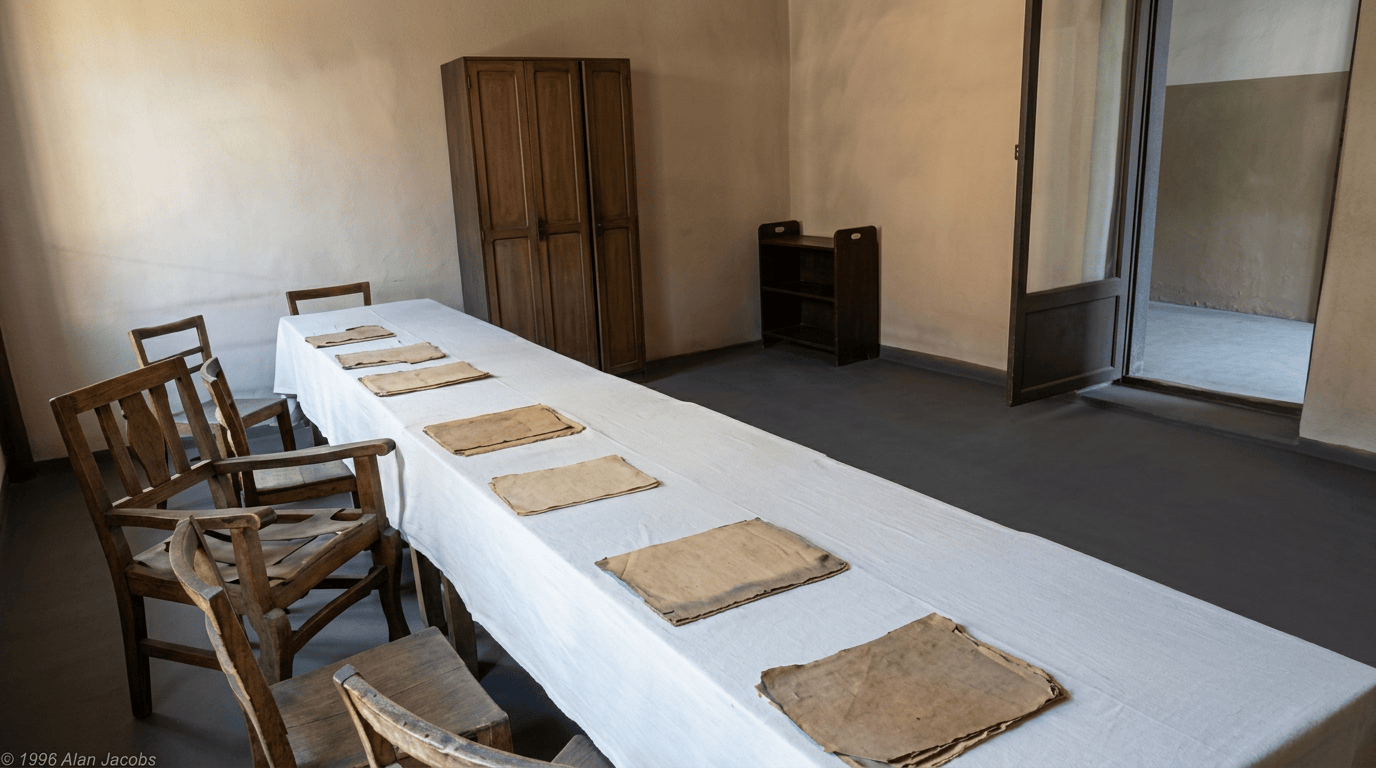
Room in Block 11, the prison within the camp, was used to hear cases against prisoners.
Almost all who cam before this were soon taken to a hold room and then out to the courtyard of Block 11 and shot against the killing wall, shot in the back of the head or in the neck.
People were sometimes executed for minor infractions like stealing bread, or clothes.
Who created the Then and Now exhibit?
The Then and Now exhibit is part of Alan Jacobs’ documenting the camps, and the stories inside those camps. He took photos from 1979-2004 of Auschwitz, Birkenau, Mauthausen, and more. Each visit he’d spend time with the Auschwitz museum staff, earning their trust with his commitment and questions. That trust is why you’re able to view this exhibit. We appreciate the gift.
From a personal level, this is Alan’s eighth and ninth trips to Auschwitz, and each time he sees it differently; the place doesn’t change, the act of witnessing changes you. So that photo isn’t just a photo to match the survivor; it’s a 25-year journey started by those drawings and his first Auschwitz visit.
From the book Man’s Search for Meaning:
“We who lived in concentration camps can remember the men who walked through the huts comforting others, giving away their last piece of bread. They may have been few in number, but they offer sufficient proof that everything can be taken from a man but one thing: the last of the human freedoms — to choose one’s attitude in any given set of circumstances, to choose one’s own way.”
― Viktor E. Frankl
When you view the next series of drawings, understand the choice the artist survivor is making. First, they choose their own way and survive. And then they choose to go back to that memory and preserve what few captured on film, or in writing. For us.
Auschwitz prisoner life is what created these drawings, and the photos taken almost 60 years later to connect Then, to Now.
Auschwitz Prisoner Life – Part 2
Part 1: Auschwitz I & Birkenau | Part 2: Auschwitz Prisoner Life | Part 3: Auschwitz Barracks
The Then and Now exhibit features photos by Alan Jacobs from Now, contrasted with Then – Auschwitz survivor paintings from memory.
Photographs taken in Auschwitz and Birkenau in 1996, and in 2003-2004.
Then and Now updated and re-released in May 2017 along with images enlarged using Photoshop and Topaz Gigapixel, and web site updated to standards. Second update in 2026 to realign work with original Alan Jacobs commentary, and photos from the Virtual Tour of Auschwitz which visited many of the same perspectives.
© 2003, 2004 Alan Jacobs all rights reserved
All artist reproductions courtesy of Auschwitz Museum Archive, 1980
Please contact us for questions related to this exhibit and using it for any instructional purposes.