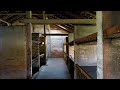
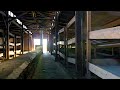
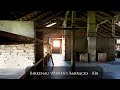
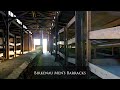
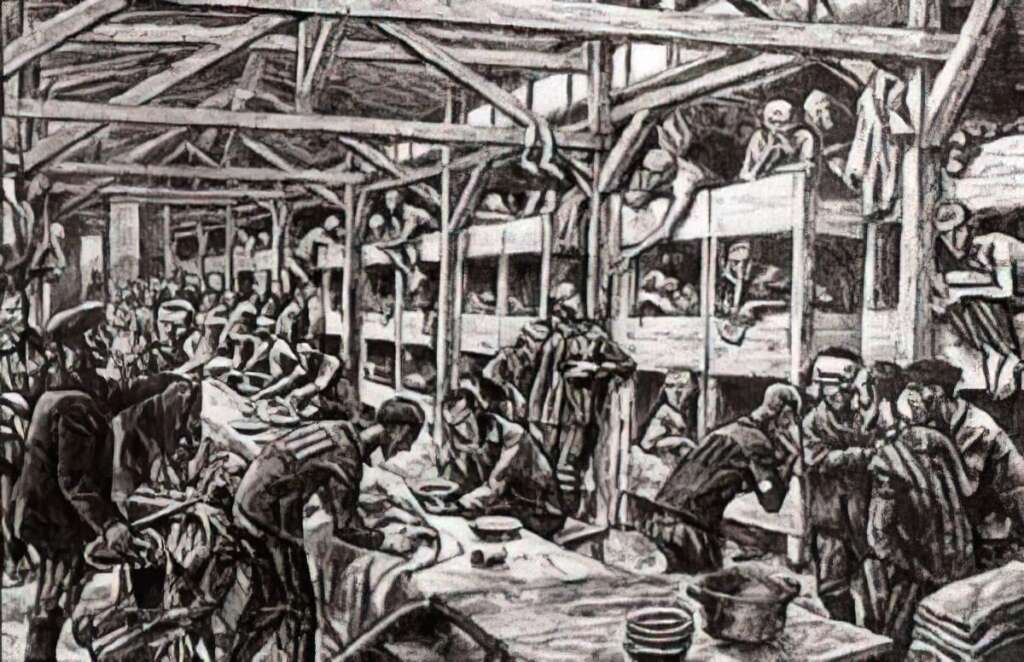
Originally built for Soviet POW’S, these Birkenau barracks were later to become part of the woman’s camp. Each tier was to have three straw mattresses, one for each prisoner. In reality, two or more slept on each mattress, 6 to 9 prisoners on each tier.
“To sleep, to sit, and keep his belongings, each prisoner was now provided with ‘private’ space that amounted to the surface dimensions of a large coffin or the volume of a shallow grave.”*
“A brick has come loose from the low wall separating our cell from the next where other larvae sleep, moan and dream under the blankets that cover them – these are shrouds covering them for they are dead, today or tomorrow what does it matter… We feel that we teeter on the edge of a dark pit, a bottomless void-it is the hole of the night where we struggle furiously, struggle against another nightmare, that of our real death.” ** Charlotte Delbo (1995). Auschwitz and After. New Haven and London: Yale University Press.
In three tiered bunks, or hutches, there were at times 9–12 persons on each level, especially during the arrival of the Hungarian Jewish transports in the Spring and Summer of 1944. The bunks were about 3 meters wide. If prisoners wanted to turn, the whole row had to turn over with them. BIIa had only one row of barracks.
Most of the other sub-camps, BIIb-e, had two rows. These barracks were actually prefabricated wooden stables (Pferdestallbaracken, OKH-Typ 260/9), originally intended for use on the Eastern Front in Russia. They had rings attached to the walls for tying horses. There were 153 of these barracks in BII, the men’s camp, and the camp hospital, not including toilet and washing barracks.
The three deck hutches were originally intended to hold 15 prisoners, the total population about 400. In reality the number of prisoners in each barrack varied according to the size and number of arriving transports. In May-June of 1944 the Quarantine barracks could hold as many as 2,000 prisoners each.
“If the barracks walls were suddenly to fall away, many thousands of people, packed together, squeezed tightly in their bunks, would remain suspended in mid-air. Such a sight would be more gruesome than the medieval paintings of the Last Judgment. For one of the ugliest sights to a man is that of another man sleeping on his tiny portion of the bunk, of the space he must occupy, because he has a body – a body that has been exploited to the utmost: with a number tattooed to save on dog tags, with just enough sleep at night to work during the day, and just enough time to eat.
And just enough food so that he will not die wastefully. As for actual living, there is only one place for it – a piece of bunk. The rest belongs to the camp, to the fatherland.”