
Birkenau Little White House
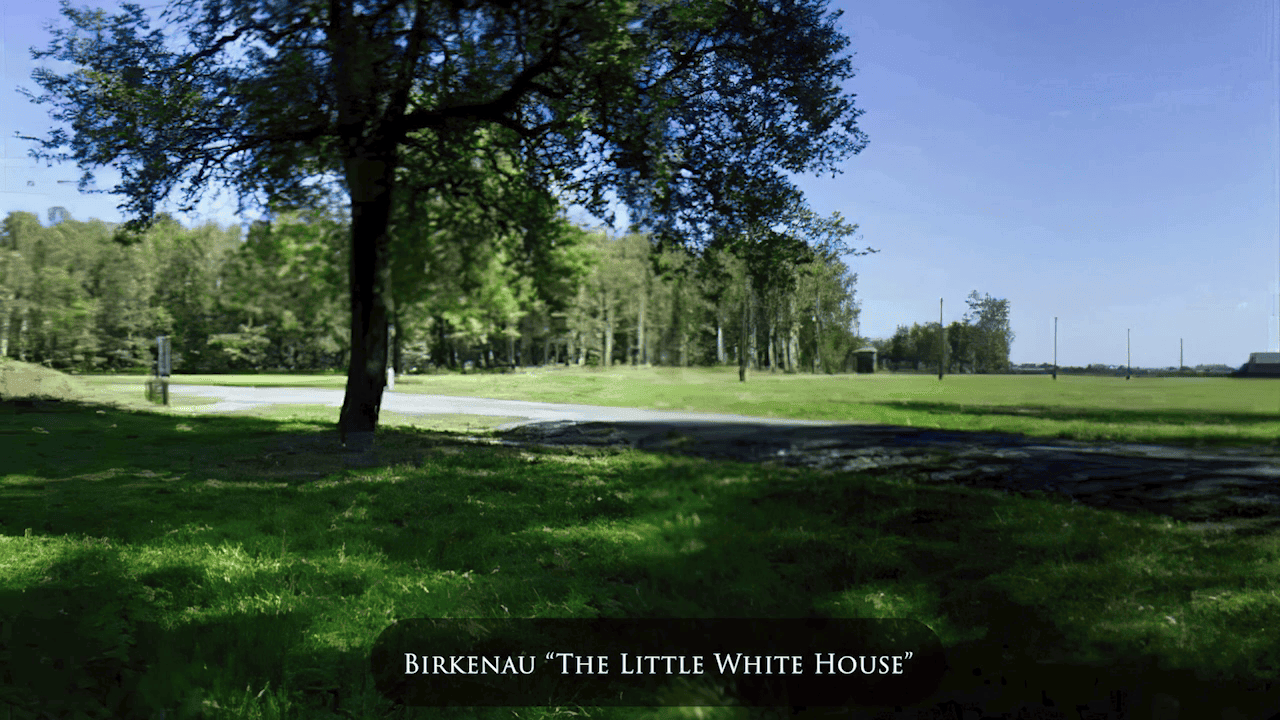
The Makeshift Gas Chamber
The Birkenau Little White House – also called Bunker 2 – was used until the spring and summer of 1943, when the larger Krems II, III, IV, V were opened. Because the walls were plastered, it was called the “Little White House.”
About June of 1942, the number and size of Jewish transports sent to Auschwitz increased necessitating the use of two farmhouse expropriated from Polish farmers from the village of Brzezinka as provisional gas chambers.
← PREVIOUS
Birkenau Sauna Interior
” So Höß made the decision to immediately set up a new location on the same principle as Bunker 1. It will be called Bunker 2. According to the Kalendarium from D. Czech, its first use could be dated June 30, 42.
It is, as in the case of Bunker 1, an already existing building having belonged to a Polish peasant, which rapid work will adapt to the function that the SS intended for it (essentially walling up unwanted openings and transforming the others –doors and skylights – in order to make them waterproof).
It is also located on the edge of the Birkenau camp. As in Bunker 1, two stripping huts will be installed nearby (and three from June 44).” Sonderkommando Bunker 2, the Little White House
The Little White House in Birkenau
About June of 1942, the number and size of Jewish transports sent to Auschwitz increased necessitating the use of two farmhouse expropriated from Polish farmers from the village of Brzezinka as provisional gas chambers.
The “Little White House” was used until the spring and summer of 1943, when the larger Krems II, III, IV, V were opened.
(No photographs of the Little White House survive. The video includes an AI rendition of the farmhouse as it appeared at the time.)
Here’s a large field where their bodies were buried or cremated in open pits. However with the increase in Jews from Hungary pouring into the camp in the spring and summer of 1944, it was put back in operation.
The building was destroyed in autumn 1944, when extermination operations in Birkenau were completed. Traces of the foundations of the Little White House are still visible.
The rear of the Sauna (new prisoner processing center) and then the foundation of the Birkenau Little White House is seen at the end of the video.
Early Testimony
In a remote field a few miles from Auschwitz I, a cottage stood that would come to be known as the Little Red House, or Bunker 1. The windows and doors of the cottage were bricked up and two new entrances built, making the structure into two separate gas chambers. A few weeks later the Nazis rebuilt another nearby cottage exactly the same way. They called this one the Little White House.
In late March 1942 Jews deported from Slovakia first arrived at the railhead in Birkenau, two miles distant from the new cottages with their gas chambers. Eva Votavov, a Slovakian Jew who came on a later transport, remembers her arrival there.
“When they opened the train carriages and forced us out, they shouted at us immediately. They were screaming in German. They were SS men who were dealing with us. We had to stand in line.Men had to step out first, then women with children, and then old people. I looked at my father, here, and I saw a sad look on his face. This is my last memory of him.”
SOURCE: Auschwitz Inside the Nazi State
← PREVIOUS
Birkenau Sauna Interior
CREDITS AND COPYRIGHT
The Virtual Tour of Auschwitz photos by Alan Jacobs.
This exhibition was prepared by invitation from
Auschwitz-Birkenau State Museum, Oswiecim, Poland
Photographs taken in Auschwitz and Birkenau in the years 2003-2004.
They were then converted into one of the first VR tours by Krysia Jacobs.
Updated in 2022 to a video-based Virtual Tour of Auschwitz.
© 2003, 2004 Alan Jacobs all rights reserved
All artist reproductions courtesy of Auschwitz Museum Archive.
Please contact us with questions related to this exhibit.