
The Trial of Adolf Eichmann
The Trial of Adolf Eichmann
In 1961, the world watched the first televised courtroom trial as a Jerusalem court tried Nazi SS Lieutenant Colonel Adolf Eichmann for crimes against the Jewish people.
Eichmann’s role in was the target of a fifteen-year manhunt by Israeli agents.
In this comprehensive site, you’ll find The Trial, Classroom Activities, and information about the Documentary.
← Trial and Documentary
The Trial | Documentary Info | “In His Own Words”
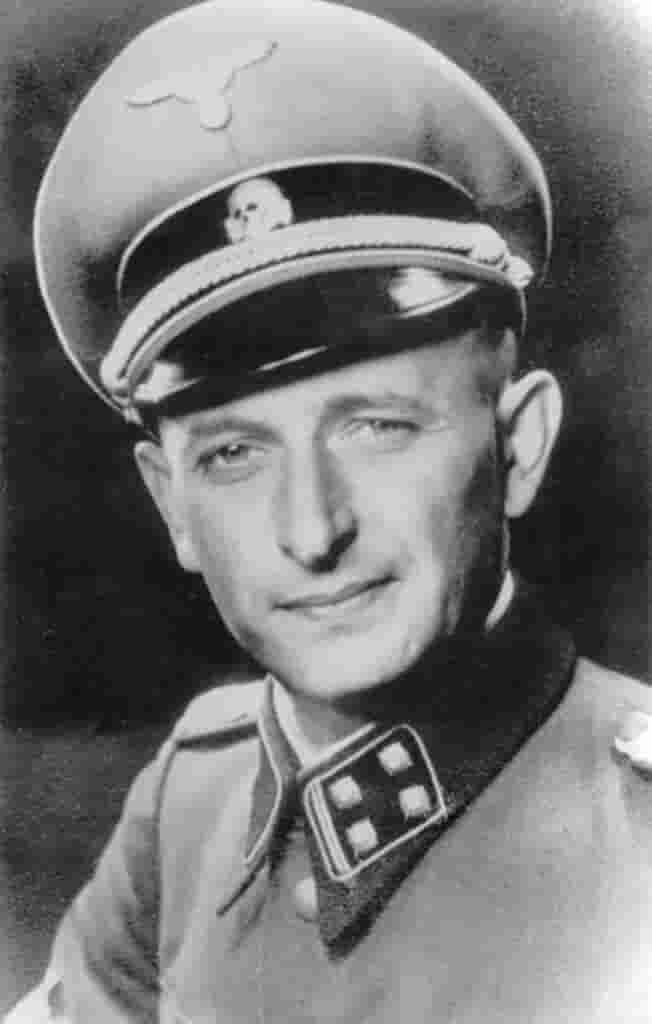
Who is Adolf Eichmann?
Eichmann’s name first surfaced during the Nuremberg Trial. In 1950 he fled to Argentina with the help of the Nazi underground. The Israeli government found him living in Buenos Aires with his wife and three sons. In the May, 1960, the Israelis kidnapped him and forcibly brought him to Israel to stand trial as a war criminal.
His defense, like that of other Nazis, was that he was “just following orders.” Eichmann’s trial was the first televised trial in the history of television. No one knew very much about the Holocaust when the trial began. Holocaust survivors did not speak about their ordeals at the hands of the Nazis until the trial.
Eichmann was the mastermind behind moving the Jewish people out of their homes into the ghettoes, and then into the concentration camps. He proved to be the Nazi’s foremost Jewish specialist. His ability to organize, categorize, and supervise enabled him to bring over six million Jews to their deaths. By piling men, women, and children in cattle train cars, he sent millions to their deaths.
The Trial of Adolf Eichmann: The Glass Booth
During the trial, Eichmann sat enclosed within a glass booth. He became known, and is known today, as The Man in the Glass Booth. The Israelis built the booth for his protection because they feared someone would try to kill him before the trial was over.

Who’s Who ?
Who’s Who in the Eichmann Trial, with photos.
Eichmann Trial Participants: Where Are They Now?
Reactions from the trial in 1961 and looking back in 1996.
The Sentencing
What the judge said as Eichmann was convicted
The Trial of Adolf Eichmann
Classroom Activities
“The Trial of Adolf Eichmann” Classroom Activities were designed for students from the 7th grade to college level by Gary Grobman, who also wrote a Pennsylvania Teacher’s Guide to the Holocaust.
The first responsibility of the teacher is to teach the event. The actual history must be the foundation for any critical understanding and pursuit of the issues related to the Holocaust.


Eichmann was charged under a 1950 Israeli law enacted to punish Nazis and their collaborators. He was charged on 15 counts.
The trial was an emotionally explosive event that revealed for the first time to a shocked world audience the Nazi campaign to exterminate European Jewry.

Making the Documentary
The trial of Adolf Eichmann was the first trial ever televised and one of the first major events ever videotaped.
Nightly, a compilation of that day’s trial “highlights” were prepared and disseminated to the world broadcast media.
Sometimes the tapes were literally cut with razors to assemble the reel–a far more difficult process than cutting film where you can visibly see the image.
After the trial ended, the tapes were not centrally collected and archived; the court had no official need for it and over time many of the tapes became dispersed. Years later some of it was “found” in a closet in the New York offices of the ADL to whom the producers had donated it. Other pieces were in Israel.
Geoffrey Wigider, a journalist at the trial, collected the disparate tapes and Eli Evans, president of the Charles Revson Foundation, saw to it that the tapes were preserved by duplicating them and placing them in facilities in New York(The Jewish Museum) and Jerusalem for use by scholars and an occasional TV clip.

Now this tape odyssey reaches its conclusion. For the first time since they aired during the trial, a major television documentary goes back to these original videotapes to recreate the landmark case and retell the story of the event which transformed the world’s consciousness about the Holocaust.
To many, the Holocaust was unspeakable remembrance, but the trial was a catharsis, and people began to tell their tales. Gideon Hausner, Attorney General representing the State of Israel, called over 100 witnesses to the stand.
The courtroom was packed. After an emotional 16 weeks, Eichmann was found guilty on all 15 counts of the criminal indictment against him. He was hanged, his body was cremated, and his ashes were scattered in the Mediterranean Sea.
View the complete Trial of Adolf Eichmann
← Trial and Documentary
The Trial | Documentary Info | “In His Own Words”
CREDITS
The Trial of Adolf Eichmann Broadcast
Premiered: April 30, 1997
Credits for The Trial of Adolf Eichmann
Created by:
ABC News
Great Projects
Film Company
PBS
Web site Design:
Remember.org
Library of Congress Catalog Number: 2003557011
Reviews
New York Times
April 30, 1997
Crime and Punishment: The Trial of Eichmann
By WALTER GOODMAN
Translations read by:
Adolf Eichmann
BRIAN BEDFORD
Gideon Hausner
PETER GALLAGHER
Dr. Robert Servatius
ED ASNER
David Ben-Gurion
Pinchas Freudiger
ELI WALLACH
Aaron Lindenstrauss
Dr. Joseph Melkman
STEPHEN LANG
Franz Meyer
Israel Gutman
ERIC BOGOSIAN
Please contact us with questions related to this exhibit.