
What this page contains: We share holocaust documentation, historical records, and scholarship with primary source documents, historical scholarship, rescue operation studies, educational guides, and archival photography that document and contextualize the Holocaust from institutional, legal, educational, and historical perspectives. This includes the complete Eichmann trial documentation, peer-reviewed academic research, teaching guides used in classrooms for three decades, survivor-authored documentation of specific historical events, and photographs preserved from the Warsaw Ghetto and other camps.
What these sources represent: Official trial testimony from the Eichmann proceedings. Scholarly studies of rescue operations including the Swedish Red Cross White Bus. Holocaust education guides developed by academic institutions and used continuously since the 1990s. Survivor and witness accounts of specific historical events and operations. Historical photography and archival materials. Journalistic and biographical accounts that trace both the machinery and human meaning of the Holocaust.
Geographic and institutional scope: Documentation spans multiple countries and regions including Poland, Hungary, Germany, France, the Netherlands, and others. Sources include partnerships with major institutions such as the Auschwitz-Birkenau Memorial and Museum, university presses, and archival collections.
A note on curation: These are not listicles or links pointing elsewhere. The complete Grobman teaching guide lives here — used continuously in classrooms since 1995. The Eichmann trial documentation is hosted in full. The White Bus rescue study is preserved complete. Photographs are cataloged with historical context. Where works are excerpted or linked, that is noted. This collection represents what Remember.org has stewarded and made accessible over three decades.
Return to Witnesses of the Holocaust

COMPLETE HISTORICAL DOCUMENTATION — READ IN FULL
These three primary material resources are hosted in their entirety on Remember.org. No purchase required. No registration. The complete text, pictures, and more are here.
The Trial of Adolf Eichmann (ABC/PBS documentary)


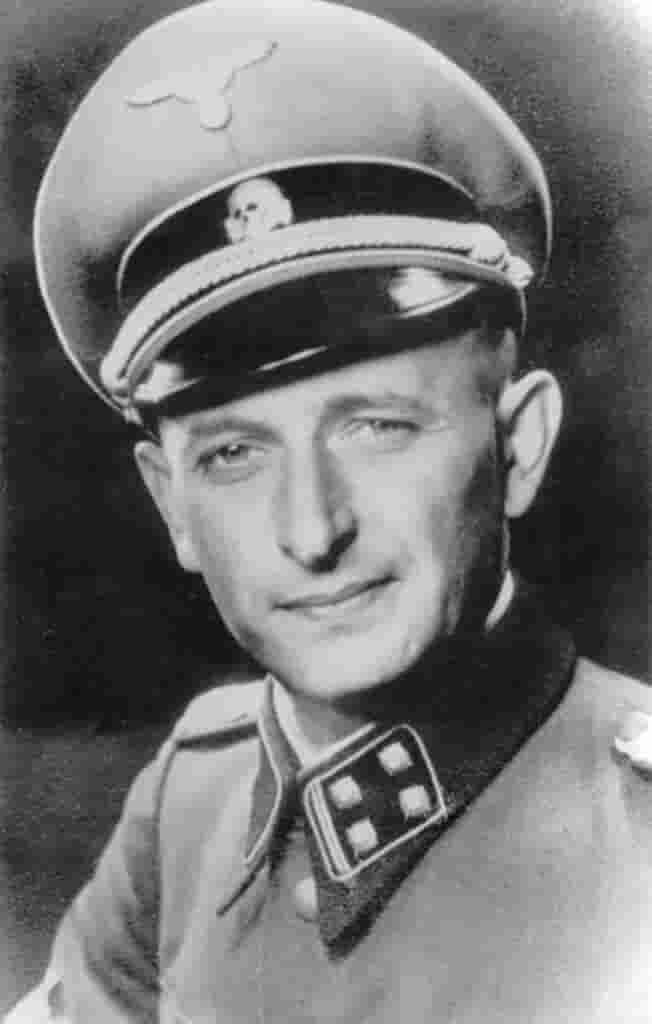
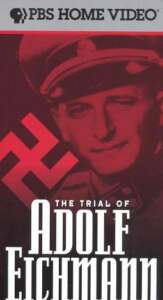
The Eichmann trial in 1961 was one of the first times Holocaust survivor testimony was heard in a public forum — survivors speaking in their own words on record, before the world. Remember.org features voices of those who testified, primary documents from the trial, and an early collaboration on an ABC/PBS documentary. A people’s history of the Holocaust includes the people who stood up and said what happened.
The trial of Adolf Eichmann was the first trial ever televised and one of the first major events ever videotaped. Nightly, a compilation of that day’s trial “highlights” were prepared and disseminated to the world broadcast media.
Sometimes the tapes were literally cut with razors to assemble the reel–a far more difficult process than cutting film where you can visibly see the image.
After the trial ended, the tapes were not centrally collected and archived; the court had no official need for it and over time many of the tapes became dispersed. Years later some of it was “found” in a closet in the New York offices of the ADL to whom the producers had donated it. Other pieces were in Israel.
Now this tape odyssey reaches its conclusion. For the first time since they aired during the trial, a major television documentary goes back to these original videotapes to recreate the landmark case and retell the story of the event which transformed the world’s consciousness about the Holocaust.

10 Gifts From the White Bus Rescue
In the final months of World War II, the Swedish Red Cross negotiated directly with Himmler to rescue 15,345 prisoners from Nazi camps. The White Bus Rescue is one of the least known large-scale rescue operations of the Holocaust.
In the late winter of 1945, rumors of Hitler’s order for a “final solution” were spreading around Europe. A supposedly “neutral” Sweden opened back-channel conversations with Heinrich Himmler about removing Swedish prisoners from the doomed concentration camps.
The diplomatic pressure on Sweden to stop selling materials to the Nazi regime despite their professed neutrality also opened conversations of what they would do about their own citizens being interned in the death camps.
These negotiations ultimately led to a plan to lead convoys of buses and trains into Ravensbrück, Neuengamme and other camps in an effort to rescue the Scandinavian citizens inside their gates.
This research created by: Roger A. Ritvo, Ph.D. – Distinguished Professor Emeritus at Auburn University Montgomery,
Allison Stone – Clinical Research Coordinator at the Children’s Hospital of Colorado and a Healthcare Administration MBA candidate at the University of Colorado Denver Business School, and Caitlyn P. Traffanstedt – Performance Improvement (PI) Analyst within the Office of Patient Safety at East Alabama Health (EAH) and an MBA candidate at Auburn University at Montgomery (AUM). The authors acknowledge that Auburn University Montgomery provided partial support for this research.
 The Holocaust: A Study Guide for Pennsylvania Teachers
 The Holocaust: A Study Guide for Pennsylvania Teachers
This Holocaust Resource Guide is designed so that the teacher does not have to pursue original source material in order to feel comfortable with the complexity and diversity of Holocaust history and the range of the subject matter. This includes understanding the history or anti-Semitism and the history of the Jewish people as well as the events occurring in Europe which led to the rise of Nazism and the machinery of technology and bureaucracy which the Nazis implemented in order to fulfill its second front, which was a “War Against the Jews” (which is the title of one compelling text on the Holocaust by Lucy Dawidowicz).
Teachers should read through the entire guide and then consider in what manner parts of it can be used through various subjects in a school environment. The first responsibility of the teacher is to teach the event. The actual history must be the foundation for any critical understanding and pursuit of the issues related to the Holocaust.
Gary Grobman was the author of The Holocaust: A Guide for Pennsylvania Teachers, a resource published in 1990 by the Pennsylvania Department of Education (Harrisburg) and/or Millersville University (Millersville, PA).The guide is cataloged under call numbers such as 940.5315 G873h and includes bibliographic references, maps, and an index.

Escape From the List
Elliot L. Hearst | Netherlands
The Holocaust story of Elly Rodrigues and her Dutch rescuers. Courage, sacrifice, and survival in the Netherlands. Along with my Research Assistant Angelica Roman, I have conducted personal meetings and interviews with Elisabeth’s daughter, Carolyn Stewart. Ms. Stewart has graciously shared many heretofore unknown details of her mother’s story of rescue, as well as photographs and documents, including some that have been unseen by anyone in over sixty years. What follows is new insight into Elisabeth Rodrigues’ escape from the list: a true story of courage, sacrifice, and survival.
This research created by: Professor Elliot L. Hearst, research Assistant Angelica E. Roman, at Pace University, New York, NY – July 8, 2016
SIGNIFICANT HOLOCAUST DOCUMENTATION: EXCERPTS — SUBSTANTIAL TEXT AND IMAGES
These Holocaust documentation and historical records are represented on Remember.org with extensive text along with photographs, maps, or illustrations. They are reading destinations, not summaries.

Official Secrets
What the Nazis Planned, What the British and Americans Knew — documentary account of Allied knowledge of the Holocaust as it happened. Great Britain already had some of the evidence, however, for, all along, its intelligence services had been intercepting, decoding, analyzing, and circulating many German police radio messages and some from the SS. Yet this critical evidence was sealed away–marked “Most Secret;” “To Be Kept under Lock and Key,” and “Never to Be Removed from This Office”–and it has only now reappeared.
Integrating this new evidence with the known sources, Richard Breitman examines how Germany’s leaders brought about the Holocaust–and when. He assesses the British and American suppression of information about Nazi killings, and the tensions between the two powers over how to respond. His absorbing work concludes with an examination of the consequences (including the failure to punish many known war criminals) of keeping this information secret for so many decades.
This research created by: Richard Breitman – a professor of history at American University, editor in chief of Holocaust and Genocide Studies,and the author of The Architect of Genocide: Himmler and the Final Solution.

The Last Witness: The Child Survivor of the Holocaust
Judith S. Kestenberg and Ira Brenner
Published by American Psychiatric Press. Examines the interplay of genocidal persecution and child development — a clinical and human account of what survival in childhood produced.
Some twenty-five years ago, faced with my first patient who was a child of survivors, I became concerned with the generationally transmitted effects of persecution, but I still knew very little regarding the adult fate of children who were themselves persecuted. I read several stories of how children rescued themselves, but I still knew very little about these young children except for my knowledge about the Theresienstadt children brought to Anna Freud’s Hampstead nursery and clinic after liberation.
But nothing I read had the same effect on me as the analysis of a man who was born during the Holocaust and spent his first two and a half years in ghettos and two more in a concentration camp. The effect on his cognitive and moral development was overwhelming. I knew then that I must learn much more about the adult fate of young children who suffered under the Nazis,both those who survived with their parents and those who were left to make it on their own.

Courage Under Siege
Charles Roland | Warsaw Ghetto
The medical community resisting the ravages of disease and starvation in the Warsaw Ghetto. Includes actual photographs from the ghetto.
When the Warsaw ghetto vanished, the Jews of Poland had been under Nazi domination for 44 months. The ghetto itself ceased to exist in May 1943. It had been a living — and dying — entity for exactly 30 months. This book has attempted to show how the Jews tried to live, and succeeded in dying, during this time. The account being done, what can be concluded?
Perhaps most broadly, the great cliche of humanity is displayed yet again: we are tough and resilient and enormously adaptable under pressure. Not all of us,but enough so that it matters. Thus large numbers of Jews did survive many months of hunger, exposure, and disease. The fact they they could not withstand the ultimate murder process at Treblinka and similar camps does not alter the remarkable fact of their having survived until that point.
Charles G. Roland is Jason Hannah Professor of the History of Medicine at McMaster University, Hamilton, Ontario.
Jan Karski: How One Man Tried to Stop the Holocaust
E. Thomas Wood and Stanislaw M. Jankowski | Poland / Washington D.C.
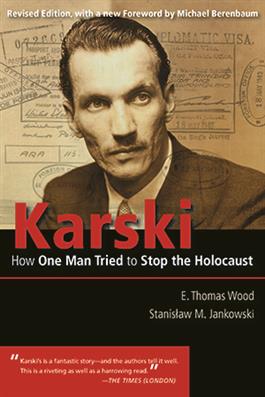
Jan Karski was a Polish underground agent who, in 1942, smuggled himself into the Warsaw Ghetto and witnessed a Nazi transit camp for Jews being sent to their deaths. He carried what he saw to the leaders of the Western world — to the British Foreign Secretary, to President Franklin Roosevelt, to Supreme Court Justice Felix Frankfurter. He told them what was happening. They did not act. This is the story of a Jan Karski, a Holocaust rescuer who risked everything to deliver a message the world was not ready to receive.
Remember.org holds primary source material from and about Karski that exists only here: audio recordings of Karski speaking in his own voice, and book excerpts from the definitive account of his mission, Karski: How One Man Tried to Stop the Holocaust by E. Thomas Wood and Stanislaw M. Jankowski, published by Texas Tech University Press.

Forget Adam Weinberger
Belgium – Fiction
“A moving and powerful portrait of a Polish Jew who returned from the camps disconsolate and mute.” — La Libre Belgique. The only novel in this collection. Fiction that tells what testimony sometimes cannot.
A story that explores the difficulty of speaking about the Holocaust.
First there is Adam Weinberger’s long childhood, in a world that has no idea yet what is in store for it. The childhood of a lover of illusions, who dreams of changing the world and of freeing his family from the burden of a tradition that he finds unbearable.
The adolescence of a young boy who is unable to express his love for Esther, his admiration for his uncle, his tenderness toward his mother. The helplessness of a young man who sees that dreams and fiction are unable to halt the destruction of this world and of its inhabitants.
Author: Vincent Engel professor at the University of Louvain, novelist, playwright – in particular as friend and right-hand man (although he is left-handed) to the late Franco Dragone for a decade – and screenwriter, not to mention his many collaborations with the press and the media as a columnist and literary critic.
– Translated by Richard Kutner. Richard Kutner is an independent translator of fiction and non-fiction. His translations include After the Roundup, by Joseph Weismann, and Cast Away on the Letter A, by Fred, for which he was awarded a Hemingway Translation Grant from the Book Office of the French Embassy in the United States.
Return to Witnesses of the Holocaust
Related on Remember.org
Auschwitz Birkenau virtual tour map – Complete Video List