
Auschwitz Entrance Street
Most museum entrances build excitement; Auschwitz I builds fear. Entering the same gravel paths between the same brick barracks, past the same iron gate people did so long ago, in something close to silence. Capturing the past? Alan Jacobs knew that now is not the same, as then:
“Some people come home after a day or two, if they can take it for even that short amount of time, railing about how horrible and how difficult it was for them, betraying a kind of hope for martyrdom for merely being there. But you know going there is not surviving.”
← PREVIOUS
Auschwitz I Camp Video Tour Map
The First Thing You See at Auschwitz I
Look up and see the infamous “Arbeit Macht Frei” sign – little did they know what was next. Once those gates close behind you as a prisoner, the world as you knew it was gone. Now each day became it’s own survival test.
This was the original camp, opened in June 1940 in the buildings of a former Polish army garrison, and it operated for nearly five years as a place of systematic starvation, forced labor, torture, and death.
Walking into Auschwitz
It began with Polish political prisoners and Soviet POWs before becoming a central site of the Nazi genocide of the Jews. The name Auschwitz has come to stand for the whole of the Holocaust in the minds of many people — but Auschwitz I was only the beginning of what was built here.
↑ Auschwitz 1 Entrance approaching the Gate- photo by Alan Jacobs 2004.
“They brought us into Auschwitz. I could see the chimneys burning, smell the smoke. I did not think about it. They gave us tattoos: 33076. I did not have a name anymore; just a number.” Sara Polonski Zuchowicki, Survivor
Start the Original Auschwitz Virtual Tour
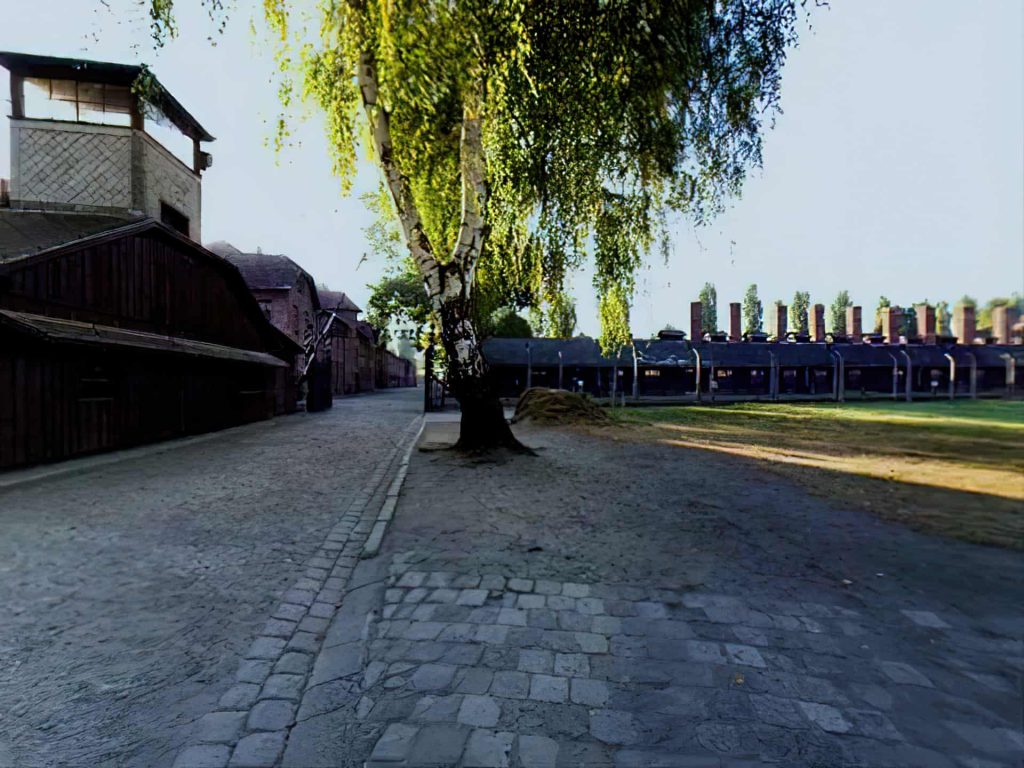
The Auschwitz I Entrance Exterior
Outside the entrance to the First Auschwitz camp and administrative headquarters. The large building with the peaked roof is the Reception, or Admissions Building, partially ready only in late 1943. It received only one or two transports.
Continuing you see a small air raid shelter for the guards just to the right of the large tree, and then the long, low, camp kitchen with its many chimneys. Moving on you see the SS Guardhouse and the famous gate with Arbeit Macht Frei (roughly, “Work Will Make You Free”) over the entrance.
Entrance Interior – Inside a Place Few Would Escape
Once you enter the gate, the discovery begins; imagine what it was like for person thrown into this dangerous new world. Directly in front of you now, the tree where prisoners being punished were tied. Sometimes the dogs would be loosed on them.
The building just behind the tree is the prisoner administration building and just to its right, the camp kitchen. Moving you see the main entrance guardhouse and the main gate.

Painting of dog attacking by survivor Wladyslaw Siwek
Reproduction courtesy of Auschwitz Museum Archive, 1980
Main Entrance
These are the streets of Auschwitz I. Next are the production workshops. Directly in front, the camp kitchen. The camera seems to be placed at the main crossroads in Auschwitz I. Continue down the street where you see a small, narrow, dark structure on the edge of the sidewalk.
This is the Rapportführer’s booth from which he commanded the roll call, or Appel. Follow through numerous barracks and roads. As you scroll past it, the area beyond the guard tower in the distance is Krematorium I.
Scroll right to the main entrance in the background, and to its right, the prisoner administration and reception building. Then back around to the camp kitchen.
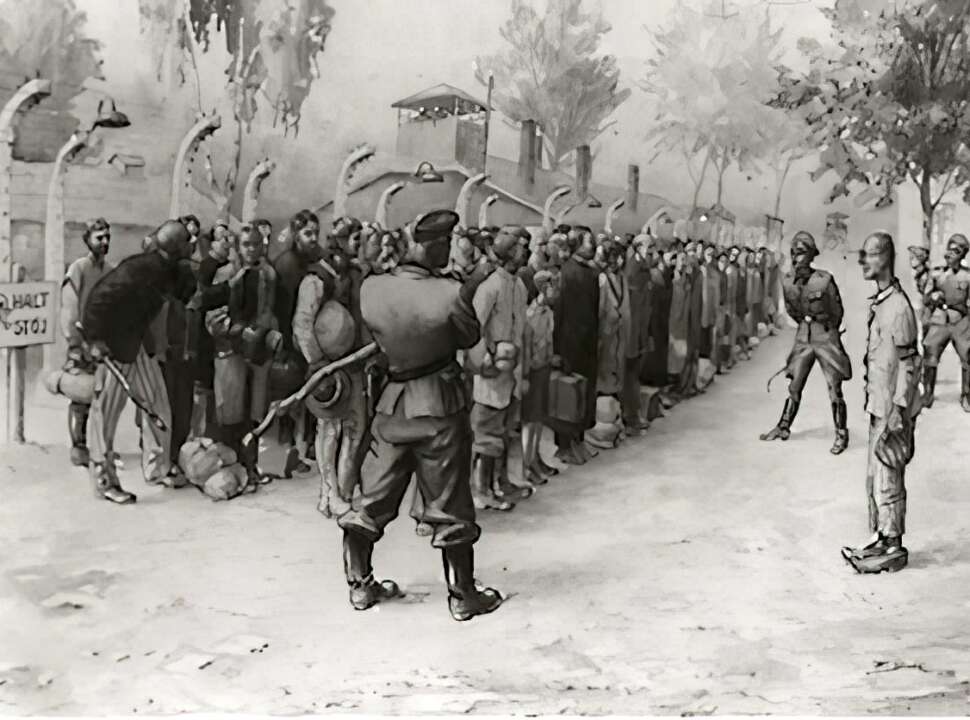
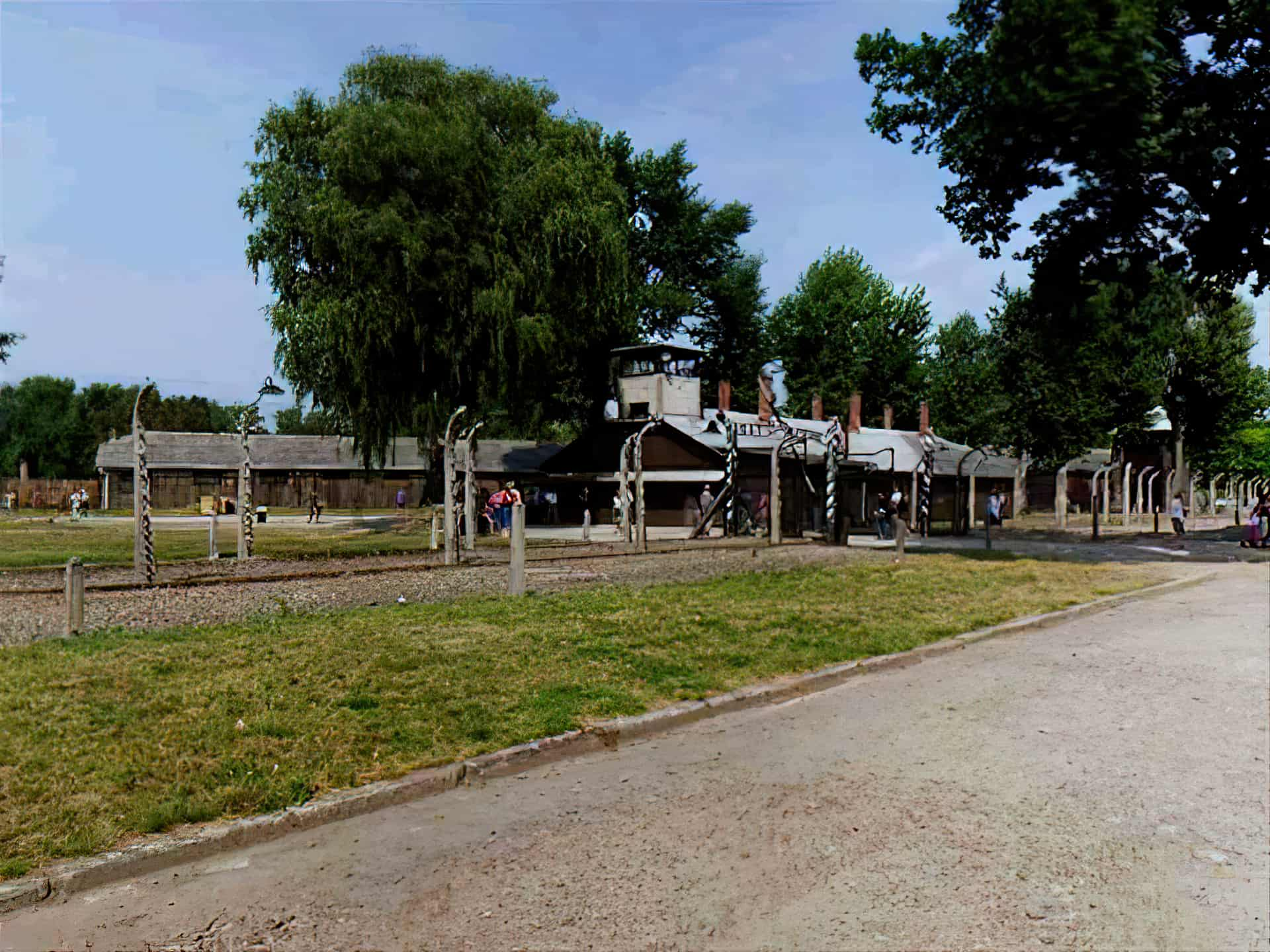
This is where prisoners marched to and from slave labor, seen in the painting by Wladyslaw Siwek below. Just behind the prisoner’s backs and to their left is the guard tower at the main entrance to the camp. Slide to see Alan Jacobs’ photo, of what this main entrance looks like now.
 Wladyslaw Siwek – Reproduction courtesy of Auschwitz Museum Archive, 1980
What was it like taking photos at Auschwitz?
Many who experienced A Virtual Tour of Auschwitz wrote to Alan, wanting to know more about why he goes to Auschwitz.
He was open to unpacking the many questions sent his way.

“Dear Mr. Jacobs,
I have just finished reading “I Escaped from Auschwitz” by Rudi Vrba, and then came across your site and photos of the camp at Birkenau. It was very moving to see the photos, along with your tags and descriptions – lot of which I could appreciate having read Rudi Vrba’s book. But as they say, “a picture’s worth a thousand words.” I wanted to know – what is the atmosphere like there? Does it still echo the past or has nature abated the stains? When you were there, how did it feel?
My partner and I are planning to visit Auschwitz in the next one or two years, and we’re both keen to get a deeper appreciation of Auschwitz and its actual history.”
Name kept private.
Alan Answers:
I think it is different for different people.
One’s frame of reference shapes the experience.
I have been there 9, yes 9, times since 1979. Each time my experience was/is different and, hard as this may be to understand, enriched. Echo the past? This depends on how much one knows (and I stress, understands) about the past, history, moral questions etc…
The first time I was sad, frightened and shocked. Over time I have learned how to protect myself. As Birkenau survivor and great writer Charlotte Delbo that when writing or thinking about it, she developed an Auschwitz skin.
In the world it is folded like a hooded jacket behind my neck. When I am in the camp I unfold it and wear it for protection. Each time there I have learned more about life and myself and I realized that my seeing it was really nothing compared to the inmate’s experience.
Some people come home after a day or two, if they can take it for even that short amount of time, railing about how horrible and how difficult it was for them, betraying a kind of hope for martyrdom for merely being there. But you know going there is not surviving.
Look we go in there warm, well fed, with clean toilet facilities taken as a matter of course, with the ability to sit down and rest, this in contrast to the killing labor. So why should it be so difficult?
Well the first time it is for most people as it was for me….
Read:
Auschwitz and After, Charlotte Delbo.
This way to the Gas Ladies and Gentlemen, Tadeusz Borowski
Hope this helps,
Jake
November 20, 2008 email exchange
← PREVIOUS
Auschwitz I Camp Video Tour Map
CREDITS AND COPYRIGHT
The Virtual Tour of Auschwitz photos by Alan Jacobs.
This exhibition was prepared by invitation from
Auschwitz-Birkenau State Museum, Oswiecim, Poland
Photographs taken in Auschwitz and Birkenau in the years 2003-2004.
They were then converted into one of the first VR tours by Krysia Jacobs.
Updated in 2022 to a video-based Virtual Tour of Auschwitz.
© 2003, 2004 Alan Jacobs all rights reserved
All artist reproductions courtesy of Auschwitz Museum Archive.
Please contact us with questions related to this exhibit.