

Return to Voices HOME | Buy VOICES
Voices of the Shoah, Remembrances of the Holocaust
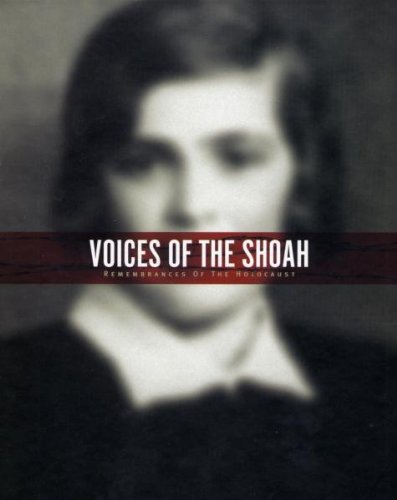 Voices of the Shoah
It’s easy to order Voices or ask us questions
Reviews & Articles: Voices of the Shoah
Voices of the Shoah, Rhino Entertainment’s four-CD oral history of the Holocaust produced by David Notowitz, drew coverage from newspapers and outlets across the country following its release in spring 2000. Below is a short, original summary of what each outlet covered, with a link to the outlet where available so you can read their coverage directly.
Quotes from Reviews
“A stunning sculpture in sound” The Jewish Week
“Powerful and moving.” Philadelphia Inquirer
“Remarkable and rending.” David Elliott, San Diego Union-Tribune
“…this project pricelessly evokes the sweep of the century in all its optimism and despair, becoming an important handbook for understanding history.” Amazon.com
“Poignant” Jewish Bulletin
“One of the most important collections to ever emerge on the spoken word scene.” TheEntertainmentReport.com
“Ground breaking… the focus here is closer to home: real people reacting to the unfathomable.” CheckOut.com (Rated 8 of 10)
“a rich resource…” Arizona Education Assoc. review
“…the deep eloquence of a single human voice can serve as the most powerful testimony of all.” CDNow.com
New York Daily News
Their Stories Survive, on CD
By David Hinckley, New York Daily News Staff Writer May 2, 2000
“Hinckley’s piece opens with survivor Edith Birkin’s memory of Auschwitz and traces the CD set’s chronological arc from prewar life through liberation. He quotes Notowitz on why audio, unlike film, leaves room for the listener’s own imagination, and on his intent to push back against the stereotype that Jews were passive during the Holocaust. The piece also recounts Cesia Kingston’s account of returning after the war to find that most of her town’s Jewish community had not survived, and that several who had were later killed in a postwar pogrom. Published to coincide with Yom Hashoah 2000.
Notowitz, through narrator Elliott Gould, fills in the lives of his subjects both before and after the war.
In a chilling passage, Cesia Kingston recalls that the Polish people she met after she was freed from the camps told her things were fine back in her town, that everybody was home. In fact, almost no one had survived — and among those who did, 42 were summarily beheaded in 1946 in an anti-Jewish pogrom.
Yet this is precisely why Notowitz says he wanted to stress “the strength of the survivors. These were people who had lost everything. They often found themselves in a new country, with nothing. When you hear people in this situation talking about a positive outlook, you think, ‘We can do anything.'”
The Jewish Week (New York)
By George Robinson May 5, 2000. Copyright 2000 George Robinson, author of Essential Judaism.
Robinson frames Notowitz’s editing process through a sculptor’s metaphor carving four hours of finished material out of more than 600 hours of tape. The article traces how Rhino Records president Richard Foos initiated the project after noticing no audio Holocaust documentary existed, and covers Notowitz’s earlier editing work on Yale Strom’s Klezmer documentaries. It highlights Notowitz’s deliberate choice to omit his own interview questions so survivors appear to speak directly to the listener, and his interest in documenting prewar Jewish life, not just the Holocaust itself.
“I wanted to have the survivors be speaking directly to the listener, not to the interviewer,” he explains. “That would have just been one more wall between the listener and the survivors. It’s most important to hear the survivors talking.”
And that is what one remembers most vividly from hearing “Voices of the Shoah,” the survivors talking. “The survivors are extremely powerful, strong for having gone through this,” Notowitz says, echoing a famous passage from Hemingway.
“They came out with desire to rebuild their families, to have kids again.”
Amazon.com Review
By Wally Shoup
A favorable customer review describing the collection as first-person testimony spanning prewar European Jewish life through the founding of Israel. It singles out an American soldier’s account of encountering a train car of Holocaust victims as one of the set’s most searing moments, and commends Rhino for donating proceeds to charity.
“For these survivors, the Shoah is not merely history, but an unforgettable, permanent part of their beings. Through their remarkable voices, we are reminded that this evil was in fact witnessed, and with powerful documents like this, should never be forgotten. Rhino Records should be commended for this project and for understanding that the deep eloquence of a single human voice can serve as the most powerful testimony of all.”
Oakland Tribune
“Voices” CD Preserves the Holocaust
By Natali T. Del Conte, Staff Writer (also ran in San Mateo Times, Fremont Argus, Hayward Daily Review, Alameda Times-Star, and the Tri-Valley Herald)
Profiles three featured survivors Siegfried Halbreich, Sonia Meyers, and Cesia Kingston and Notowitz’s path from film studies at UC Santa Cruz into this project, which took shape over five years in partnership with Rhino Records and the Jewish Federation of Greater Los Angeles. The article walks through the box set’s four-volume structure, including its segment on Japanese-American soldiers who helped liberate Nazi camps while their own families were held in U.S. internment camps.
“This project, according to Notowitz, is just as timely today as it was 55 years ago.
“All but one of the people I spoke to were young when this happened to them,” says Notowitz. “This is very much the end of our ability to speak one-on-one with Holocaust survivors because they’re dying out. And each survivor is such a miracle.”
Philadelphia Inquirer
Indelible stories of Holocaust are told by survivors, soldiers
By Sandy Bauers May 2, 2000 (also printed in the Orange County Register and Knight Ridder papers nationally)
Opens with Shlomo Berger’s account of deportations to Belzec and reviews the set favorably overall, noting that some survivors were speaking about their experiences for the first time. Bauers praises the segment featuring American soldiers who liberated Dachau and the accompanying 100-page book, but singles out the added music and sound effects as an unnecessary distraction from the testimony itself.
“The project was the idea of Richard Foos, president of Rhino Records, who was prompted by a visit to the Holocaust Museum in Washington. When he looked in the gift shop for a memento to “keep fresh the memories of my visit,” he was disappointed that there were no oral histories. He decided to change that. His production was released in time for May 2 – the Day of Remembering.”
San Diego Union-Tribune
By David Elliott June 22, 2000
A short, strongly positive review outlining the four discs’ structure the onset of persecution and camp conditions, liberation and postwar survival, reflections from liberating soldiers and Rabbi Abraham Klausner’s postwar relief work, and closing testimony from two children of survivors, Dr. Gary Schiller and Dana Schwartz. Elliott also references Notowitz’s earlier work on the film Carpati.
CDNOW.com
Never Forget the Voices
By Adam Sternberg McGovern
McGovern frames the collection as a corrective to what he calls an era of oversimplified, “reassuring” Holocaust media, praising its unscripted, conversational structure and the way it moves from a chorus of shorter accounts into longer individual narratives. He highlights the segment on Japanese-American soldiers who fought in Europe while their families were interned at home, and on a rabbi’s postwar relief efforts, as material that resists easy sentimentality.
CheckOut.com
Rated 8 of 10. By John Srebalus
Srebalus frames the collection as offering “perspective” rather than horror alone, praising its balance between survivor and escapee testimony and outside witness accounts from U.S. military personnel. He notes the project avoids academic or political framing in favor of personal testimony, and closes by suggesting the material carries an implicit warning about parallels to hatred in the present day.
Jewish Journal (Los Angeles)
Aural History
By Michael Aushenker, Staff Writer April 28, 2000
An interview-style profile covering Notowitz’s background in Los Angeles’s Pico-Robertson Jewish community, his earlier Emmy-nominated work on Carpati, and his decision to conduct his own survivor interviews rather than rely solely on an existing archive of British-recorded testimony. The piece describes his approach of asking survivors not just what happened to them but how it shaped their relationship to faith, and includes a personal note that he met his wife while working on the project.
Jewish Bulletin (California)
Survivors’ moving stories fill CD of oral history
Opens with survivor Siegfried Halbreich describing what it means to live daily with the memory of his experience across six concentration camps. The piece traces Notowitz’s Bay Area roots and his path into Jewish-themed documentary work, and outlines the box set’s four volumes, from prewar life through a closing volume centered on a hidden child survivor and a child of survivors reflecting on inherited memory.
To buy Voices of the Shoah, click here. Or, if your browser doesn’t support forms well, send us email.
Standard of New Jersey
Filmmaker turns up the sound on the Shoah
By Alexandra J. Wall April 2000
Wall opens by noting the irony that the project took nearly as long to produce as the Holocaust itself lasted. The piece covers Notowitz’s initial hesitation about taking on “another Holocaust project,” his method of spending roughly four hours interviewing each survivor and probing philosophical and religious questions, and the box set’s four-volume arc ending with a hidden child’s story and a second-generation survivor’s reflections.
Jewish World Review
Notowitz: A different sort of Hollywood Jew
By Jon Kalish June 27, 2000
A long-form email Q&A in which Notowitz discusses an early ambition to build a web platform connecting Jewish artists worldwide, his own path to Jewish identity via college demographics at UC Santa Cruz, and how the Rhino/Jewish Federation team approached him rather than the reverse. He details his philosophy of audio versus film (audio leaves room for the listener’s own memory and imagination), his editing process narrowing roughly four-hour interviews down into 119 individually indexed tracks, and an early idea for a Holocaust memorial video for a Jewish cemetery.
TheEntertainmentReport.com
A short, strongly positive capsule review calling Voices of the Shoah one of the most significant collections in spoken-word audio and the first comprehensive oral history of the Holocaust in that medium, drawn from over 180 interviews recorded between 1988 and 1998. (See the full pull-quote above under “Quotes from Reviews.”)
Now that you have a sense of the depth of Voices of the Shoah, click to inquire about buying on CD or cassette or email us a good question.
Return to Voices HOME | Buy VOICES