

Return to Table of Contents || Imagine Gallery by Students
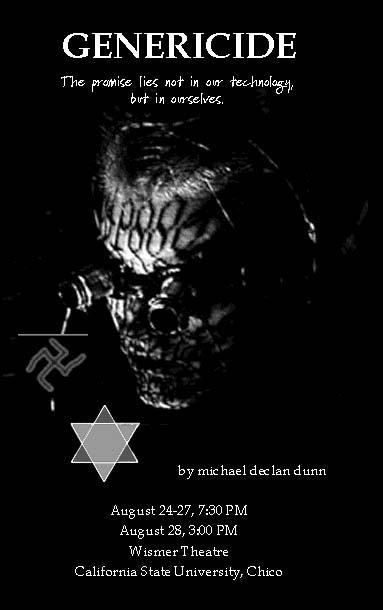
Genericide
Performed in 1994
This one-act play (performed August 24-28, 1994 at Wismer Theatre on the Chico State campus, written and directed by Michael Declan Dunn) addresses the difference between history, memory, and virtual reality in the time passage of a single day.
The play begins and ends with a dream, mingled with four fantasies weaving in and out of Carl’s reality framed by the two dreams. The line between history and memory is a central theme to this play. The Holocaust is an event whose recreation creates an abstraction; it is impossible, short of torturing prospective actors, to recreate the degradation. By doing so, a myth has been created of what the time period was like.
This play works against the myth and into the memory of the survivor, a participant in history who was turned in by her German friend, Karl, just when she was about to escape a concentration camp. History is represented by Carl Mari, who upon learning of her plight in a dream and confirming it in reality, spends the entire play trying to rescue her from her own past.
Theatre was an interesting component of this approach. While the play was, like many creative ventures, the viewpoint of one individual attempting to share it with an audience, it was also a means of sharing multimedia development.
The cast of Genericide were trained and coached using multimedia materials on the Macintosh. They were given choices of materials to read, view, and interact with. The feedback provided an important source of learning for the developer, who understood various points that weren’t being addressed.
The audience provided the final key, with questionnaires demanding to hear the survivors’ stories. While this feedback fit in well with the developer’s intent to draw on audience input, the staging of a play about the story of a survivor admittedly created bias. Asking someone what they would like to learn while showing them what may be created undermined the reliability of the results.
Despite the inherent weakness in the theatre-driven development, the desire to hear survivors’ stories became the driving force. The expressed need for oral histories, coupled with the difficulty of presenting video on CD-ROM, led to an audio-based design. The stories of the survivors were the central navigation point around which the experience was centered.
Multimedia development requires this duality of roles, of participant and observer, listener and creator, because the power lies in the collaboration with other imaginations. The live interaction with an audience, that changes each night, was an invaluable experience.
By engaging the audience and finding several points of missed communication like any playwright, the resulting CD-ROM attempted to correct those problems and integrate the feedback via questionnaires. These tools were effective because they involved the developer in a direct, one-to-one relationship with his audience.
The goal to create an educational and entertaining CD-ROM benefited because most of the work has been done with the audience. Whether collecting content in Israel or performing for an audience in Chico, the variety of viewpoints expressed have built a foundation of content. The true measure of this approach will be evident in the final CD-ROM, which will not be formally evaluated.
These descriptive ideas can only share the production of the CD-ROM, not the results. Ultimately the value of this approach and piece can only be tested by the responsiveness of others to the learning materials.
Learning about the Holocaust provides a variety of perspectives. Thousands of books have been written on the subject, from academic studies to survivors’ stories to historical judgments. What emerges is the difficulty of words to describe the events, yet words (and some artifacts and pictures) are all that is left.
Raul Hilberg’s Perpetrators Victims Bystanders is an important starting point for learning about the Holocaust. Hilberg took a unique perspective by sharing stories and categories, separated into three clearly defined sections. These roles were not as clearly defined during the Holocaust, but Hilberg works on this in the book. Within each category are a collection of stories; the reader can jump back and forth throughout the book to create her/his own perspective. As Hilberg relates about the Holocaust:
It was also an event that was experienced by a variety of perpetrators, a multitude of victims, and a host of bystanders. These three groups were distinct from one another and they did not dissolve in their lifetime. Each saw what had happened from its own, special perspective, and each harbored a separate set of attitudes and reactions. (Hilberg, 1992, p. ix)
His unique understanding of multiple perspectives is the basis of multimedia, of being able to look at an event through different eyes. Hilberg also created an interactive book, in that by jumping from story to story one could achieve the intended effect just as well as reading it straight through. The separations of Victim, Perpetrator, and Bystander work as boundaries to guide the reader through a complex subject broken down to three categories, three perspectives.