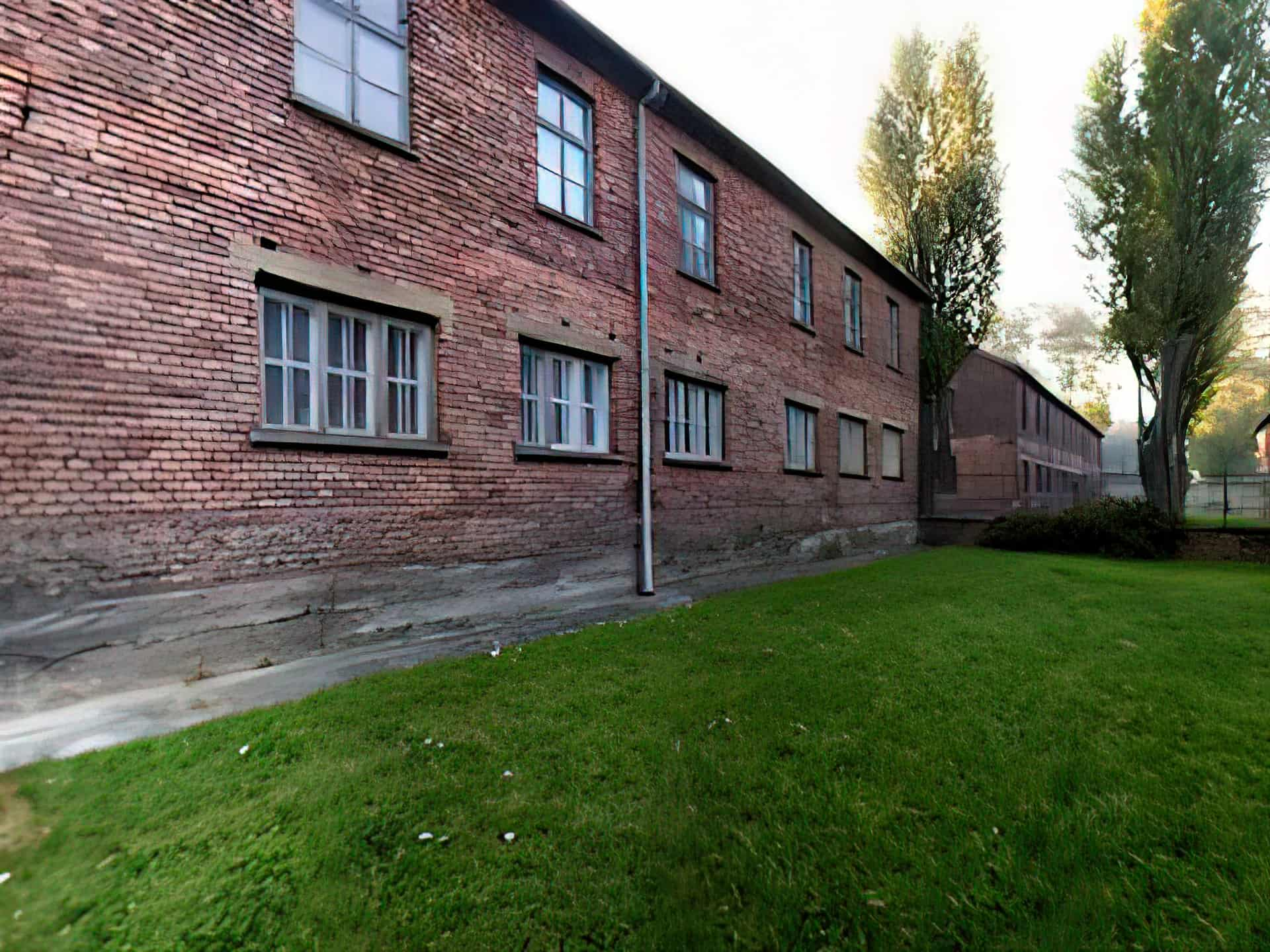
The next stop on the Virtual Tour seems safe, the Krankenbau – the camp hospital. As you slowly turn around, looking at the non-descript brick buildings in the camp, the sameness may lull you into forgetting where you are. A hospital where prisoners might get healthy, feel safe for a moment? For a prisoner at Auschwitz I, this was rarely a place to get better.
Instead, prisoners who came to this place either died here of “natural causes” – such as exhaustion, typhus, dysentery – or were either given a phenol injection in the heart, or taken to the gas. SS Doctor Eduard Wirths was said to have given people two weeks to recover. The Krankenbau was one of the places at Auschwitz that he’d experiment.
When prisoners were too ill or weak they made their way or were taken to the hospital seeking a brief respite from the killing work. In some ways, getting treated was more dangerous then labor. A doctor decides and you’re sent to the gas, or given a needle to get it done quickly.
Beyond the Brown Doors of the Krankenbau Prisoners Hospital
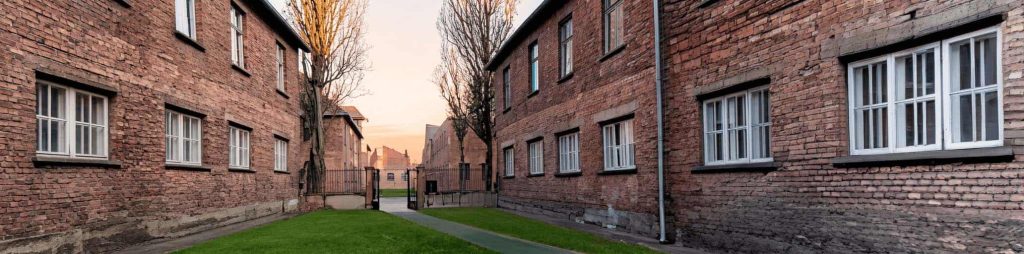
As you enter between these two buildings, you’re seeing the last view many inmates saw. Those brown double doors, commanding respect and breaking the brick of the buildings, led you to doctors who could decide right there, or in a few weeks, to send you to the gas. Between the green grass strip and brick buildings, with gates and walls on either end to lock you in, there’s no where to go but through these doors.
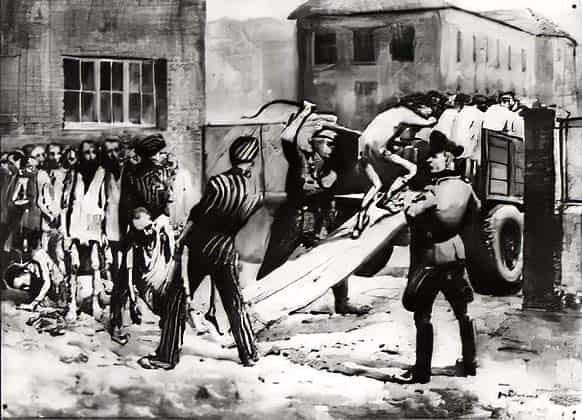
Krankenbau Memory – Photo from Where it Happened
Prisoners are lined up in front of the Krankenbau Prisoner Hospital and herded into trucks by Kapos. Water Color: Jerzy Potrzebowski Reproduction courtesy of Auschwitz Museum Archive, 1980. Photo by Alan Jacobs 2004.
Diagnosing Death in the Hospital
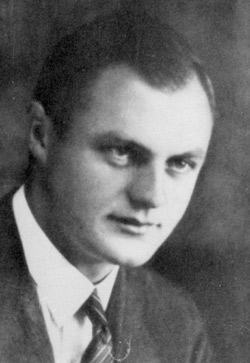
Johann Paul Kremer — he served in the SS in Auschwitz as a physician from Aug. 30, 1942 to Nov. 18, 1942 — at a hearing on July 30, 1947 in Kraków, Poland claimed that Eduard Wirths, the chief SS doctor (SS-Standortarzt) at Auschwitz-Birkenau from September 1942 to January 1945:
“decided what the prospects were for this patient to recover, whether he was already unfit for work, whether he should be sent to the sick bay or treated as an outpatient or else whether he should be liquidated. People the SS doctor designated for this latter category were taken away by SS personnel on duty.
Most of the prisoners who were designated to this group by the SS doctor had been given the general diagnosis ‘general bodily weakness.’ I observed the prisoners in this group carefully and whenever one of them particularly interested me because of his advanced stage of starvation, I ordered the medical orderly to reserve him and to inform me when this patient would be killed by injection.”
The Krankenbau was a hospital built to process prisoners, and experiment on human beings.
Easy to understand why prisoners would keep their health issues to themselves. The hospital was more a place where your life would end, than where you would get healthy.
‘Auschwitz hospital’ was itself an oxymoron; prisoners commonly referred to the hospital as “waiting rooms for the crematoria.” The doctor was there to see if people were worth keeping alive to work.
*Gawalewicz, A. (2000) Reflections From The Waiting Room to the Gas, Oswiecim: State Museum at Auschwitz.
*Gawalewicz, A. (2000) Refleksje z poczekalni do Gazu, Oswiecim: Panstwowe Auschwitz-Birkenau.