
Auschwitz I Electrified Fence
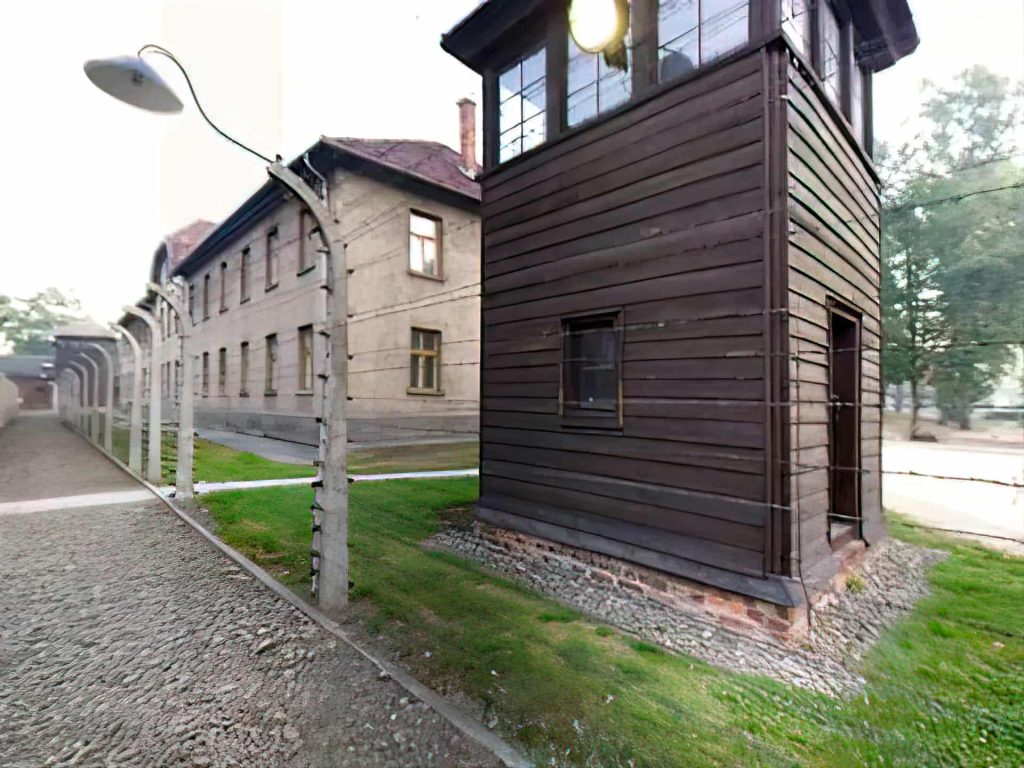
The electrified fence at Auschwitz I was built by the first prisoners brought to the camp in 1940. Primarily political prisoners and Polish intellectuals, they were forced to build the camp’s perimeter security.
The double barbed-wire fence system featured high-voltage electricity with concrete posts over 3 meters tall, with inward-curving tops to prevent climbing.
← PREVIOUS
Appleplatz Roll Call Square
Hook onto something that gives you hope. or walk into the electrified fence.
“These things, you have to hook onto something that gives you hope. Because if you give up hope in that situation that’s it, you might as well walk up to the electrified fence.
You’re probably not going to get there because they’ll shoot you before you hit it…You go through the control zone and the guys from up there yell at you, Halt! Bup bup bup bup bup, one more body. So quite a few people passed on that way.”
Walter Frank Survivor Testimony, May 15, 1990, Holocaust Oral History Project, San Francisco, California.
Under the Towering Electrified Fence
This physical barrier both prevented escape and brought its own psychological threat. The fence’s construction symbolized the SS’s dedication to creating a closed camp, with escape attempts often resulting in the punishment of the general camp population.
The Barb Wire Electric Fence at Auschwitz I
The first view is of one of the streets that run almost the entire width of the camp, bordered by the Auschwitz electrified fence..
Scroll and pause in the middle of the double fence This was built by the first prisoners in 1940. It was electrified and warning signs were posted along it.
Note the precision in its construction. Not only is this representative of the German talent for order, it also indicates just how dedicated the creation of the SS concentrationary universe was, with attention to detail.
“Escape from Auschwitz was made difficult not only by the physical barriers, but by the negative attitude of the general camp population, which suffered after every escape. If an escapee somehow made his way beyond the two electrified barbed-wire fences and watchtowers, blaring sirens alerted the whole countryside.
Dogs were put into pursuit, and SS and military personnel began to comb the fields and woods. With his shorn head and prison uniform, an inmate could expect no help from the local populace, for assisting an escapee meant death.” The Alfred Wetzler – Rudolf Vrba Report
National Socialist Totem: Electric Barbed Wire
The electrified fence at Auschwitz I was built by the very first prisoners and kept people tightly contained. Stretching for kilometers around the camp, with concrete underground to prevent tunneling, this piece of German precision delivered on its threat. Try to escape and you will be electrocuted, shot, or if you manage to get out, no one will help you.

National Socialist Totem photo by Alan Jacobs
As you go through the Tour, notice how this fence keeps reappearing all around. The electrified fence did more than keep you in, it increased the fear following inmates every day. Thinking of leaving, think again; if you get out, everyone else gets punished. If you throw yourself into the fence, the same thing happens.
This is part of the control at Auschwitz 1, and from first entry you feel that loss of control On the Tour, you get to leave whenever you want. But as a prisoner, would you try to break out of that fence?
← PREVIOUS
Appleplatz Roll Call Square
CREDITS AND COPYRIGHT
The Virtual Tour of Auschwitz photos by Alan Jacobs.
This exhibition was prepared by invitation from
Auschwitz-Birkenau State Museum, Oswiecim, Poland
Photographs taken in Auschwitz and Birkenau in the years 2003-2004.
They were then converted into one of the first VR tours by Krysia Jacobs.
Updated in 2022 to a video-based Virtual Tour of Auschwitz.
© 2003, 2004 Alan Jacobs all rights reserved
All artist reproductions courtesy of Auschwitz Museum Archive.
Please contact us with questions related to this exhibit.