

Return to How Dark the Heavens
PREV Chapter 1: Daugavpils Ghetto and the Flight from Lithuania
Next read Chapter 3: Dachau Concentration Camp & Allach Liberation
How Dark the Heavens by Sidney Iwens
Daugavpils Ghetto & Prison Massacre
Part II: July 1941 to November 1941
In this excerpt from Part II of How Dark the Heavens by Sidney Iwens, the author recounts the harrowing days of mid-July 1941. Read a rare, detailed account of the Daugavpils prison massacre and the subsequent establishment of the Daugavpils Ghetto through the eyes of a teenage Holocaust survivor from Lithuania.
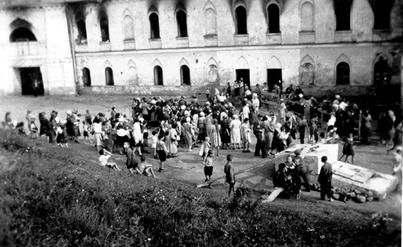 Jews in the Daugavpils ghetto. Created: no earlier than July 25, 1941, and probably no later than August 22, 1941.
You can also order How Dark the Heavens: 1400 Days in the Grip of Nazi Terror, available from Amazon.com.
Waiting in the Line: The Massacre Begins
Wednesday, July 9, 1941: The eighteenth day
As always, we were up early and waited to be marched out to the prison yard, but time passed, and there was no command to leave our cells.
After a while, we could hear something that sounded like the backfiring of trucks on the embankment highway. The traffic was always heavy there, but there couldn’t be that much backfiring, and I was worried, we were all worried, knowing full well that something was very wrong. We soon realized that what we heard was the sound of rifle shots.
“Maybe there’s a shooting range nearby, soldiers might be practicing,” someone said hopefully.
“Those ditches they dug last night . . . and the chlorine . . .” the accountant said quietly. “But that can’t be . . . .”
No one said anything for a while.
It was hard to believe that people were being shot, but I could find no other explanation. I kept hoping the shooting would stop and we’d be allowed to go to work, but it went on. A series of shots . . a short interruption and again shots . . . and again . . . .
It wasn’t long before we got confirmation of what we’d been suspecting all along. One of the men of a neighboring cell stuck his head in the doorway, and said, “They are killing Jews. From the washroom window someone saw people lined up in the yard. They are from the first floor.”
There was little talk. We all sat quietly, overcome by shock. The morning dragged on, and the shooting continued hour after hour. The sound of people being moved from the lower floors came closer and louder, closer and louder. Around ten o’clock I could hear people being ordered out from cells of the first half of our hallway, and shortly afterward they were in our half. And then a German rushed in to our cell, shouting, “Everyone out, take along everything you have!”
We were marched down to the basement. As we passed through the corridor in single file, we were ordered to empty our pockets and throw everything we had on the piled up heaps of personal belongings of the people who had just passed before us. We walked between two long, knee-deep rows of wallets, documents, pictures, watches, trinkets worthless to anyone else. . . . I kept my handkerchief and threw away everything else including my Bar Mitzvah watch. We were then marched out into the yard, formed into groups of twenty, and ordered to stand at the end of a long column of men.
We were guarded by many Germans pointing their rifles at us. Every few minutes the people in front moved ahead, and then we did also. By now any small doubt, I might have had that not everyone was to be killed vanished completely. We are waiting in line to be executed, went through my mind again and again.
I could not yet see it, but I knew there was an iron gate on the other side of the building, opening into the small Railroad Park where the ditches were dug yesterday. The column of men—thousands of them—wound itself around the prison like a vast, coiling serpent, going first north to the corner, then west lengthwise, then back again south around the wall of the building. Eventually it must enter the park through that gate. Since our group had been housed at the end of the third floor, we were toward the tail of the serpent, only a few hundred men behind us. The multitude was silent. The only sounds we heard were the sharp reports of the rifle shots and the occasional threatening bark of a guard.
When we got to the corner and started to move west, I could see above us, on the embankment, German soldiers and their sweethearts looking down at the scene below as if we were in an amphitheater.
When they had first herded us down from our cells, we third-floor Jonaver gravitated together. I was with Shmulke Palec, Froike Milner and a few other old acquaintances. It seemed a little easier to die in the company of people one knew.
The tall drayman and volunteer fireman from my cell told me that he didn’t drop his pocket watch on that pile; instead he hid it in his cap. He muttered defiantly, “If they kill me, at least the murderers won’t get my watch.” I wondered why he said “if.”
The blue sky was almost clear, with only here and there a wisp of cloud. I looked up, and the thought hit me hard: I will never see the sky again . . . . I felt a great sadness.
It is said that, when a person faces death, his whole life flashes before him. But my thoughts were disjointed, disorderly; they tumbled through my mind rather like the flimsy clouds above, forming, changing shape, disappearing and reappearing . . . . Catching myself picking at a hangnail, I thought, How silly. In a few minutes it will make no difference at all . . . . And then: Is it possible—do the Germans really believe that the Jews set fire to the city—is that why they are killing us? No. They couldn’t believe that.
I was following the movement of traffic on the embankment, and it occurred to me that many of the trucks were returning from the front line. I turned to Shmulke and whispered, “The Germans must be retreating. If only we could have lasted another day or two, we would have been liberated.” Illogical assumptions kept going through my head.
We had always been under heavy guard at work, but now, unreasonably, I thought of that time as one of missed opportunities. If only I had run away . . . at the unloading of cars . . . even when we were in the water . . . I should have started to swim away real fast . . . if only . . . . But I didn’t, and now I’m going to be killed.
But then the comforting thought: At least Ruvke is in town and alive, and Father, Mother, and Nehamah must be somewhere too. God, how thankful I am that they are not here with me. How could I have faced it, knowing that they have to die with me? They are alive. And I felt lucky for it.
It occurred to me that reality was often quite unlike what we expect it to be. People standing in line to be killed didn’t look very different from those waiting to buy bread. Their faces, their eyes betray nothing of what is going on in their minds. People stand in line under the hot sun, they move ahead, then their time comes to die, and it is over.
The SS guard closest to us, usually only a few yards away, was of short stature and had a sullen face. Like the rest, he was pointing his rifle directly at us, as if daring us to make a move. Not that it didn’t occur to us. One of our group muttered, “If we all jump a few of the guards, we might kill at least one before they kill us.” But another man retorted, “Just think what the Germans would do to the women and children in town.”
So much for making a move. It was noon by then and getting very hot. After standing in the sun for hours, we were all sweating profusely. I was glad I did not throw away my handkerchief. At least I could wipe the sweat from my face and eyes.
The column advanced slowly—waiting, moving ahead every few minutes. From the moment we turned the corner and started advancing southward, I could see the iron gate ahead. I gazed at it—at the entrance to death . . . the end. As we got closer, I could see that, when the gate opened, a group of twenty passed through it, and the whole line moved ahead; then there would be rifle shots, clear and sharp, and in a few minutes, another group was swallowed up. The routine went on and on.
The few of us from Jonava were not really close friends at home; the others were older than I. But now I felt a strong bond with each one, and they apparently with me. We embraced, kissed each other, and said good-bye in undertones. It was hard to speak. I tried to say something to Shmulke Palec but there was a lump in my throat, and uttering any sound was difficult. Again I thought, It is easier to die among friends.
I was struck by how quiet everyone was. There was no crying or wailing or hysteria. Just stillness. Stillness, shots and groups moving ahead . . .
That I should have to die now, I thought, and I have seen so little of life….
Time passed. Finally there were only a few groups ahead of us. I could see now that some people were given shovels as they were about to pass the gate of death. Tension increased even more. I was intensely aware that I would be dead in a matter of minutes. I thought, What we are going through—if only it could be related to someone in the future. But there will be no one left to tell. The group ahead of us was given shovels and marched through the gate. We were next. The sky, the sun. I would never again be aware of it . . . . Shots. Yes, those who stood just here, a few feet away, were now dead. Next the gate will open for us.
Minutes ticked away . . . . Is it really taking them longer, I wondered, or does it only seem that way? More minutes passed. Then at last the gate opened.
A German and a Latvian came through, but instead of ordering us to enter, there were some discussions among our executioners. Then the unexpected happened. We were ordered to turn around and march back into the prison, followed by the rest of the serpent’s tail. All told, a couple of hundred of us were still alive.
We were herded into several large cells and locked up. What could it mean? Everybody was as bewildered as I was. But there was little talk and no lessening of apprehension. This was not a reprieve, only a delay.
Digging Our Own Graves
I was not surprised when, about five in the afternoon, we were ordered out, marched across the yard, and taken through the dreaded iron gate.
So this was the killing ground. A fence surrounded the small park, and ahead of us were ditches, freshly covered with yellowish ground. Obviously the pit graves. At one corner stood a cart full of still unburied bodies. We were divided into two groups. One group, including Shmulke Palec, was ordered to shovel more earth over the filled ditches and then run over them, stamping and packing down the bodies with their feet; our group was given shovels and ordered to dig fresh pits nearby.
So that was the reason for the delay. They had run out of ditches. We were digging our own graves. Later, probably, other Jews would be forced to run over us and pack us down with their feet.
Like drowning men grasping at straws, a few tried to save themselves. A middle-aged man tried to explain to the guard that he was a decorated German veteran of the last 1914–1918 war, and Shmulke Palec insisted he was actually a Russian prisoner of war, but it was all quite useless. Each of them received the same answer: “You are a Jew!” and a blow.
It was hard to dig in the stony ground with its entanglements of roots, but the Latvian guards forced us to work faster and faster, using their rifle butts or heavy clubs to rain blows over our heads and bodies. Our tormentors spoke and cursed mostly in Latvian, but that language is related to Lithuanian, so I had a vague idea of what they were saying. One or another of them jeered at us steadily. “Katiusha,” a Russian popular song, was mentioned laughingly. “You don’t feel like singing it now, do you?” (implying that the Jews were communist sympathizers). One guard, recognizing a Jew he had known, hit him until the man was covered with blood, the guard laughing and taunting him all the time. Another, his face set in a permanent snarl, like what one would imagine a murderer’s face to be, was especially cruel. He hit people indiscriminately.
But those in charge who supervised the operation were German, and of them all, the one I dreaded most was actually a pleasant faced young man. Blond, of slight build, dressed only in tan-colored shorts and sneakers, he was the picture of cheerfulness as he skipped around among us, whistling the popular song “Rosamunde” (the tune of “Roll out the Barrel”). But a heavy pistol was thrust in his belt, and every now and then he stopped next to someone who seemed to slow down in his digging, and in a rather benevolent tone of voice, observed, “Looks like you are too tired . . . .” and, aiming his pistol, shot him from behind through the head, continuing with his whistling after a moment’s interruption. In this playful manner, he finished off quite a few prisoners.
He stopped not far from me, next to Froike Milner. Froike begged for his life, at the same time digging feverishly, as if to justify his existence. Oddly enough, he left Froike alone and went on to mete out death to someone else who seemed to be slowing down.
Running and stamping on the graves was just as hard as digging, if not harder, because the people assigned to that task were also not allowed to stop for even a moment.
All this time, townspeople watched curiously from behind a wire fence.
When we finished digging the ditches, it was almost dark. We were ordered to form a column. Without thinking, I walked back a few feet and bent down to pick up the jacket I had taken off when I began digging. Immediately the guard with the murderous face started hitting me with his club. “You stupid Jew!” he bellowed. “You don’t need a jacket anymore!”
Once more, we were led back into the prison but not to our previous cells. Instead we were directed to the basement. The cells were left unlocked, and we could move around through half of the hallway.
We all knew that this was our last night, and we would be shot the next morning. People were calm and talked quietly to each other—no hysterics, no lamentations. Again I was in a cell with my friend the accountant, his two brothers and their elderly father, who was brought to prison just the day before. They looked calm and composed, but my heart ached for them. How terrible to see your close ones die!
Those who were religious kept saying the evening prayers and repeating the Vidui, the prayer before death. I lay down on the floor. After the long day of intense dread while “waiting in line,” and the terror at digging the pits, I now felt almost serene. I heard the soft murmur of the people praying. I kept thinking, Tomorrow morning, at daybreak, I will die. But the hours until then seemed like a great abundance of time—tomorrow was far ahead . . . . I was deeply grateful for these hours . . . . I will think everything through carefully, I told myself. I will review my life and try to understand things . . . . There was even something comforting about anticipating this large amount of time—a whole night—still available to me.
My reverie was suddenly interrupted by Shmulke. He whispered, “Shaike, I was just talking to a fellow from Utena—he has an idea about a hiding place . . . .”
The Hiding Place
Where could one hide in a prison cell? I was skeptical, even slightly annoyed at being torn from my thoughts. But I walked into the hallway to meet Haim Kuritzky, who was a few years older than I. His idea was to crawl into the apertures of the hallway, which were there for the purpose of metal heating stoves for the individual cells.
“These are the first places the guards will check,” I objected. “And then they’ll beat us before they shoot us.”
“I guess you’re right . . . ” Haim admitted.
“But this room—no one seems to be here . . . .” We were standing next to an unlighted cell that looked unoccupied. “Let’s have a look.”
The room was crammed with odds and ends, and in the half-darkness we could make out a small pile of blankets and boxes in one corner.
“Maybe under the blankets . . . it’s worth a try.”
It wasn’t very promising, but what could we lose? We decided to hide here and to get Froike Milner too.
As I returned to my cell for Froike, the accountant pushed a piece of suchari in my pocket, saying quietly, “It looks like you are planning something—it might come in handy . . . .” The chance for our plan to succeed was so remote that food seemed irrelevant, but I couldn’t refuse his gesture. I thanked him, and we said our farewells.
The four of us slipped into the room, burrowed under the blankets, and hoped for the best. The chance of our not being discovered was very slim. There weren’t many blankets above us, and any one of the prison guards could notice that the small pile had grown overnight into a small mountain, but still . . . .
We had just got settled in when we heard a man cough. He must have followed us in, wanting to hide too. He kept coughing. We whispered to him to get out, but we still heard him cough. “Listen,” one of us said, “there is no chance for any of us as long as you’re there!” The coughing went on for a while, but finally he must have left for it was quiet the rest of the night.
Thursday, July 10, 1941: The nineteenth day
As expected, there was commotion at daylight—people being driven from their cells. We were only a few feet away and could hear everything very clearly: the shouting of the guards . . . the beating . . . the screams . . . and only minutes later, shooting . . . . I knew our friends were now being killed at the pits we had dug yesterday. Then we heard the guards return. They were searching the cells; doors were opened and then slammed shut with the distinct clang! of an empty room. Some people were found and pulled out. (From under a bunk? There was nothing else in the cells.) We heard the outcries of pain as they were beaten. Then they started searching our room . . . .
I hardly dared breathe. The beating of my heart sounded to me like the firing of a machine gun. Boxes were turned over . . . something heavy was moved . . . they were inches from our heads . . . .
But they passed us by and left the room. We could hear the few who had tried to hide being driven out, then the shots. . . . .
We could still hear guards in the hallway, and every once in a while one came into our room looking for something. When that happened, we froze. Once, while rummaging through the boxes, a guard actually stepped on me—on the blankets with which we were covered—but we were not discovered.
A few more hours passed. Shmulke whispered, “Of all the thousands, only we four are still alive.”
“If they catch us now, we’ll still have lived that extra time anyway,” Haim replied.
“Yes . . .” I agreed. “It’s at least three hours.” Every minute of life we could grasp onto was something gained, even if every second of it was filled with the extreme of dread and horror. The prospect of getting caught now seemed somewhat less frightening. If we were shot now, at least we’d have cheated death by a few hours. There was some satisfaction in that.
As more hours passed, we began to worry about what to do next. How were we to get out? We exchanged some of our ideas in whispers: If no new prisoners were brought in, could we get out of here at night?
But toward evening, we suddenly heard many voices in the hallway. “You hear?” Froike whispered. “I think they’re speaking Yiddish. I’ll go and see who they are.”
Carefully, Froike slipped out from under our blankets and went to reconnoiter. After a short time he returned. The men were all Jewish, he said, had all been recently arrested and were being held here in the basement. We took for granted that they would all be killed in the morning. We remained in our hiding place for a second night. There was no way for us to escape.
Friday, July 11, 1941: The twentieth day
The morning passed quietly, and no shots were heard. This offered little relief. Obviously, sooner or later the new prisoners would be murdered too.
Like the day before, we heard guards come into our room several times to look for things. And then around midmorning, while we heard them rummaging around, there was sudden shouting— “Out! Get out!” The blankets were pulled away. One of us must have made a slight movement, and it must have been noticed. This is the end! flashed through my mind.
We jumped up. Facing us were two Latvian guards, each holding a heavy iron wrench. We just took off, running as if possessed, without thought or plan. The hallways were wide open. We ran from floor to floor, guards tearing after us, shouting, cursing. I lost sight of my friends but kept running like mad. Up and down the stairways I flew, through the hallways . . . . In front of me was a closed door with a nailed-on panel. I crashed through it with my shoulder and kept on.
In the end I was cornered in the basement. Haim and Froike were there already. The three of us were lined up at the wall, and two of the guards commenced beating us in deliberate fashion with heavy lengths of rope. The blows came down mostly on our backs and shoulders. The guards were cursing and shouting as they swung their ropes.
When they finally thrust us into a cell, we found out from the people there that the guards had been yelling at us in Latvian: “Why did you hide? Why did you run?” I realized then that they thought we were brought here last night; they were unaware that we were survivors of the massacre.
Shmulke was not with us when we were caught; he’d run up to an upper-floor cell, by now occupied by Russian POWs and had claimed to be one of them. Shortly afterward, they discovered he was Jewish and threw him back in with us.
My whole body ached from the beating, but some of my new cellmates had to endure much more. They had been wounded by German planes while trying to cross the Russian border, and the injuries had gone untended and were festering. One young man, part of whose hand had been blown off, kept moaning most of the time.
In the evening we were able to move around freely in the hallway, and I was surprised to meet more people from Jonava. Hershyankale Stein and Shmerke Namjot were both classmates of mine. Shmerke’s brother Eli and his father, as well as Hershale Lukman and his uncle Manishewitz, were also here. They, and many others, had left Jonava either by truck or bicycle and had made it to the Soviet border pretty fast, but they had been prevented from crossing by Russian border guards. “If you are a friend, stay and fight the enemy,” they were told. “If not, then we don’t want you—there may be spies among you!”
Hershale, who was only fourteen, told me that while waiting at the border, they were constantly attacked by German planes; his parents were both killed, and his brother Shmerke was wounded and left at some hospital.
After waiting for days, exposed to the strafing and bombing of German planes, many turned back, only to end up here. (Eventually people were allowed to cross the border into Russia, but too late to save most Jewish refugees.)
Most of these newcomers didn’t believe us when we told them of the slaughter of all the men.
We received no food all day.
The Killings Continue
Saturday, July 12, 1941: The twenty-first day
It was quiet again this morning. Was it possible that they would let us live? My body was covered with welts. The pain and the thought that they would probably shoot us at daybreak had kept me awake most of the night.
Some people thought we were spreading crazy rumors about the mass killings. Someone said, “I’m sure that solid, upstanding citizens are in no danger of death. It will be rough, yes, but killing? I cannot believe it.”
We received only a little thin soup.
Sunday, July 13, 1941: The twenty-second day
In the afternoon ten men were sent to do some work outside the prison. Among the ten who left were some of my friends, Hershyankale Stein, Eli, Shmerke, and Froike Milner.
This evening we were all lined up and asked our professions. This had never happened before, and it gave us hope. I said I was a carpenter. All craftsmen were separated from white-collar workers and professionals and placed in separate cells.
The ten men taken to work earlier in the day did not return.
Monday, July 14, 1941: The twenty-third day
We woke up to loud voices—prisoners were being beaten, forced from their cells. Then the sound of shooting. Was this finally the end for all of us? At every minute we expected to hear our door being unlocked. But no. After a while, it became quiet. Our cell was one of those spared.
In the evening we were lined up again in the hallway and again questioned about our profession or trade. We took it for granted that having a trade was an advantage, so all of us from Jonava claimed to be carpenters or cabinetmakers—Jonava was famous for its furniture factories. Carpenters, shoemakers, locksmiths, whatever—each was assigned to a particular cell. In ours there were fifteen men, and on our door a sign was fastened: Carpenters. A list of our names was compiled by Magaram, the prisoner foreman in our room. It was said that he used to own a small factory and was well known in Daugavpils.
After the big massacre, I saw few Germans in our area of the prison. The Latvian collaborators seemed to be in full control.
Tuesday, July 15, 1941: The twenty-fourth day
We each received a small piece of bread and were still very hungry. The ten men taken to work two days ago still did not come back.
Wednesday, July 16, 1941: The twenty-fifth day
More killing today. Same pattern. It was sheer agony to listen intently to the sounds of approaching guards. Will the steps stop at our door? They came closer and closer . . . they passed our door and stopped at the next one; the door was unlocked . . . shouting . . . later shots. The guards came back; more people were taken out . . . We sat terror-ridden, helpless, locked in the cell . . . .
New people were brought into the prison every day. Since Jews were kept in basement cells only, the shootings must be to make space for new arrivals.
In the killings so far, our cell had been skipped. At first I assumed it was because we were listed as carpenters, and the Germans needed craftsmen. But some artisans were killed, while the people wounded at the border and kept in a separate cell were still alive.
Thursday, July 17, 1941: The twenty-sixth day
A repeat performance. We sat and waited. The shouting of the guards and the screams of the victims was worse today and harder for us to bear.
While these early morning routines were taking place, we usually perched on the two benches in our cell, tensely waiting. Our cell was long and narrow—at one end the door to the dreaded hallway, at the other a barred and boarded-up window. Next to the window was a small table and along the side walls two benches. That was where we sat, listening with dread to the sounds, sharing the suffering of the victims outside. Something stronger than reason prompted us to sit as far from the hallway, and as close to the window, as possible—to separate ourselves from the death right there behind the door.
Today, Hershale Lukman and his uncle Manishewitz sat right next to the window. There was a tacit understanding that he, the youngest, was entitled to the farthest spot. Because the table at the window was so small, only the first few—two on a side—had it between them. Most of us sat facing each other with nothing in between. There was enough room on the benches for everyone, but instinctively we pushed our bodies as close to the window as possible, leaving half the benches empty. Every inch that we distanced ourselves from the hallway was important.
Noise, tumult in the hallway . . . Locks were unlocked, people driven out . . . . Steps sounded as guards came closer to our cell . . . and then a key turned in our lock . . . . This was it . . . .
The door opened, and two Latvian guards, red-faced, inflamed by liquor and the excitement of the kill, appeared in the doorway, armed with heavy clubs. “Two people, get out!”
They shouted but no one moved. One second . . . two seconds . . . We were paralyzed. One guard turned on the two people closest to the door and hit them on the head. “Out!” he yelled, but they did not budge.
Finally the guards started striking the two victims with abandon, battering them insanely, chasing them out of the cell. The door was locked again, and we could hear them still being beaten outside. One of the prisoners was Israel Namjot, the other from Daugavpils.
A few minutes later, the door was unlocked again. The same two guards ordered: “Five men out!” Again no one moved. Again, indicating those closest to the door, they struck each one brutally: “You . . . you . . . you . . . you . . . you . . . ” The five were forced out of the cell. The next time they come, I told myself, it will be me . . . .
But within seconds another Latvian, apparently in charge, burst into the cell and started talking to Magaram; they seemed to know each other. The official hurried out and within minutes brought back the five men.
“Another two were removed earlier,” Magaram said, but the Latvian answered matter-of-factly: “Too late.”
After the official left, Magaram told us, “We won’t be shot— I was promised. They need us as carpenters.”
The five returned men were all badly beaten, one with a large gash on his forehead. The guards were using clubs roughly four or five feet long. But in the afternoon another guard came in and said in a friendly manner that we’d get bread that evening. I had noticed that, when there was a killing in the morning, some of the guards showed a bit of humanity in the afternoon.
Friday, July 18, 1941: The twenty-seventh day
Today we worked fixing up some wooden barracks several kilometers from town. This must be what the Nazis needed carpenters for. We constructed a fence around the compound and wooden bunks inside.
It was said that this will be a ghetto for the Jews. But how could they fit a whole population into a few flimsy buildings?
Monday, July 21, 1941: The thirtieth day
Among those shot today were the wounded, those who had been kept in a special cell without medical attention. Obviously the wounded people had been allowed to stay alive this long so that their agony could be prolonged. That was the rhyme and reason of the Nazis and their friends. Was there no limit to their barbarous cruelty?
My brother Ruvke had been on my mind all this time, and our separation was constantly before my eyes: the prison yard . . . the Nazi officer forcing him to leave . . . Ruvke’s tear-stained face as he slowly walked toward the gate.
Tuesday, July 22, 1941
This morning, while waiting in the yard to go to work, I saw Shmulke, who’d been in a different cell lately. My smile of recognition enraged one of the guards. He struck me with his club several times, shouting, “You feel like laughing, do you—you goddam Jew? I will show you!”
We were still fixing up the barracks. We got very little food.
It was exactly one month since the Nazi invasion.
Entering the Daugavpils Ghetto
Wednesday, July 23, 1941
While at the barracks, we were suddenly ordered to stop work and were marched to a half-destroyed fortress, where we spent the rest of the day cleaning and making small repairs to some rooms. We saw Jews standing nearby and thought that this might be the ghetto. This was confirmed at the end of the day. The rooms we worked on would be occupied by the guards. We were told to stay with the other Jews. I could hardly believe it. We were in the Daugavpils Ghetto and did not have to go back to the prison! I had gotten out of there alive!
Thursday, July 24, 1941
I’d been watching the people who entered the ghetto, hoping to find Ruvke among them. But many people were arriving, and he might have come in unnoticed. Or he might arrive tomorrow . . . or something might have happened to him . . . or . . .
But suddenly: “Shaike!”
“Ruvke!”
There, just a few feet away, stood my brother. We hugged and kissed each other, and there were tears of joy. We were together again! He looked just fine and seemed to have grown, and changed in the time we had been separated. He’d managed pretty well, too. Together with Peisale, the boy who’d been with us in the basement, he had found work in a military field kitchen, and the German soldiers had been good to them. They liked Ruvke and fed him well. My brother had always been very engaging: tall for his age, slim, blond hair. When he smiled, he had dimples in his cheeks. Besides, he was very bright—nobody could help but like him.
Despite his good experience at work, Ruvke had also experienced an assortment of Nazi brutalities, but when I told him about my prison experience, about the “waiting in line,” he was shaken. “How could this have happened—to shoot everyone, every single person . . . ?”
Friday, July 25, 1941
An unbroken stream of humanity passed into the ghetto the entire day. An order had been posted that all Jews were to be inside the ghetto by tomorrow. Our ghetto was actually the old fortress, on the “other” (western) side of the Daugava. It was several kilometers northwest of the city, next to the steel railroad bridge and the newly built wooden bridge. A massive semicircular structure of concrete and stone, it touched the river at one end, completed a half circle and reached the river again at the other end. The building was very long, more than half a kilometer, and actually consisted of a series of two-story structures, all connected but with separate entrances. The walls of the buildings were thick and had no windows facing out, except for a few in the hallways. The windows faced the interior yard. There was no other wall surrounding the fortress. The half-moon shaped area between the river and the building was elevated ground, about fifteen to twenty feet in height. And the space between that elevation and the building was in effect a narrow, submerged court running parallel to the whole length of the building. Latvian guards were stationed on the high ground, and we were confined to the building and court only. A wide moat, now dry, surrounded the building, and some guards were also stationed on that side.
The buildings were very old and decrepit, and because in the past the Latvian army had stationed cavalry units there, many of them had been used as stables. Large parts of the building had been heavily damaged, whether from shelling or fire, I didn’t know. The galvanized iron roof, smashed in many places, looked like the top of a clumsily opened can of sardines. Least damaged was the area near the gate, which was occupied by the Latvian guards. A road passed by our ghetto.
Saturday, July 26, 1941
People poured into the ghetto, saying that any Jew caught outside after today would be shot. It was a sad picture—throngs of men, women, children, elderly and invalids. People carried what they could, some using small carts or even baby buggies. Among them were many who, like us, tried to flee at the beginning of the war and were either turned back at the Russian border or overtaken by the attacking Germans.
Besides the Jews from Daugavpils, many were from the surrounding towns and from Lithuania. Those from the provinces had marched long distances, some for fifty kilometers or more. We heard gruesome stories of the suffering on the roads, how they had discarded most of their possessions as they went because of heat and exhaustion. I also heard of people shot by guards when they were unable to keep up. The place was soon very crowded, the rooms filled up, and even the stables were all occupied. People were stretched out in the hallways and even in the yard, bewildered, their children crying. Many women had to cope with their children and aged parents all by themselves, for their men had been killed in the prison massacre.
I met quite a few from my hometown, among them Shmerke Lukman, Hershale’s brother, who’d been wounded at the Russian border. His wounds were healed, but he limped. We used to be in the same grade at school, and were happy to see each other. Some people, when I told them about what happened in prison, still didn’t believe me. Many of the women whose husbands were arrested that First Sunday thought that their men were sent to some work camp and would return soon. By now everyone here had experienced or witnessed various brutal, violent acts. But the kind of methodical, wholesale slaughter I had witnessed seemed beyond what most people were able to believe.
Sunday, July 27, 1941
So far we received no food. Those from Daugavpils brought some provisions along with them, but we refugees had nothing. I was luckier than most. Ruvke brought me a piece of bread every day from work. We were also lucky to have a place to sleep; as one of the early arrivals, I was able to get us into a decent room on the second floor. I talk about “rooms.” Actually, they were more like dormitories, at least forty people in each one.
This evening I heard people yelling out:
“Kipyatok, they are giving kipyatok.”
What was that? I wondered (I understood some Russian but not this word.)
I found that it meant “hot water” in Russian—we were getting hot water! People stood in line with excitement at the prospect of getting a cup of plain hot water.
Monday, July 28, 1941
I worked today. Some people, like my brother, had been working for German military units for some time and continued to do so after they were moved into the ghetto. They had permits that allowed them to leave in the morning and return at night. We were all eager to work, so as to get some food.
About my work: This morning a German airman took me along to help dig a gun emplacement. He was quite friendly to me, although he didn’t say much. He was manning an antiaircraft gun, just a couple of hundred yards away, and I had to help him dig a dugout for it. It was there for the protection of the bridge in case of attack by Russian planes.
He shared some of his food and later brought me back to the ghetto, promising to come back for me again the next day. Being outside the ghetto, I was able to take a good look at the area. A huge railroad bridge spanned the river. A section of it had been blown up, but the damage must not have been too serious, for it was being used. Next to it was a wooden bridge. With surprise I recognized this as the same place where we went through that evening of torture. The heavy lumber we had carried was for the wooden bridge then being built, and the rocks we had to roll up the hill were from the wall of the fortress, blown up in order to extend the highway toward the new bridge. We received food today—a piece of bread and watery soup.
Tuesday, July 29, 1941
The same airman came back for me. On the way to work, we walked through part of the ghetto yard, and he was shocked by what he saw. As we maneuvered our way through the masses of people, he muttered to me, “All of these thousands, all these babies, and I saw only one faucet for water!” And later, “If I describe it to my friends in Berlin, they won’t believe me.”
I had been so happy to have gotten out of the prison and to have found Ruvke that until now I hadn’t quite noticed the great suffering all around me. Only now was I made fully conscious of it—and by this German soldier: people all over . . . the dirt . . . the infants crying for food . . . the mothers trying to care for their families under impossible conditions. And the lines! A line to get a little cold water, a line for a slice of bread, a line for soup, a line for the latrine.
The soldier kept me most of the day. There was little left for me to do, but he kept me with him anyway, gave me some food and even offered a cigarette. Without thinking I told him I didn’t smoke—and was instantly sorry. I should have taken the cigarette and given it to someone in the ghetto who did smoke. Some people there were desperate for something to smoke.
Wednesday, July 30, 1941
The night before, another column was brought in from small towns and villages. The place was bursting at the seams. I heard that, according to the komitet, there were more than 14,000 people here. Yes, there was a komitet, a committee of about a dozen inmates, mostly of the professions and well-known in the community, who were responsible for the internal affairs of the ghetto, such as keeping order, food distribution, “housing,” and so on. This committee was led by Misha Mowshenzon, an engineer. What had happened to the rest of our family? Here, too, we asked every Jonaver we met about them, but no one had seen them.
Friday, August 1, 1941
It was announced today that a brand new camp had been prepared not far from the ghetto, with more space and food. The people in the ghetto who were not residents of the city of Daugavpils were to be moved there. Jewish ghetto police went from room to room and informed the people of the decree. We were urged to take our belongings and form a column in the yard. Slowly the column grew and grew until there were about 2,000 people. The whole process was conducted in a leisurely voluntary fashion, and I saw no one forced to leave. The order, of course, applied to us Lithuanian Jews too, but Ruvke and I did not go.
Many other Lithuanians, including a few Jonaver, did join the column. After some hours they all moved out under the guard of a few Latvian auxiliaries. The column was long and contained many young men and women. After they left, I felt a sense of relief not to have joined them.
Saturday, August 2, 1941
There were rumors that the people who left yesterday for the new camp were all killed.
Sunday, August 3, 1941
The ghetto was rigid with shock. All the people from the provinces, led out two days ago, were taken to a wood around Pogulianka, a resort area, six kilometers northwest of here, and murdered. The details were described to several ghetto inmates by gentile friends. After marching some distance from the ghetto, the column was suddenly surrounded by many Germans and Latvian auxiliaries. The people were beaten and driven to previously prepared ditches, and then were butchered.
It is said that the Nazis did not even bother to shoot babies but hurled them into the ditches while still alive. Later, some of the populace, like vultures, threw themselves upon the belongings left by the victims. I also found out today that as early as July 28, hundreds of old and sick people were removed from the ghetto—supposedly taken to a special camp, but, of course, never heard from again. Even I, with my prison experience, had almost believed that there might be “another camp.” It had seemed logical, this ghetto being so overcrowded. I had no illusions anymore.
Monday, August 4, 1941
Fear hung over the ghetto. People were eager to be picked for any kind of work, for regular employment seemed to provide some security. Every morning there were a lot of people at the gate, trying to catch the attention of the Germans who came to select workers. I’d had no luck so far. For some time now, many new laws had been in force regarding our behavior. Among them, we were to wear yellow, six-pointed stars on front and back, never to walk on sidewalks, never to speak to gentiles, and on and on. But all that seemed not very important in comparison to the reality that any minute our lives might be snuffed out.
The August Aktionen and the “Magic” Certificates
Tuesday, August 5, 1941
I got work for one day—unloading boxes from railroad cars next to a military field kitchen. After working hard the whole day, we received a little vegetable soup and were allowed to rest. The cook, very fat, was sprawling comfortably in his unbuttoned tunic, reading a newspaper. With a self-satisfied grin, he turned to us and said, “In two weeks Leningrad kaput, Russkies kaput!”
Wednesday, August 6, 1941
This evening terror reigned supreme. Late in the afternoon, when most work commandos had returned, we were ordered to go down to the yard and form lines—no exceptions—everyone to stand together with his family. Assembled, our column stretched from one end of the ghetto to the other. We were surrounded by Latvian guards, who swarmed all over the place, and we waited a long time. Then word was passed along the column that a selection was in progress. Workers with Schein, certificates issued by German military units, and their families were separated from those who had no magic documents. Ruvke had a Schein, but would it be good enough?
A group of three German SD (Security Service) officers was moving along the line, stopping at each family group, checking certificates, and sending people to one side or the other—here to live, there to die.
As the uniformed, jackbooted officers approached closer, and closer, I could see the drama being played out in all the details. If a man possessed a certificate, his family would be allowed to go to the side of “life”—usually. But there was no certainty. Except for an occasional scream of anguish and a few pleading words, the performance went on in silence. The SD officer in charge was icily polite—if a Jew didn’t move fast enough, the Latvian guards would do the beating. As the trio neared us, the tension mounted, our hearts pounded . . . And then they were before us.
“Are you working?”
“Yes,” Ruvke answered, showing his certificate.
“Who is he?”
The German pointed to me.
“My brother.”
“Go there.”
We passed, we were to live. The exchange took only seconds. The SD men moved on. I felt a moment of cool relief, but the agony in the waiting column continued. I could see that it all depended on the officer. Certificate or no certificate, if he was annoyed with someone for some reason, that person was sent to his death.
The selection ended but, still we all had to wait. Our rooms were being searched, and it took them a long time. A fine rain started coming down steadily—an autumn kind of rain, although it was August. We, the reprieved ones, were separated from the column destined for death. They stood just a few yards away surrounded by guards. Meanwhile guards returned with people pulled from hiding places and, of course, beaten, and forced them to join the condemned line. Still we waited. The searching went on, and the rain came down.
Many of the condemned were women and children. About five or six young women with infants huddled next to a small wooden building. The babies, wet from the rain, hungry and tired, nevertheless must have sensed the terror of the moment; they didn’t dare cry aloud, but whimpered quietly. And the mothers, holding them protectively in their arms or over their shoulders tried to comfort them, talking softly and rocking them. I was facing the woman standing closest to me, a young mother, dark-haired, probably in her twenties. Her light brown blouse was wet, and she was trying to shield her baby from the rain; at times she caressed its head tenderly. All I could think was: Can there be anything more terrible than this—to know that your baby will soon die with you? And meanwhile to have to wait in the rain . . . .
It was late evening when an announcement was made: A gun had been found in one of the rooms. The room’s occupants were beaten and pushed in among the condemned. At last their column was ordered to move. The sad procession started out slowly, but took on speed as the guards, running around like enraged dogs, cursed and clubbed the people, forcing them to go faster. When we were at last back in our rooms, I could sense a general feeling of relief.
We were suddenly free of the incredible tensions of the past hours. Thousands of people had been taken away to die, but those of us who had no relatives among them could think only of our own close brush with death and our good fortune in surviving. We had made it. There was a touch of hysteria in the air. Whoever had food was eating. I could even hear a few high-pitched voices, bragging that they had managed to get through without a Schein and how they had fooled the SD.
Thursday, August 7, 1941
There was a change of mood over night. The first flush of excitement over surviving had worn off. Now we were sad, and dispirited. Between two and three thousand people were taken out yesterday. Now the ghetto was less crowded, but that only reminded me of our vanished fellow Jews—people who had been here yesterday and now were most likely dead. There was a tremendous drive to find work.
Like many others I was at the gate hoping to be picked for work. You had to be working on a regular basis to get a Schein, this stamped piece of paper seemed to offer one’s only chance of not being taken out in the next Aktion. But again I had no luck.
Friday, August 8, 1941
The latest news: Two boys who were among those taken out in the last Aktion survived the massacre. There were no surprises in the story they told. The people were all shot, again in the Pogulianka woods, where ditches had already been prepared for them. The boys were only slightly wounded, but had been left for dead. Later they were able to crawl out of the ditch, which was covered only with a thin layer of soil. After hiding in the forest, they managed to get back to the ghetto; there was no place else for them to go to.
I heard someone say, “The ghetto is just a slaughterhouse.” It was quite true. We expected another Aktion any day—Aktion, “procedure,” we had learned was the cynical Nazi euphemism for one of these weeding-outs.
Wednesday, August 13, 1941
Today I was with a group of men doing cleanup work in a synagogue. I’d heard about this synagogue before. On Saturday, June 28, just two days after the fall of Daugavpils—it was the day the candy-carrying woman was shot outside the basement where Ruvke and I had taken shelter—Jews were rounded up, brought here, and, after a day, were taken away and shot.
Today was a very hot day. Our job was to collect the material the murdered people had left behind, a shattering task. Scattered all over the synagogue were personal belongings and articles the victims had tried to hide away in the desperation of the moment, silent witnesses to their last hours. One person even found an American twenty-dollar bill.
I wondered about those doomed people. Our own situation wasn’t that much different—except that we knew what to expect. It was evening by the time we got back to the ghetto, dejected and full of foreboding. I stopped at the small building, where the Komitet was located, because a noisy crowd had gathered at the doorway. People were begging for advice, clamoring for answers, and I could hear Mowshenzon, the head of the Komitet, repeat several times, “I don’t know any more than you do. A Schein is the only thing that can help.”
Saturday, August 16, 1941
Bad news. The German unit for whom Ruvke and his friend had worked for almost six weeks was leaving for the front. Now neither one of us had regular work and no Schein.
Monday, August 18, 1941: The fifty-eighth day
Both of us were in the yard near the gate early in the morning, along with hundreds of men and women, all desperate for work. As soon as a German appeared, people ran up to him, vying for his attention, pleading for any kind of labor to get out of the ghetto. After a while, Ruvke was able to get some work for the day only—better than nothing.
The morning went by, and I was ready to give up. Just then, I noticed a soldier accompanied by Magaram, whom I had known from the prison, walking in my direction.
Workers were being selected, and Magaram immediately included me in his list of construction crew. Within a few minutes our group of twelve men was ready, and we left for our new job in the post office. This was the same place where we had buried those dead Red Army soldiers on June 29. Now we were to remodel the badly damaged garage.
There were among us a real carpenter and locksmith, and a few who were handy with tools, but most of us were not really skilled. Of course, we had to pretend that we were all experienced craftsmen. At noon we received half a pail of hot soup from the German kitchen and, later in the day, a fair-sized portion of bread. Best of all, we got certificates stating that we were employed by this unit, that our work was important and that we must report daily!
We left for home in a very happy mood, only to find out from Jews coming in the opposite direction that an Aktion was in progress. They hoped to delay their return to the ghetto long enough to avoid the new purge, but we hastened on back. Each of us had somebody close to him, and with the new Schein in our possession, our arrival on time would mean the difference between life and death for them.
Naturally I was thinking of Ruvke. I came not a minute too early. The Aktion was in full swing, and the selection going on, but the SD officer hadn’t quite reached my brother yet. I located him just in time, and we passed. In general, this Aktion was conducted in the same manner as the previous one—people were separated to the right and to the left. But the sieve had smaller holes now, and it was harder to fall through to safety. Older people and parents of workers had less chance to pass the selection.
Tuesday, August 19, 1941
“Oh, God, again?”
Our group was just returning from work, and as we entered the ghetto, we were faced with the by now familiar horror—an Aktion in progress. Didn’t they get enough victims yesterday? People were standing in long lines, and I could see that some were already penned up in an enclosed area.
Ruvke.
I ran to the room, but he was not there. I had to join the line. I looked for him throughout the column but could not find him. Someone said that the Aktion had started much earlier than yesterday’s, about three o’clock, and that people who weren’t working had already been taken away. I hoped desperately that Ruvke had found work after I’d left this morning and that he hadn’t returned yet.
Not much time to think. As the selection went on, a girl I had seen before but knew only slightly, ran over to me, begging me to save her by claiming her as my wife. I was seventeen, she was about my age, and if we were suspected of lying, it would be the end for us both.
But I agreed. She was a refugee from Poland who had came to Lithuania in 1939, had escaped from Lithuania, and was now caught in Daugavpils. She was dark-haired and had huge dark eyes. Many people had no certificates at all. But even the best certificate was no guarantee of safety. The decision of the SD officer, always final, was often arbitrary as well. A direct stare interpreted as impudence, could be enough to land one on the side of the doomed. Often someone begging for the rest of his family was told: “You want to stay together? Good, go to that side.”
And the whole family was pushed to the column of the condemned. We were all of us, the whole column, pervaded by a dread that one could almost touch.
Like a small frightened bird, the girl stood close to me, trembling. The group of SD officers was like Death in Person advancing toward us. Left, right, left, right . . . closer and closer. . . And suddenly the Angel of Death was looming over me.
“Schein!” I handed over the certificate without looking at him directly.
“What do you do?”
“I am a carpenter.”
“Who is she?” He pointed to the girl.
“My wife.”
He hesitated for a fraction, then waved us over to the side of life.
As soon as we were allowed to leave, I ran to my room. My brother was not there. I kept inventing plausible explanations: He might have returned from work later and could be standing at the other end of the yard. Any minute he might pop in.
Time passed. I became more anxious. I tried to hold on to the slim hope that Ruvke might have been detained at work. After all, I was once or twice forced to do extra work after a full day’s labor. All around were people who felt they had just escaped death. In the room there was the familiar release of tension. People were eating. Realizing that I myself was chewing on a piece of bread, I stopped with a shudder. How could I? Ruvke was no longer here. I sat in my corner and repeated to myself, My God, they took Ruvke away . . . they took Ruvke away . . . . My mind was numb with grief. He was gone, I would never see him again.
Wednesday, August 20, 1941
When our group formed to go to work, three men were missing. Although we’d all had the same certificates, they didn’t make it last night. They all had families, too. Magaram chose three replacements.
There was a deep sadness in the ghetto. In the last two days how many people were taken away? Who could count? Belongings and empty spaces were scattered here and there, but I heard no wailing. For family members, the pain was felt inside. In any case, it was only a question of time before we’d all join them . . . .
Thursday, August 21, 1941
This evening Haim Kuritzky and Shmulke Palec, the two friends with whom I hid in prison, came to see me. Haim handed me a 100-ruble note and said:
“Ruvke asked me to give it to you.”
I grabbed at him.
“What do you mean? When did you see him?”
“The day of the Aktion, in the morning,” Haim explained. “We were all at the gate hoping to get work. Ruvke was picked for a work commando, and just as they were leaving, he pushed the money into my hand and said, ‘In case of something, give this to my brother.’ That’s all I know.”
My poor brother. I just couldn’t understand it. Had he had some kind of premonition of what was to come? How could he have guessed? We’d never had Aktionen on two consecutive days. And yet he was worrying about me!
Shmulke, with a good job in town, had had no trouble passing the selection, but Haim was not working; he’d lost his mother and just barely made it himself. On Monday he was with a group of about thirty people who were saved by two German soldiers. Aware of the impending Aktion, the soldiers pretended they needed the Jews for work and kept them until the danger had passed. The next day he was saved by a young woman who claimed him as her brother.
Saturday, August 23, 1941
Rumors about the latest double Aktion: On Tuesday, while being led to be shot, a large group of young people managed to escape and were expected in the ghetto. I knew it was probably untrue, but maybe—just maybe. But if escape attempts were made, my brother would be among the first to try. I had a glimmer of hope.
As in the previous Aktionen, the hospital patients were not liquidated. On the other hand, people consigned some weeks before to help farmers with the harvest were all returned on Tuesday, the day of the Aktion, and taken away with the rest of the condemned.
Tuesday, August 26, 1941
Shmerke Namjot was here in the ghetto! He was one of the ten men taken for work from the prison six weeks before and not heard of again till now. This is what he told me: They were taken from prison to a cemetery—a real cemetery—and ordered to dig graves. After they buried ten German soldiers who had died of wounds, the German in charge said: “Now it’s your turn—you’ll pay for their deaths.” When Hershyankale Stein started begging for his life, explaining that he was not really Jewish but a Karaite (a small sect who circumcise their males), Shmerke and some of the others began to run. The guards opened fire, and Shmerke was hit, but he kept running and escaped. Severely wounded, he reached a hospital, and remained there until his wounds healed. Being circumcised, I didn’t know how he’d managed to conceal the fact that he was Jewish. Shmerke said that one other man, also wounded, was able to get away too. The others were all killed, including Hershyankale, Shmerke’s brother Eli, and Froike who had hidden with us in prison.
Nothing more was heard about the supposed escape from the last massacre—I was giving up hope of ever seeing Ruvke. Of course, my own days were probably numbered as well.
There’s been talk for some time that the killing of Jews is going on throughout all of Latvia and Lithuania. I imagine that the Jews of the other German occupied countries must also be facing the same fate.
Thursday, August 28, 1941
Our work at the post office consisted of rebuilding the garage. We mixed cement with gravel and poured the concrete; we put up timber supports, repaired ceilings, and made all the other necessary repairs. A German corporal, Goerbel, was in charge, responsible for all necessary repairs, and had complete authority over us. We promptly fulfilled his every wish. He was not especially fond of Jews, but we were “his Jews,” so he felt a certain sense of proprietorship and treated us fairly well.
Autumn in the Ghetto
Month of September 1941
Magaram was more or less in charge of our work group. He was competent at every task, in general a fair person, and attempted to help us all whenever he could. Corporal Goerbel trusted him and talked to him a lot. Before the war Goerbel had attended an engineering school, but never finished. In the army, he was only a corporal but now he had an opportunity to do pretty much as he pleased. I could tell he was enjoying his situation. He had a dozen people under his complete control, eager to satisfy his every whim. But we had it nice, too. We got some food at work, while people in the ghetto were starving.
One day Goerbel drove us by truck to the forest to get timber needed for our construction. We spent the whole day there. Although only twenty or thirty kilometers away, it seemed like a different world, so calm and serene among the trees. We cut and trimmed small trees and loaded them on the truck. While we worked, Goerbel and a friend, another German soldier, spent the time at a farmer’s house, eating and drinking. We could hear merry sounds from the house, including the laughter of women. He didn’t bother us at all, and even let us go to the neighboring farmers to buy food, after first telling a farmer to feed us. The rubles we had weren’t worth much—the official rate of exchange was ten rubles to one Ostmark—still, we were able to purchase food we never got in the ghetto or from Germans. It was pleasant to have the whole day in the country. For a while, the ghetto seemed farther away.
A few weeks had passed since the last Aktion, and some people were getting slightly optimistic. After all, most of us were working, performing useful tasks. We kept hearing a variety of rumors to justify both the optimists and pessimists.
I found a few Jewish books, left by people who had been taken away. I put them under my cot. I was amazed that, at the time of banishment to the ghetto, when people could bring along only a very limited amount of belongings, some still insisted on bringing their books.
Manishewitz gave me a handsome pair of light gray breeches that had belonged to Hershyankale Stein. I could remember Hershyankale dressed in them with his high leather boots and Betar uniform—the militant Zionist organization. For a short time I had belonged to it too. I could close my eyes and still see a double line of Betarim on parade, each one standing tall and proud. Were any of them still alive?
Besides me, there were still five people in the ghetto from my hometown. I saw them quite often. What happened to my other friends from home? I wondered about Leib. I last saw him on the highway, riding on the fire engine. He must have made it to Russia. But my parents, Nehamah—I had little hope for them. With what the Nazis had been doing to Jews here, what chance could they have had in Lithuania? Still, there was always a possibility; maybe by some miracle they had managed to get a ride on the highway.
We were, of course, forbidden to read newspapers or listen to the radio, but news filtered through to the ghetto. We heard that Leningrad was surrounded by the German Army, and, that the city might fall any day. Also, down in the Ukraine, the important city of Kiev had been captured by the Germans. We knew they were advancing deeper and deeper into Russia. But for some time now, I’d been hearing the name “Velikie Luki,” a Soviet city about 250 kilometers away. A big battle was being fought there, and the Russians were apparently putting up a good fight. I was still convinced that the Germans couldn’t win the war. Russia was so huge; surely in the end the Nazis would be defeated. But when? Next week we might all be dead. There were still about 6,000–7000 people in the ghetto.
Every week or so we made a trip to the forest to get logs, and we always looked forward to it. It gave us a chance to acquire food from farmers, and being in the country was always a treat. One time, though, an unpleasant incident occurred. As usual, we were cutting down trees, while Goerbel and his buddy were enjoying themselves at the farm some distance away. We heard the sound of shots and assumed they’d had quite a lot to drink and were target-practicing. Suddenly Goerbel’s friend ran over to where we were and ordered us to follow. The problem became apparent in a few minutes: Smoke was pouring out of the barn next to the house. The Germans had apparently been shooting into the wall of the barn, and the hay inside had caught fire. Now they were in a panic. As the smoke increased, Goerbel yelled to us: “Fast, fast, remove all the hay! If we don’t get the fire out, I’ll shoot you and say you Jews set it!” We worked feverishly. Some of us emptied the barn, while others brought pails of water. Finally, we put out the fire.
I’d been working at the post office for over a month. I wondered, how long it would go on; few repairs were left to be made. The past few days we’d been moving furniture, and a few of our people had built an elaborate rabbit hutch for Goerbel. He, too, was trying to stretch things out. It was quite clear that he’d like us to continue on with him, but eventually it would have to end. Meanwhile we still received food every day and continued making trips to the country quite often.
Tuesday, September 30, 1941
Tonight was Yom Kippur. Shmerke Namjot and I went to Kol Nidre services in one of the blocks. The room was packed with people praying devoutly, some crying. On Yom Kippur eve, as a child, I’d always experienced a sense of awe unlike any other time. But I hadn’t been observant the past few years and had little faith right now.
How could one be inspired with religious belief—Ruvke was dead, most likely my parents and sister were too, and any day now we would all die, too. I thought of the Aktion of early August, the mothers huddling in the rain with their babies waiting to be taken to the pits. Surely, if one had faith, one had to believe that there was some reason for all this to happen. But no one in the world could possibly convince me that there was some divine purpose for what was being done to us. And as I looked at the people swaying back and forth in the fervor of their blind faith, I felt like an outsider. I left shortly after.
Month of October 1941
We knew it was coming, yet we couldn’t help feeling bad. This was our last day of work at the post office. Everyone except Magaram and one other man was told not to return tomorrow. Goerbel would probably hang on to the two men as long as he could.
These last days I had smuggled a lot of potatoes into the ghetto, which I had bought from farmers on our trips to the country. At least I would not starve for a while yet.
Without work, I was faced with the dark, miserable surroundings all day long. The weather was cloudy and rainy, night came much too soon. No electricity. In some blocks our people ingeniously improvised kerosene lamps, “organizing” kerosene from God knows where. But it was a gloomy place, and people were starving. I felt lucky to have my potatoes, and I baked some every day; it helped a lot. Above all else, there was the constant fear that at any moment the ax would drop on our necks. In our bitterness we criticized our so-called leaders, blaming our komitet and the Jewish ghetto police. They got better jobs or extra food for their friends and relatives.
The last couple of days I’d been reading one of the books I had found earlier, called The Weavers of Kolomyya. It’s about Jewish workers in the south of Poland, their struggle with the bosses, and a bitter strike that goes on for many months. I got quite engrossed in their plight. But the present was never too far from my mind, and now and then it flashed through my head: God, how insignificant was their plight in comparison to what we’re experiencing right now.
I was getting to know more people in my block, and talked often to two men, probably in their twenties, Bentzke Kotzin and David Weksler, both from Panevezys, Lithuania. Bentzke was sharp-witted and had a shrewd look in his eyes. Weksler was older, a violinist. In the ghetto he gave haircuts, for which he sometimes got a little food. Both were smart and worldly-wise.
There was a lot of talk of a small town, Braslav, in White Russia, about fifty kilometers from here. They had never had an Aktion there, no Jews were killed. That was the story. Shmulke told me he had heard that some Jews even had their own cows.
I’d been trying to get regular work for the past couple of weeks, but instead wound up with an occasional day’s work, which was usually hard labor with no chance of a work certificate. At least I still had potatoes to eat. Last time I fell into the so-called lion’s den. In the morning waiting to be picked for work, a group of us were marched away to the SD Headquarters. These were the people who conducted the Aktionen in ghetto—no telling what they might do to us. In fact, it was quite bad.
Our work consisted of removing a mound of earth, shoveling it into wheelbarrows, and rolling it away to dump in a different spot. Several of the SD kept hurrying us (“Schneller . . . schneller . . . “) with curses, foul language, and threats of shooting us. During the whole day we could not stop to catch our breath and, of course, got nothing to eat. At last the mound was all gone, but since it was still daylight, they made us remove ground from one pile to another and then back again until it got dark. I found out that four Jews, two men and two women, worked regularly for the SD as handymen and charwomen. In the perverse way these Nazis had, they admired and even liked these Jews. I was told they made remarks like “Don’t worry, you’ll be the very last ones to be shot,” followed by a hearty laugh.
One man, captured on the outside, was being held in the ghetto “jail” (a small, one-room wooden structure, in the middle of the yard). I got a glimpse of him through the small barred window. He had a reddish beard and looked very sad. There were all kinds of rumors about him. Some said he was a Jewish Red Army man, who had escaped from a POW camp.
Next day Haim Kuritzky came with surprising news. The “bearded man” was a first cousin of his, Max Kuritzky, from the town of Anyksciai in Lithuania. A few days later, he was released from jail, and I heard from Haim that this cousin of his had been wounded before and that a bullet was removed from his wrist. This was done at our hospital, but now he was in a barracks like everyone else and was starving. When I got to the fellow’s room with four cooked potatoes, I found him asleep. I left the potatoes on a bench next to his bunk, asking a neighbor to give them to him when he woke up.
There’s been more and more talk about Braslav. Bentzke Kotzin told me that word was received from someone who had escaped there last week. It was true; Jews were not being shot, and in comparison to Daugavpils the situation was very good. Some peasants arrived regularly from there and usually stopped close to a certain German unit in town, where Jews were working. For money or valuables, they were ready to take anyone back to Braslav. I had neither money nor valuables. I talked about it with Shmerke Namjot, who was very eager to run away. Two days later, I heard from Manishewitz that both Shmerke and his cousin had escaped to Braslav.
I saw Max Kuritzky. He was very grateful for the potatoes. He couldn’t quite get over the fact that I’d brought him food, although I had so little myself and didn’t even know him. With his strong face and erect bearing, he looked very different from the sad man with the beard whom I first saw through the jail window. He was a few years older than I, with brown wavy hair and dark eyes.
He told me a little of his experiences before his arrival in Daugavpils. The Jews were being killed in all the Lithuanian towns the same as here, he said. In his hometown, Anyksciai, he had run away from certain death many times. In the end, he and a group of men were taken by the Lithuanian auxiliaries to a previously prepared pit and machine-gunned. He was left for dead but was only wounded. In the darkness he pulled himself out from among the dead bodies and ran away. With the help of a gentile girl, he’d been hiding out in the vicinity until his wounds healed and then had headed in the direction of the front line. He spent a couple of months wandering through forests and fields until he was caught around Daugavpils by German soldiers. At first they took him for a Russian spy and were going to shoot him, but in the last minute determined that he was a Jew and brought him to the ghetto.
We heard that the German army was marching deeper and deeper into Russia. Kharkov, Odessa, and almost all of Crimea had fallen. Leningrad had been surrounded for more than a month, barely holding out. But our “military experts” in the ghetto didn’t give up hope. I heard someone say, “The next thirty days will be decisive, one way or the other.” But the favorite saying, one I had heard repeated by several people and usually with a knowing smile, was, “The Russians have a new general, General Winter.” No one really knows anything. It was true, though, that as winter approached, we were more hopeful of a German reversal. Everyone remembered what had happened to Napoleon in 1812 and never got tired of reminding each other of the well-known facts: how the French cut through Russia and they reached Moscow only to be done in by the Russian winter and the perseverance of the Russian people. Back home I’d spent many an evening engrossed in Tolstoy’s War and Peace.
I had run out of potatoes and was always hungry. Once in a while, Shmulke helped out. Last time, watching me eat the piece of bread he’d just given me, he remarked, “You eat it as if it were the tastiest confection.” I chewed it slowly, carefully, savoring every bite and making sure that no crumb was lost.
Shmulke hoped to get a Red Schein, something new. Actually it is a pink card issued to those who have regular work, confirming that they are engaged in useful labor. These certificates were different from the earlier Scheine. They were uniform for all the work commandos, and all certificates issued previously were void. It gave a feeling of security to the people who got one, but made those who could not get work even more insecure and helpless. I said to Shmulke, “Whatever happens, we have already lived three and a half extra months.” We often referred to that day, July 10, when we were supposed to have been shot—the date had become a point of reference for us. We felt that if we were to die now, at least we had cheated death of that extra amount of time. There was comfort in that.
It was the end of October. Ten weeks had passed without an Aktion, but we had not relaxed. As always, plenty of rumors were flying around, some encouraging (“Electricity will be installed”), some frightening (“The Latvians are pressing the Germans for permission to kill all the Jews.”) Any little scrap of good news was clutched at—people were so eager to believe that we had a chance to survive.
Lately, in the evening, we sometimes played cards, usually twenty-one. It helped to relieve the tension that we always felt.
Hiding in the Molina
Wednesday, November 5, 1941
Nothing unusual most of the day. Typical fall weather—chilly, cloudy, with the threat of rain. It was quiet during the day, but it would soon be dark, and then the ghetto would become alive as the work commandos returned from the city.
I was sitting with David Weksler on his cot, talking about the latest events and trying to interpret their meaning. A few days ago there had been another order that all valuables—gold, silver, diamonds, furs—were to be turned over to the authorities. There had been orders like that before; I couldn’t imagine there being much of value left in the ghetto. More disturbing was the new rule about providing each worker with a Red Schein; it effectively separated the workers from nonworkers, and the meaning of it was clear enough. Then, there was a new development: Some people were being kaserniert (“barracked”); certain German units had “their Jews,” people working for them, billeted on their own premises. These people were lucky, they didn’t have to stay in the ghetto.
“If only I had the money,” Weksler said, “I’d escape to Braslav right now!”
We all had a very strong urge to flee, but I felt there was another side to this:
“Life in Braslav may be all right now, but sooner or later, they’ll kill the Jews there too. If only there was a way to get to the front line and cross it . . . ” But I knew this was just a dream. The fighting was taking place hundreds of kilometers away. “Daugavpils is doomed,” Weksler insisted. “We have no chance here at all.”
“That’s true,” I had to admit. “And if I had the money, I’d escape too. Still, Braslav is probably no safer than Daugavpils.”
Abruptly our conversation was interrupted as Bentzke Kotzin and another fellow rushed in from the outside.
“Did you hear what’s happening?” And he answered his own question: “A fence is being built across the yard. People with red certificates will be on one side and all the rest on the other. Listen . . .”
The staccato sound of nails hammered into wood could be heard distinctly, and in my mind I could see a coffin being nailed together, a coffin for me. We knew that it meant the end for those without certificates, and none of us four had one.
“Let’s go,” Bentzke said.
Sometime ago he’d told me he had a plan and that I should stick with him in case of an emergency. Now we all followed him to a spot where there was an unused, nailed-up wooden gate in the outer wall. I could see that some boards were loose, and I felt some hope. We hardly ever saw guards on this side of the ghetto, because the building here was built solid with no windows. Since the moat was dry, we should be able to squeeze through the opening, get across the moat, and escape. But like the rest, I looked through a crack, and what I saw sent a cold shiver through me: guards were stationed on the road at short intervals. We were completely surrounded and trapped.
We turned back. It was now completely dark and starting to snow large wet flakes. The workers had been returning from the city, and the yard was crowded with people milling around in agitation and fear. The fence was nearing completion, symbolizing our approaching doom, like a scaffold for a man sentenced to die.
I noticed Bentzke was hanging back. Pretty soon the other two fellows were gone. Bentzke started walking very fast. I asked him if he knew of a molina (hiding place), but he just mumbled. He must have something in mind; it was now my only hope, and I made sure not to lose him in the crowd. Pretty soon he slipped into a doorway and emerged in a few minutes carrying a small loaf of bread under his arm. Again we walked fast. He made another stop and came out with a fellow I’d never met before, both walking briskly through the throng. I followed close behind. We walked up a stairway and were on the landing. To the right and left were doors to rooms, and facing us was a window with broken windowpanes. We waited awhile. As soon as there were no other people around, Bentzke leaped through the window; I was right behind, and the other fellow followed me. We landed on a tin roof. Quickly Bentzke removed a loose section, and we slid in one after another, covering the opening again from the inside with the same piece of tin.
Complete darkness. But I knew we were in some kind of loft. I crawled after Bentzke until he stopped; then we all lay down close to each other. In the cold, we tried to gain a little heat from the closeness of our bodies. We were all dressed lightly; I had only a jacket on.
Later that night, there was a slight disturbance, someone getting in through the hole. Then a heated discussion in an undertone between two women about a child they were trying to save. I couldn’t make out the details. After a while it was quiet.
Thursday, November 6, 1941
The two women left before daylight, and we never saw them at all. We could hear the voices of people passing on the landing just outside, and therefore knew the expected Aktion had not started yet.
Later in the morning we decided to leave our hiding place in order to get warmer clothing and, if possible, food. As we got out or in, we had to be very careful not to be noticed by anyone, for the landing was used by many people.
Although the fence was in place, people could still move around from one end of the ghetto to the other. I could see quite a few Latvian police or auxiliaries inside the ghetto yard—they usually stayed outside.
The next day, November 7, was a big Soviet holiday, the anniversary of the Bolshevik Revolution; whatever the Nazis were preparing for us must be their way of “celebrating” that day. I could see that people were aware of what was to come but could do nothing about it. It was painful to witness total helplessness.
We got a little food and some clothing and went back to our molina. Bentzke had told two friends, who had certificates, where to find us. They were to let us know when it was safe to emerge.
This hiding place—it really was not a bad one—was located in the space between the roof and ceiling of a small building that extended toward the moat. It was lower than the main building and when we slid out through the broken window, we had to jump down about three or four feet to the roof. The place, a sort of attic, was about twenty to thirty feet long and had no opening at all. The piece of tin was loosened up purposely and was the only entrance.
Bentzke Kotzin’s buddy, the third member of our group, was Borekh Fixer. He was in his early twenties and seemed to be a resourceful kind of person. Even though I barged in, not quite invited, I was treated as an equal by both of these older fellows.
END PART II
This material, copyright 1990 by Sidney Iwens, is excerpted from his prize-winning book “How Dark the Heavens.” This material may not be reprinted or reproduced in any form without the expressed written permission of Sidney Iwens.
PREV Chapter 1: Daugavpils Ghetto and the Flight from Lithuania
Next read Chapter 3: Dachau Concentration Camp & Allach Liberation
Return to How Dark the Heavens