

← Return to the Roma and Sinti Holocaust
The Least Taught Chapter of the Holocaust
The Roma Holocaust is likely the least taught chapter of the Holocaust, and it’s worth asking why. There’s no single clean answer.
Part of it is cultural. Roma and Sinti communities have long carried their history within families and clans — an oral tradition that protects what matters most rather than putting it forward as public testimony. Part of it is how the historical record itself was built. Roma appear throughout the documentation of the Holocaust — named in the same laws, registered in the same camps, present at the same trials — but rarely as a subject in their own right. The persecution was recorded, but was rarely opened up.
That’s what this page tries to help with: ten resources, chosen because they open it up.
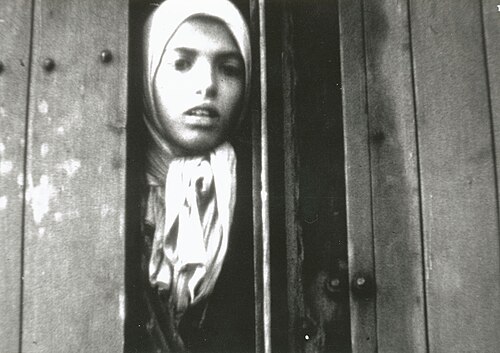 A famous image of 10-year-old Settela Steinbach, a Dutch Romani girl on a train to Auschwitz in 1944, mistaken as Jewish for years by historians.
Roma and Sinti — distinct but related Romani peoples who have lived in Europe for centuries — were classified alongside Jews as “enemies of the race-based state” under a 1935 supplement to the Nuremberg Laws.
They were subjected to forced registration, sterilization, internment, deportation, and systematic murder in concentration and extermination camps. Germany did not officially acknowledge this genocide as racially motivated until 1982. Roma survivors were excluded from the Nuremberg trials. Reparations, where they came at all, arrived decades late.
Language and Terminology
- Roma— A broad term for Romani peoples, used especially in Eastern and Southeastern Europe.
- Sinti — A culturally distinct Romani group that has lived in Central Europe, especially Germany and Austria, since the Middle Ages.
- Romani — The language family and the adjective referring to Roma culture and identity.
- Gypsy — historical sources and titles on this site sometimes use “Gypsy,” reflecting the language of their time or the choice of their creators; current usage prefers Roma and Sinti but usage is still widespread in research, history, and even testimonies.
- Porajmos (or Porrajmos) — “The Devouring” in Romani, a controversial term for the Roma Holocaust introduced by Ian Hancock.
- Samudaripen — “Mass killing” in Romani, used by some communities as an alternative to Porajmos.
- Antigypsyism — The specific form of racism directed at Roma and Sinti, as defined by IHRA. The word “Gypsy” is generally considered a slur in English; where it appears in historical source titles, it reflects the language of the period.
The silence around this history is not accidental. And it is not simple.
Roma and Sinti communities carry their histories differently than many other survivor communities. Oral tradition lives within families and clans, not in public testimony. Many Roma cultures protect their stories out of a deep tradition of keeping what matters most within the community.
The few survivors who published memoirs or gave public testimony like Ceija Stojka, Otto Rosenberg, Philomena Franz made a choice to share their stories. In that time period, the challenges within community, and around the teaching of the Holocaust in general, made these testimonies important, and sometimes controversial.
This means that building awareness of the Roma and Sinti genocide requires a different kind of listening. With this page, we point you toward the best resources we found, created by scholars, institutions, and Roma communities who have chosen to make this history visible.
We honor both the stories that have been shared and the ones that remain protected.
Essential Resources for Teaching and Learning
These ten sources represent valid and available materials for educators, students, researchers, and anyone seeking to understand the Roma and Sinti experience during the Holocaust. Each has been selected for historical accuracy, institutional credibility, and — where possible — including Roma and Sinti voices. Let’s listen.
1. The Genocide of European Roma and Sinti — Learning Website
URL: romasintigenocide.eu
Created by: OeAD/ERINNERN:AT (Austria), with support from IHRA and the Foundation for the Memory of the Shoah
What you’ll find: The most comprehensive online teaching resource focused exclusively on the genocide of Roma and Sinti. Available in 12 languages, it covers individual biographies, places of persecution, the long history of anti-Roma discrimination in Europe, resistance, and the consequences for survivors. Includes over 70 downloadable worksheets designed for students aged 14 and up. A teachers’ handbook provides historical background and methodological guidance for organizing lessons.
Best for: Teachers building a lesson plan or unit. Students researching independently. The worksheets make this immediately usable in a classroom without additional preparation.
2. USC Shoah Foundation — Roma and Sinti Testimony Collection
URL: sfi.usc.edu | Research guide to Roma interviews
Created by: USC Shoah Foundation (Visual History Archive)
What you’ll find: The largest collection of video testimonies from Roma and Sinti Holocaust survivors in the world — 407 interviews gathered in 18 countries and 16 languages between 1995 and 1999. The interviewees include 185 men and 222 women, predominantly from Poland and Ukraine, with a smaller group from western and southern Europe.
Twenty-four testimonies are conducted entirely in the Romani language. Survivors describe camp internment, ghetto experiences, mass shootings, resistance, and the continuing persecution they faced after the war.
Best for: Researchers and universities with institutional access to the Visual History Archive. Some clips and excerpts are publicly available. The research guide provides context on what the collection contains and how to search it.
3. Testimonies of Roma and Sinti — Prague Forum Database
URL: romatestimonies.org
Created by: Prague Forum for Romani Histories (Institute of Contemporary History, Czech Academy of Sciences / Charles University), in partnership with the Museum of Romani Culture, Brno
What you’ll find: A searchable database of printed Roma and Sinti testimonies from the Czech Republic and Slovakia, with detailed abstracts in Czech and English. An interactive map connects testimonies to specific locations — places of birth, internment, mass murder, rescue, and armed resistance.
The database was launched on August 2, 2023 (International Roma Holocaust Memorial Day) and is expanding to approximately 250 testimonies. Led by researcher Kateřina Čapková, the project deliberately centers the perspective of Roma and Sinti themselves, shifting away from the Nazi-authored documents that have dominated scholarship.
💡 Best for: Researchers, educators, and anyone interested in how Roma experienced the war in Central Europe. The map feature is especially powerful for students — it makes the geography of persecution concrete. This is a newer resource that deserves wider visibility.
4. USHMM “Experiencing History” — Roma and Sinti in Nazi Germany
URL: Experiencing History collection
Created by: United States Holocaust Memorial Museum
What you’ll find: A curated collection of primary sources — oral histories, letters, documents, and photographs — that trace how persecution of Roma and Sinti became increasingly radical under the Nazi regime.
Includes oral histories with Karl Stojka and Rita Prigmore, a postwar letter from Otto Rosenberg listing his camps, and contextual essays by USHMM historians. The broader USHMM bibliography on Sinti and Roma is one of the most comprehensive English-language reference lists available.
Best for: Teachers who want vetted primary sources with scholarly context. The USHMM’s curatorial authority gives these materials institutional credibility that administrators and curriculum committees recognize.
5. Ceija Stojka — Memoirs, Art, and Legacy
URL: ceijastojka.org (Ceija Stojka International Association)
Book: The Memoirs of Ceija Stojka, Child Survivor of the Romani Holocaust — translated and edited by Lorely E. French (Boydell & Brewer, 2022). First English translation of her three memoirs, with poems, artwork reproductions, and an interview by Karin Berger.
Who she was: Ceija Stojka (1933–2013) was an Austrian Lovara Romani writer, painter, musician, and activist. Interned at Auschwitz-Birkenau, Ravensbrück, and Bergen-Belsen from age nine to twelve, she broke decades of silence in the late 1980s. Her 1988 memoir We Live in Secrecy was one of the first accounts by a Romani Holocaust survivor. She created over a thousand paintings and drawings — divided between “dark pictures” of camp life and “bright pictures” of pre-war Romani life — and became Austria’s leading advocate for recognition of the Roma and Sinti genocide.
Best for: Anyone seeking to understand the Roma Holocaust through art and personal narrative. Stojka’s work bridges memoir, visual art, and activism. Her paintings are the most extensive visual testimony of Roma camp experience in existence. A 2026 exhibition at the Drawing Center in New York, Ceija Stojka: Making Visible, is bringing fresh international attention to her work.
6. Otto Rosenberg — A Gypsy in Auschwitz
Book: A Gypsy in Auschwitz by Otto Rosenberg (originally published 1999; reissued 2022 by Monoray). Available in English.
Profile: Otto Rosenberg life story — Holocaust Memorial Day Trust
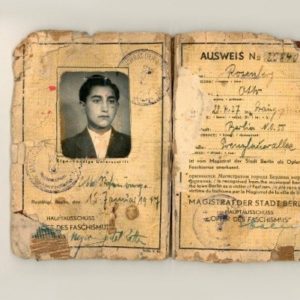 Otto Rosenberg ID card on Holocaust Memorial Day Trust
Who he was: Otto Rosenberg (1927–2001) was a German Sinti survivor who grew up in Berlin, was forcibly relocated to the Marzahn camp before the 1936 Olympics at age nine, and was sent to Auschwitz at sixteen. He survived Auschwitz, Buchenwald, and Bergen-Belsen, and later founded the Berlin-Brandenburg State Association of German Sinti and Roma. His memoir, recorded on tape in 1995 and published with writer Ulrich Enzenberger, maintains the direct voice of oral testimony. None of his ten siblings survived.
Best for: High school students and general readers. The book’s accessible, conversational voice and relatively short length make it the most approachable English-language Roma Holocaust memoir. It covers the full arc — pre-war community, the Olympics roundups, camp internment, armed revolt, and liberation.
7. IHRA — Genocide of the Roma: Resources and Recommendations
URL: IHRA Roma genocide resources
Created by: International Holocaust Remembrance Alliance, Committee on the Genocide of the Roma
What you’ll find: Policy recommendations for including the Roma genocide in school curricula, the IHRA working definition of antigypsyism, and resources for educators, scholars, and journalists. IHRA’s interdisciplinary committee develops tools that connect the history of Roma persecution to contemporary discrimination, and their recommendations are the framework that national governments and education ministries reference when developing Holocaust education standards.
Best for: Curriculum developers, school administrators, and policy-level educators. If you need institutional backing for adding Roma and Sinti content to an existing Holocaust unit, IHRA’s recommendations are the document to cite.
8. Holocaust Memorial Day Trust (UK) — Roma Genocide Section
URL: HMDT Roma genocide overview
Created by: Holocaust Memorial Day Trust, United Kingdom
What you’ll find: A clear, well-sourced overview of the Roma genocide with individual survivor profiles (including Otto Rosenberg), historical context, and downloadable PDF life stories for classroom use. The trust supports both January 27 (International Holocaust Remembrance Day) and August 2 (Roma Holocaust Memorial Day) with distinct educational materials.
Best for: Teachers who need clean, ready-to-use classroom materials. The downloadable life story PDFs are especially useful for class discussion or independent student research. Materials are designed for UK schools but widely applicable.
9. Documentation and Cultural Centre of German Sinti and Roma (Heidelberg)
URL: sintiundroma.de
Created by: Documentation and Cultural Centre of German Sinti and Roma
What you’ll find: The world’s first permanent exhibition on the Holocaust against Roma and Sinti, housed in Heidelberg since 1997. The centre has systematically collected survivor testimonies, family photographs, and archival materials documenting over 600 years of Sinti and Roma history in Germany.
It holds twelve German-language video testimonies from the USC Shoah Foundation and maintains the most extensive archive of pre-war Roma and Sinti family photographs — images that show people as they lived before persecution.
Best for: Researchers and anyone planning to visit in person. The family photograph archive is irreplaceable — it humanizes the history in a way that documents and statistics cannot. The centre also serves as a hub for contemporary Sinti and Roma civil rights advocacy in Germany.
10. Ian Hancock — We Are the Romani People and Scholarly Writings
Book: We Are the Romani People by Ian Hancock (University of Hertfordshire Press, 2002). Also: The Pariah Syndrome (1987) and numerous scholarly articles.
Profile: Ian Hancock — Wikipedia
Who he is: Ian Hancock is a Romani linguist, scholar, and political advocate — the first Roma in British history to receive a PhD. He has represented the Romani people at the United Nations, served on the US Holocaust Memorial Council under President Clinton, and coined the term Porajmos (“the Devouring”) to name the Roma genocide. Over time that term has become controversial, still his research is essential. He is founder of the Romani Archives and Documentation Center at the University of Texas at Austin.
Best for: Understanding the broader context — Romani identity, the thousand-year history of migration from India, centuries of European persecution including slavery in Romania, and the cultural foundations that make Roma history distinct. Hancock’s work provides the background students need before engaging with Holocaust-specific material.
Key Dates
August 2 — International Roma Holocaust Memorial Day. On the night of August 2–3, 1944, the SS liquidated the “Gypsy Family Camp” (Section B-IIe) at Auschwitz-Birkenau, murdering over 4,000 Roma and Sinti men, women, and children in the gas chambers.
January 27 — International Holocaust Remembrance Day. Commemorates the liberation of Auschwitz-Birkenau in 1945, honoring all victims of Nazi genocide including Roma and Sinti.
How You Can Help
If you are a Roma or Sinti educator, scholar, or community member who would like to contribute to this resource — or if you know of additional sources that should be included here — please contact us. Remember.org has always been built by its contributors, and we recognize that this section can only grow with the involvement of the communities whose history it concerns.
We are grateful to the scholars, institutions, and survivors whose work made this page possible.