


From Sidney Iwens about Witnessing…:
“Throughout the war it seemed very important to me, as it did to many others, that there be left an authentic record of what actually happened to us. And although we had very little hope of survival and the ability to tell all, something compelled me to record dates and make notations on scraps of paper. In effect this became a crude sort of diary. Even in the midst of these experiences, part of my mind seemed to be observing, and committing to memory in sharp detail, the events I was witnessing.”
“How Dark the Heavens” is a journal of survival, divided into 1400 days
Sidney Iwen’s Biography
Return to Holocaust Survivor Books
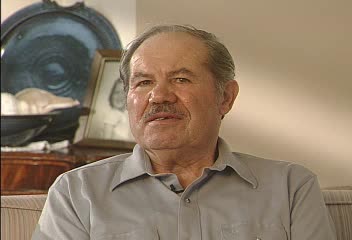 Sidney Iwens
Read Chapter 1: Daugavpils Ghetto and the Flight from Lithuania
Read Chapter 2: Daugavpils Ghetto & Prison Massacre
Read Chapter 3: Dachau Concentration Camp & Allach Liberation
This material, copyright 1990 by Sidney Iwens, is excerpted from his prize-winning book “How Dark the Heavens”. This material may not be reprinted or reproduced in any form without the expressed written permission of Sidney Iwens.
You can also order How Dark the Heavens : 1400 Days in the Grip of Nazi Terror, available from Amazon.com .
Holocaust Journal Intro: From Lithuania to Dachau/Allach
June 22, 1941 — the first day of Sidney Iwens’s long nightmare. The night before, he had been at a dance, enjoying himself with the other Jewish boys of his small Lithuanian city. Now he stood watching a dogfight between two distant planes. Tomorrow he would be fleeing for this life — a flight that would last for nearly four terror-filled years.
Lithuania, Latvia, and White Russia, directly in the path of the invading Germans, fell into the murderous clutches of the first SS Einsatzgruppen, the Special Action Groups whose only missions was to kill Jews. In four months, aided by virulent anti-Semitic Latvians, Lithuanians, Ukrainians, and other native peoples, they shot 250,000 Baltic Jews. And that was just for starters. Sidney himself, herded together with other boys and young men in a city prison, reached the very gates of the killing ground, only to be reprieved temporarily –because the SS had run out of ditches.
Thereafter, his life became a patchwork of hiding, pretending to be a skilled workman (and thus worth the Germans’ while to preserve for a time), fleeing to the partisans, returning to the ghetto, and finally being shipped west to Dachau.
Sidney tells his story in diary form, reconstructed from memory of the diary he actually kept during the Holocaust years. he tells of his bittersweet romance in the shadow of betrayal and death, of the horrendous experiences of his friends and fellow survivors, of having every hand against Jews, even fellow enemies of the Nazis, of the occasional acts of generosity — usually from the most unpredictable source, German soldiers themselves — of his slow starvation and final rescue (like his first) at the gates of death.
This vivid and dramatic story of a Holocaust survivor is in a class by itself– a day-by-day recounting of murder, heroism, stoic endurance, good luck, bad luck, love, intrigue, and humanity.
Sidney Iwens Memoir Preface
An introduction to Sidney Iwens’ Holocaust journal. Learn the history behind the preservation of these raw, first-person wartime diaries.
Throughout the war it seemed very important to me, as it did to many others, that there be left an authentic record of what actually happened to us. And although we had very little hope of survival and the ability to tell all, something compelled me to record dates and make notations on scraps of paper. In effect this became a crude sort of diary. Even in the midst of these experiences, part of my mind seemed to be observing, and committing to memory in sharp detail, the events I was witnessing.
My personal reactions often surprised me. I was struck by the fact that, in extreme situations, people don’t always react in the expected way. The scraps of paper, along with all my other personal effects, disappeared when I arrived at Concentration Camp Stutthoff, thirty kilometers east of Danzig (now Gdansk), in July of 1944, but the memories have always remained clear and sharp in my mind. I was liberated on the last day of April in 1945, and about a month later, as soon as I was well enough, I once again compiled the dates and began to record all that had happened to me during the war. My primary concern then was to get everything down on paper, and though the diary was written in an irregular and rambling fashion–I could only work at it when time permitted–after some years I managed to set down a great deal of relevant information.
It was always my hope that I could some day arrange the material in a manner that would make clear exactly what had happened to us. But it was not until 1983 that my personal circumstances finally permitted me to devote the necessary time to the work I had started thirty-eight years earlier. I knew full well that there were great difficulties in trying to convey everything I saw, experienced, and thought during those years. To simplify this task, I decided to record everything in chronological order as the events unfolded. The entries document events occurring between June 22, 1941, in Janova, Lithuania, and April 30, 1945, in Camp Allach near Munich. These events were a microcosm of the Jewish experience throughout the Baltic States, during which, especially in the first few months of the war, most of the Baltic Jews were murdered. The notes I took down in 1945 were a major resource. But there is no discrepancy between what I remember now and what I write shortly after the war. For, on a certain level, I have never really left those times behind. I relive them every day.
How Dark the Heavens Book Reviews | Sidney Iwens Memoir Impact
Read critical acclaim and educational reviews for “How Dark the Heavens,”
the award-winning, deeply moving Holocaust memoir by Sidney Iwens.
“…he miraculously survived to tell this remarkable story.”
“This book is his unsentimental, clear, moving and aesthetically affecting account of his experience of the war…This is an epic tale, and a heroic one, a kind of 20th-century Odyssey.”
The Milwaukee Journal
“One might expect this to be a difficult book to read; it is not. It is as gripping as a fictional story of love and adventure. From page one the reader is swept up by the suspense and is kept riveted until the end — and it lingers even after…Recommended reading for Jews and non-Jews, young and old.”
Hadassah Magazine
“…HOW DARK THE HEAVENS is a diary of his life of flight and fight beginning on June 22, 1941, in the small Lithuanian city of Jonava…and he lived to tell his story of overwhelming courage, mental strength, and man’s inhumanity to man.”
The Jerusalem Post
“What Sidney Iwens has recorded makes compelling reading, even though there have been quite a few such books before. This one would, I think, persuade even those who doubt that a Holocaust took place that what he described actually happened…Sidney Iwens writes movingly of his 1400 days of war.”
Sunday Star Review, Johannesburg, South Africa
I am grateful for the support and encouragement of my wife Ita, and of my children, Ilana and Richard Kennell, and Judy and Roy Eidelson.
This material, copyright 1990 by Sidney Iwens, is excerpted from his prize-winning book “How Dark the Heavens”. This material may not be reprinted or reproduced in any form without the expressed written permission of Sidney Iwens.
Return to Holocaust Survivor Books
Read Chapter 1: Daugavpils Ghetto and the Flight from Lithuania
Read Chapter 2: Daugavpils Ghetto & Prison Massacre
Read Chapter 3: Dachau Concentration Camp & Allach Liberation