

💡 Note: This page on the 600 Roma is a core part of Remember.org’s new collection on the Roma and Sinti Holocaust, a Roma survivor testimony, and classroom resources for those studying the Roma Holocaust.
On the evening of May 16, 1944, SS guards came to the “Zigeunerlager” — the Roma family camp at Auschwitz-Birkenau — to carry out its liquidation. Nearly 6,000 Roma and Sinti were held there. They had been warned the night before.
When the guards arrived, the barracks stood locked from the inside. Prisoners had broken into a supply store and armed themselves with whatever could be turned into a weapon — pipes, tools, stones, the wooden slats pulled from their own bunks.
Eighty-two years later, in a theatre near Manchester, England, Roma families performed on a stage that night. Children play the prisoners. The words are spoken in Romani and English. The drama is called The 600 Roma, and it’s about how a people remember, when the remembering belongs to them.
May 16, 1944 Romani Resistance Day
The 600 Roma was performed on May 16, 2026:
“This is a live, community-led production involving around 20 Roma participants, including families, musicians, dancers and young people from across Greater Manchester.
The story we are bringing to life is based on real events from 16 May 1944, when 600 Roma prisoners in Auschwitz-Birkenau stood together and resisted a Nazi attempt to kill them…
It remains the only known moment in history where Roma from different groups united in the face of death. This is their story.”
Neil McAlisterKaskoSan Trustee
The musical drama The 600 Roma is based on true stories of the Roma Holocaust. It tells the story of the uprising on May 16, 1944, when Roma prisoners refused to be led to their deaths and fought back. The SS arrived in the “Gypsy Camp.” The Roma armed themselves with whatever they could find. The SS withdrew.
The camp was not saved. On August 2, 1944, the SS returned and murdered the remaining 4,000 Roma and Sinti. But May 16 is remembered as the night the Roma stood up. And KaskoSan built a theatrical work around that night, putting the story in the voices, and in the Roma people, performing their own history.
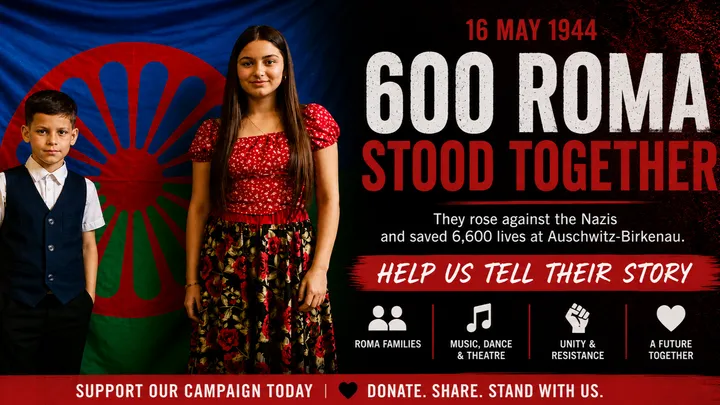 The 600 Roma was performed on May 16, 2026.
The 600 Roma was performed in Romani and English by KaskoSan members and local Roma children. It was staged at Kala Sangam in Bradford, at Theatre in the Mill, and at cultural events across the UK.
It was not a production designed for outside audiences to consume Roma pain. It is a community ritual — remembrance through performance — where families gather, children learn, and the dead are honored in the language they spoke.
This is an example of how Roma carry their stories, within the culture. Family and performance blend into a living language, even if for a moment. Backed by centuries of Roma tradition, culture, and perseverance. Through being together in a room and saying: this happened to us, and we are still here.
This page is for Juice Vamosi, Maria Palmai, and KaskoSan — proof that remembrance doesn’t only live in archives. Sometimes it dances itself into the present day, as a warning from the past and a promise of what’s possible.
The 600 Roma
Performed in Manchester, England
May 16, 2026
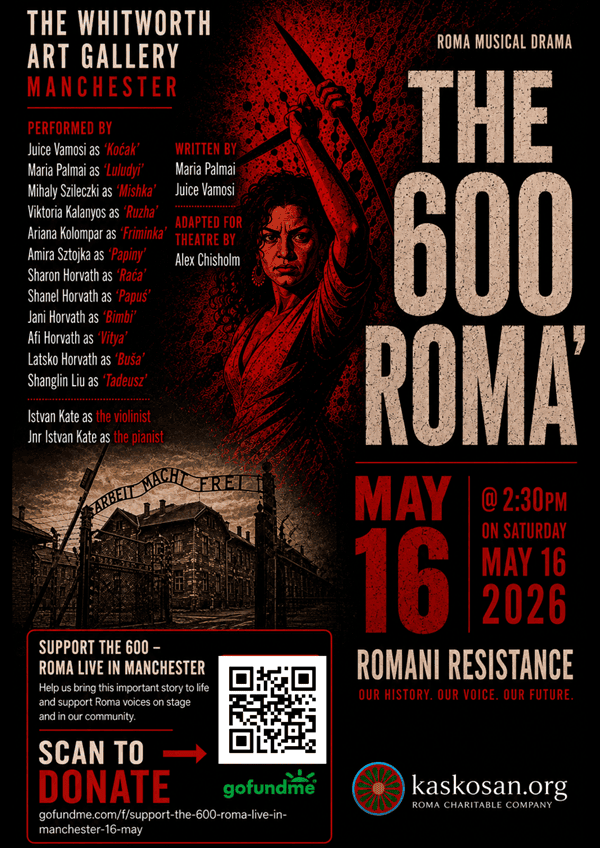
The SS did not force the barracks open that night. Fearing the revolt would spread through the rest of the camp, they retreated.
It did not save the camp. On the night of August 2–3, 1944, the SS returned, and the Roma and Sinti still held there were murdered in the gas chambers. What May 16 changed was time, not outcome — the resistance held off the killing for months it would not otherwise have had. Some who stood that night were later transferred out as forced laborers to other camps; many others were among those who died that August.
That is why May 16 is remembered as Romani Resistance Day — not because it erased what came after, but because it is the night the Roma in that camp chose to stand rather than comply, in a place built to make resistance impossible.
A Story Told Standing Up
Most Holocaust remembrance asks us to sit still and listen. What KaskoSan built around May 16 asks something different — it asks a community to stand up and become the story again, every year, together, in a room.
The Greeks had a word for that kind of repetition: ritual. Not a reenactment staged for an audience, but a shared act a community performs on itself — to grieve, to release, to remember by living through something again rather than simply hearing it told. T
The 600 Roma is not a museum piece. It’s Roma families and their children standing in a theatre, performing in Romani and English, playing out the night their people chose to fight rather than comply — and in the same act, choosing, once more, not to comply with being forgotten.
That’s also why the play doesn’t end on August 2. It could — August 2 is the day this site marks as Roma Holocaust Memorial Day, and it’s the day the camp’s story actually ends. But KaskoSan built its ritual around May 16 instead — the night before the ending, the night of the stand. It’s a choice about what a people decides to hold onto: not just how they died, but how they refused.
💡 Press Coverage (more at bottom of the page):
Theatre show gives Roma and Gypsy families a voice – BBC (2024)
In Juice’s Words
KaskoSan Roma Charity was founded in Hungary in 2008 by Juice Vamosi, a Romani filmmaker and interpreter, and Maria Palmai — the same two who wrote The 600 Roma. When the play was first staged in Bradford in 2022, Juice framed what it was really asking of an audience:
“individuals who can defeat their own ‘Gypsy’ prejudices and unite with other like minded people to save Roma lives and ‘Romanipe’ — should be celebrated as heroes on every May 16.”
Romanipe — the Romani cultural identity, the collective values and unwritten rules that hold a people together without a country of their own — is the thing being defended here, as much as any single life. That’s the argument underneath the play: unity itself, across a community that rarely gets the chance to unite, is its own act of resistance.
This year’s performance was on May 16, 2026, part of the Romani Resistance Day programme — KaskoSan’s own description of the night calls it “the only known moment in history where Roma from different groups united in the face of death.” KaskoSan built the whole performance around one night of unity, and remembering the resistance, of what’s possible.
One Phone Call
I’ve spoken with Juice once, on the phone. One conversation — profound, funny, and informative in a way that surprised me. And what that one conversation left me thinking about.
I wrote my own play, Genericide, as part of my graduate work (and the foundation of Remember.org — a piece meant to be read and watched by outsiders to the story. One night, the audience did not laugh once, to a comedy. The subject was so profound, either they didn’t find it funny, or couldn’t allow laughter into the room. We were artist and audience, but not part of the same culture.
What Juice and Maria built is something else. The 600 Roma isn’t written to explain Roma history to people outside it. It’s written the way Roma communities have always carried their history — inside the family, inside the language, inside a room where everyone already knows what the story means before it starts. It’s not that Roma stories haven’t been told. It’s that they’ve mostly been told to each other.
What’s changing now — performances reaching the Whitworth Art Gallery, a dance video with 25 million views, coverage in the Guardian and on the BBC — is that the rest of us are finally being let into the room. Remembrance didn’t just begin, we’re being invited in to listen, and remember, stories they have been sharing for years.
Epilogue: Who KaskoSan Is
KaskoSan Roma Charity works across Greater Manchester and Lancashire — theatre, film, Romani language workshops, and a dance program that brings together performers aged five to sixty from Bolton, Oldham, Preston, Blackburn, and Rochdale. In 2025, their dance videos passed 25 million views on TikTok and Facebook.
Their film and cultural work includes Gelem, Gelem, the first Romani-language animated film produced in the UK; The Deathless Woman, the first Romani-language Holocaust film; and A Flag Large Enough, a theatre piece developed with Roma families across Oldham, Bolton, Preston, and Bradford.
Juice Vamosi has also produced documentary work aired on Channel 4, BBC One, and BBC International, covering Roma life across Eastern Europe and England. KaskoSan runs ongoing community workshops at the Bolton Socialist Club, has partnered with the Whitworth Art Gallery on exhibitions of Roma art, and works with schools across Greater Manchester.
Learn More
KaskoSan Roma Charity: kaskosan.org
Press and Coverage:
- Roma families bring unfunded musical drama to Manchester — Oldham Reporter
- KaskoSan: Greater Manchester’s Romani community — I Love Manchester
- KaskoSan: The Roma 600 — Bradfordian
- Films reveal Bradford schools’ efforts to help Roma pupils during pandemic — The Guardian
- A Flag Large Enough — BBC News
← Return to the Roma and Sinti Holocaust
Remember.org — A People’s History of the Holocaust. Founded April 25, 1995.