

Return to How Dark The Heavens
 Sidney Iwens – Author
Sidney Iwens Biography:
Jonava, Lithuania
Sidney Iwens was born in Lithuania. After emigrating to the United States in 1948, he settled with his wife in Milwaukee, Wisconsin. They had two married daughters.
Sidney Iwens was a Holocaust survivor, memoirist, and the author of the book How Dark the Heavens: 1400 Days in the Grip of Nazi Terror. He was born Shaya “Shaike” Iwensky on May 24, 1924, in Jonava, Lithuania.
Readers Write Back: How Dark the Heavens
Sidney Iwens Biography Details: Source Library Thing
“Sidney Iwens was born Shaya (Shaike) Iwensky to a Jewish family in Jonava, Lithuania. His father Moshe Iwensky was head of the Folksbank, the nonprofit Jewish community bank in the small town. He learned to speak Lithuanian, Yiddish, German and Russian. His carefree childhood ended in 1940 when the Soviet army invaded his homeland.
Then in 1941, when he was 17 years old, Nazi Germany attacked and the Soviets retreated. The Iwensky family traveled to Daugavpils, Latvia, hoping to avoid the German army, but were overtaken. All the Jewish males were imprisoned in the Daugavpils prison, then taken out in small groups to a nearby park and executed. Shaike escaped death when the killings were halted for the day, and he later found a hiding place in an empty cell. Eventually he found himself in the Daugavpils Ghetto.
In 1942, he survived the liquidation of the ghetto by volunteering as a painter for a German army construction unit. He and two companions later escaped and fled into the forest, first joining the partisans, then hitching a ride on a freight train to the remote Siauliai Ghetto in Lithuania. In 1944, the Siauliai Ghetto was liquidated and Shaike was deported with the other Jews to the the Dachau concentration camp. He survived the death march forced by the Germans as the Red Army approached, and wound up at the Allach transit camp, which was liberated by the Americans in April 1945.” Library Thing
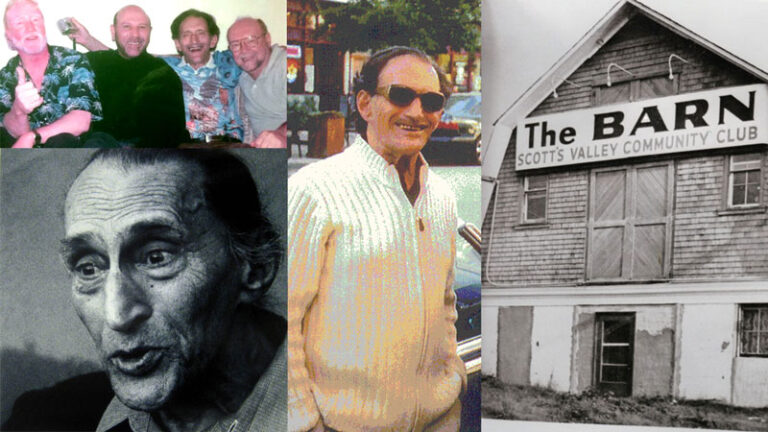 Remembering Leon Tabory
Holocaust Survivor, Friend of Neal Cassady, and Counterculture Figure – SOURCE: Kerouac.comn
Leon Tabory Connects Sidney Iwens, his uncle, to Put How Dark the Heavens on Remember.org
Leon Tabory was born in Lithuania in 1926 to an Orthodox Jewish family that owned a factory and was, by his own account, comfortably well-off before the war changed everything. As a child he was deported to Stutthof concentration camp, tattooed with a number on arrival, and later sent to Dachau, where he was put to forced labor building underground factories, roads, and railways. He survived the death march the Germans forced on prisoners as the Allies closed in. After liberation, he briefly reunited with his sister in Munich before making his way to the United States by way of Sweden, joining his father, a rabbi, in Baltimore. He worked as a laborer while attending prep school at night, eventually earning a master’s degree in psychology from the University of Wisconsin.
By the late 1950s Tabory was a research psychologist at San Quentin, where he met Neal Cassady, a friendship that would cost him his job (he was fired for “associating with ex-convicts,” then won reinstatement on appeal) and later place him at the center of California’s counterculture scene: in the 1960s he ran The Barn, a music venue in Scotts Valley that hosted Janis Joplin, Country Joe McDonald, and Ken Kesey before the city shut it down. He died in September 2009, just days before his 84th birthday. According to a 2025 remembrance published by Jerry Cimino of the Beat Museum on Kerouac.com, Tabory once compared his own reluctance to be called a hero to that of fellow survivor Harold Gordon (author of The Last Sunrise), who showed audiences his own camp tattoo at book signings so they’d understand the history behind it wasn’t abstract.
Sidney Iwens, and Leon Tabory’s, stories are one of both immense tragedy and remarkable survival:
As a Jewish teenager, he endured the German occupation of Lithuania. He survived a mass execution in Daugavpils, life in several ghettos (including Daugavpils and Siauliai), a period with partisans in the forests of Belarus, and ultimately the horrors of the Dachau concentration camp and a death march. He was the only member of his immediate family to survive the Holocaust.
After the war, he emigrated to the United States in 1948, settled in Milwaukee, Wisconsin, with his wife Ida, and changed his name to Sidney Iwens. He and his wife had two daughters.
In 1991, he published his memoir, How Dark the Heavens, based on a diary he kept during the war. The book won the August Derleth Non-Fiction book award. He also recorded a comprehensive oral history for the USC Shoah Foundation in 1996. He passed away on August 17, 2010, in Philadelphia, Pennsylvania.
This material, copyright 1990 by Sidney Iwens, is excerpted from his prize-winning book “How Dark the Heavens”. This material may not be reprinted or reproduced in any form without the expressed written permission of Sidney Iwens.
Read the Conclusion, Allach Liberation