

Return to Holocaust survivor stories and testimonies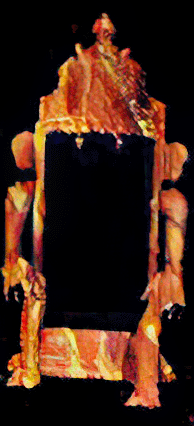
A place to think, consider, and create the topics.
Stories
Miriam Hannah:
comments: I am 13, and namesake to a girl who “died” in the Holocaust. I put that in quotes because while I was visiting the Old Jewish Town in Prague, we found a picture gallery that had drawings by children in Terezin. Under the picture that I recognized as my name-sake’s it said that she survived the holocaust! I was awed by this and made it my goal to find her and meet her someday! If there is anybody who could point my toes in the right direction, I’d be grateful. Here’s everything I know about her: *Her name is HANA GRUNFELD(OVA). *She was born on May 20, 1935. *Deported to Terezin on December 14,1941. *She has drawn 10 pictures which were done between 1941 & 1944. *She lived in block IV at Terezin. *She supposedly died at Auchwitz in 1944 *The title of one of her watercolors is: Dwellings in Terezin. It is a picture of bunks 14, 15, 16. In the room is one vase of flowers. The wall is striped various colors. Her signature is in the upper right hand corner.
Terese Pencak Schwartz:
- I Would Like to Remember the Five Million (Often) Forgotten: Even though the Gentiles were not targeted as vehemently as the Jews during the Holocaust, five million lives are often forgotten. Three million were Polish Gentiles. Hundreds of Poles were killed for giving assistance to their Jewish neighbors and countrymen. Hundreds were murdered just because it was SUSPECTED that they may have given aid to a Jew. My family’s home was burnt to the ground and my great-uncle was shot in the head for giving protection to a Jewish girl. Hundreds of Polish Gentile resistance fighters from the Polish Army fought in the Warsaw Uprising and helped to train young Jewish men for combat. Arms, ammunition and forged documents were smuggled into the Ghetto through the sewers by Polish volunteer soldiers. Not only did these righteous Poles risk their lives, but they also risked the lives of their entire family — because the Nazis would kill an entire family if even one member was suspecAll the people that were murdered during the Holocaust should be remembered and acknowledged as human beings. The Nazis, at the beginning, targeted only the Polish intellectuals, the professors, the judges, the school teachers, the librarians and the attorneys so it would make it easier to dominate the rest of the people. The Polish government formed a group, Zegoda, to specifically provide assistance to the Jews. Headquartered in Warsaw, Zegoda, had agencies throughout all of Poland and Zegoda was responsible for giving shelter, food, medicine, and financial support to Jews in the ghettos and in hiding. But, the word Zegoda does not even appear in most Holocaust rememberances. I invite you to visit this site: http://members.tripod.com/~polishboy/ Let me know what you think. Thank you for “listening”.
Rosa Maria:
- He visitado Yad-Vashem dos veces. La ultima en el mes de Julio de 1996. Era un dia soleado y en el valle se veia jugar y se escuchaban las risas de los ninos de un colegio. Esa imagen perdurar para siempre en mi vida como demostracion de que a pesar de todo el horror y el sufrimiento, a pesar de que quisieron hacer desaparecer al pueblo judio, no lo han conseguido. Fue como una explosion de luz en medio de las tinieblas. Recordar siempre. No olvidar. Shalom
Deborah:
- I’ve been interested in the Holocaust ever since I learned about what happened as a young child. I could not believe people could be so full of hate and stupidity as to have killed all those people simply because they were different.
As I have matured and grown up I am beginning to understand how this happened. It is truly rooted in fear. It seems like hate is always rooted in fear or ignorance, or even the lack of ability or power to take revenge. I initially felt like I could never have done such a thing, or that people now could never let this happen, but I am beginning to see that we all are susceptible to the influence of a powerful person, brutality and lies.
It’s quite a scary thing to realize, and in order for this to truly never happen again, we must all see the potential for evil in each one of us. This does not in any way justify the way those people chose to act. It just helps us to stop denying that we could possibly under the same circumstances, let it happen as well. This understanding will help us to be aware of the signs of this happening again and fight them.
I think there are signs of this happening again. Back then it all started with the idea that some people, due to infirmity or lack of something were somehow unworthy or too much of a drain on society to keep around. It started with the elderly, those with mental defects or physical defects. I found out recently that laws were passed around the same time in the US that allowed mental patients to be sterilized against their will. This was the beginning of such an event here in our beloved country. Thank God, it has stopped there.
I do see in the genetic research being done that we are trying to create the “perfect person”. I see it in doctors who find defects in the fetus, advising the mother to have an abortion. I see the potential for this happening again and it scares me. I think anytime we decide that we should have more power than God, we are at risk. Anytime we decide that one person is worthy of life and another is not, we are on dangerous ground. I pray for mankind, and that we may have learned from this horrible event that marks up our history.
Teresa:
- What does the Holocaust mean to me? It means that we must educate our children, that we must fight apathy and indifference, that each of us must use our voice to combat oppression and injustice. I often get told, “But you’re not Jewish..” My response, “But I’m a human being…” This site is beautiful, and serves the memory of the victims well. Thank You.
David F. Eliet:
- I am seeking information from anyone who knows about the Holocaust in Nezhin Nejin in the Ukraine or where I could look for information about the town prior to World War II. Also I am looking for anyone who has information about a ship that sailed 200 people to Palestine from Bratislava, Slovakia around 1941. Particularly I want to know if anyone has any information about the part played in this mission to save Jewish lives by Jan Flimel.
Tore Bohman:
I am a university student majoring in history in Finland. It scares me to see that fascism and neo-nazism is again gaining followers here in Europe. It makes me furious that there are people, calling themselves historians, who by trying to falsify history and downplaying the horrors of the nazi regime, give nazi movements arguments with which they can mislead specially the young men of Europe, whose frustration is growing due to increasing unemployment and social tension. I think it is important to stress, that fascism is not only an issue for jews or for the non-european immigrant groups (who are very much targeted now). Fascism is a threat to everyone; it is a violent, destructive ideology that in the end kills its own. Fascism almost managed to destroy Europe 52 years ago. It is up to us europeans to make sure it doesn’t get a second chance. The best weapon against fascism is information; to show what fascism’s true face is, and that it is important for everyone, regardless of religious or ethnical background, to fight it. It is important to show the horrors and the suffering fascism brought to all peoples living in Europe. How everybody was suppressed and that anyone who opposed the tyranny; social democrats, catholic priests and so on, and anyone who deviated from the “norm”; homosexuals, cripples, mentally impaired and so on, also were put into concentration camps. Thank You for having this site!
Danielle:
In case you forget, I am Danielle, a high school student from Massachusetts looking to do research on the Holocaust. I appreciated your extensive response. Your advice to me seems clear: the best way for me to learn about the Holocaust is to become involved with those who lived through it directly or indirectly. I will look into remember.org more carefully…and gather information that could lead me to even more information…
I would really like to listen to an audio of a survivor…but how would I go about doing that? Do libraries generally have audio cassettes of that nature or would I have to look for them in a book store? I will find out.
I am certainly interested in the literary works you recommended…I enjoy reading particularly when it is on a topic I am this interested in like this.
Some things you said in your email struck me as particularly…inspiring…:
“…That’s what scares people the most about the Holocaust, because in exploring human behavior you explore yourself. And you have to change. Which is exactly what the Internet is teaching us all. Knowledge is experience, not memorization. It is the power of minds working together.”
When you said this it reminded me of my own beliefs of what adolescent education should/should not be. i.e. memorization vs. experience
“…[on the internet]…you have an incredible collection of liberators, survivors, children of survivors and people like me…not Jewish, not German, just interested in making this world better. The only way to do this is to change yourself.”
I fit in with that category of “people like you”. And I agree that one definitely does feel the need to change themselves when learning about the Holocaust.
tew45:
I am searching for information about the Damgarten Concentration Camp Work Camp located outside the town of Damgarten in Northern Germany. It was liberated by the Russians in April 1945. Seeking list of detainees who originated from Warsaw and the surrounding countryside. There was an American traveling with the Russians — who fought with the Russians as they advanced through northern Germany. He was present when Damgarten was liberated — some of the inmates traveled with the Russians and the American to the end of the war. Would like to locate some of those liberated.
David F. Eliet:
I am seeking information from anyone who knows about the Holocaust in Nezhin Nejin in the Ukraine or where I could look for information about the town prior to World War II. Also I am looking for anyone who has information about a ship that sailed 200 people to Palestine from Bratislava, Slovakia around 1941. Particularly I want to know if anyone has any information about the part played in this mission to save Jewish lives by Jan Flimel.
Kerenor:
Help! I am searching for two months on the internet for volunteers to visit & take out my sister in a mental hospital in Denver CO. She was 12 years old and alone in Budapest on the streets in 1944 when the bombs were raining down and the Nazis reigned there. So much money & effort is spent on remembering the Holocaust, what about spending on the living survivors? I can’t believe there is no organization that can take my sister under their umbrella and make the rest of her life as pleasant as possible. Not enough she suffered so much, but the worst is the neglect of the Jewish community. Please help! I had to return to Israel because my children are here. I took care of her 4 years in Denver. She is extremely intelligent and a good hearted person.
Betsy Hawthorne:
I am a 24-year teacher in the South. I am Jewish by heritage but Christian by religion. I am teaching the Holocaust to my 2nd and 3rd graders because they, in a poor black inner-city neighborhood, think that they are the only group who has ever been persecuted. I wish not only to teach the values of acceptance and tolerance but to tell them that they cannot stand by, as so many people did, and do nothing. I am searching for ways to fully describe the horrors of what happened without being too graphic for little ones. Finally, I feel it is everyone’s responsibility to remember the six million. We can forgive, but we must not forget.
Diana:
I am doing a research project on the medical research of the holocaust. I was wondering if anyone had any information on the controversy of whether or not the medical research is valuable today or should be used today. It would be very helpful if anyone could send me any information that would help me in writing my paper on the moral issue of the holocaust medical research. Thank you.
Andrea:
I think, if anything, the Holocaust should be anything BUT propaganda. I swear, it’s sort of starting to feel like as if the next thing you’ll know, they’ll be selling little figurines in McDonald’s joints to little kids of miniature deathly peaceful plastic buildings, with windows, where, when you look inside them, you can almost smell, or maybe even hear (with “cool, new” sound effects of once real, once actually living) people, maybe even close family members or friends inside, dropping dead, like mere dominoes, naked, completely stripped of every single square inch of their both emotional and spiritual selves, so that they literally become, almost ‘everyday life’ for a whole, almost 1/8th, if not more (providing I have my statistics close to correct) of a population of our own species, to be completely wiped off this earth! I mean, like, we all see already how big of a commotion we make over saving our “beautiful planet Earth”, with respect to preserving our God-knows how many millenia-old forests, and the species of animals that are being completely wiped off the face of this earth who habitate them. I think that the most endangered species of animals that we should REALLY try to save, is the human race; for if we can’t seem to preserve our own kind, how are we possibly able to preserve the kinds of others? …I don’t know…just a thought…. (do you know what I mean, here? I’m really sorry, if you don’t…?)
Dr. Sheldon Meth:
I read the following in the Holocaust Remembrance Chat: “Jutka (Survivor): . . . . Tue, Apr 16, 4:45PM PDT (-0700 GMT) Today we commemorate the Shoah. Let’s talk about those who perished. I want to mention a few Women of Valor to start with. Those who died while fighting: Zenia Melcki of Vilna. Sonia Madeysker also of Vilna. Evelyn Kahn, Vilna. Hannah Szenesh and her mother Katherine Szenes, Budapest and Palestine. Susan Beer of Toplcany, Czech. Anna Heilman, Warsaw. Estusia Wajcblum. Rose Meth, Zator, Poland. This it for now. You know here in Canada that is what we do. Read THY names on Yom HaShoah.” As the son of Rose Meth, I can tell you that while my mother did indeed participate in the resistance at the Auschwitz Death Camp (with Estusia and three other girls who were killed by the Nazis), she is, thank G-d, alive and well today and living in Brooklyn, New York. There was a ceremony at the US Holocaust Memorial Museum on October 29, 1996, which honored the four girls. My mother was one of the guest speakers.
Sue Lyn Johnson:
I am a student at the University of Arkansas at Little Rock and I would be interested in getting responses from children of survivors about their current perceptions. I’m doing research for a project on current perceptions of the holocaust. If you have a view and would like to share, please send your mail to sljohnson@ualr.edu. Thanks
Hilary A. Zaid:
One of my students is using your site as a link for a class project on the Holocaust. I thought you might like the address of my class site. By the beginning of December, several well-written research papers based on survivor testimony — including Lucille E’s — will be up on my UC Berkeley class web page. To access the list of student papers directly, go to https://garnet.berkeley.edu/~hzaid/studentindex.html
Chuck Ferree:
As a WW-II Vet, also a “Witness-Liberator”, I would like to see more survivors and others interested in the deniers of the Holocaust, and attempts to revise what actually happened during the War. There is a news group called alt. revisionism, which deniers and believers argue various Holocaust points. It’s not for the light-hearted, because many unbelievable thoughts and beliefs are expressed. Lies abound, but some very dedicated people defend historical facts, and win 100% of the arguments. But it takes work, dedication and guts. Hope to see more participation.
Maria:
I am currently taking a class on the Holocaust at my college. My interest was sparked initially in a high school history class. I thought that everyone knew about the Holocaust, but to my chagrin this was not the case at all. In a discussion with fellow classmates and friends several stated that they had no prior knowledge of the Holocaust, or they simply denied that the whole thing ever happened. Those who denied it stated that the whole thing was made up in the minds of the European Jews. The fact that anyone could ignore all of the evidence was incredibly ridiculous. Every age or century has had at least one thing that historians refer to centuries down the line and I feel that the Holocaust gives the most important insight into the 20th century. I only hope that future societies will look back at the Holocaust and learn from this tragedy instead of repeating it. NEVER AGAIN!!!!
Raffieone:
I wish that I had answers for you, but I have only reactions. I can’t visit this site without tears. I first came across it in February; I was doing a paper in Graduate school (Grad. Student in Counseling…an “older” student). I have heard about the Holocaust all of my life and have seen movies and documentaries, and although I am not Jewish, as far as I know (I was adopted), it has always affected me. Three of us worked on a project…myself, a Child of Survivors and a Grandchild of Survivors (by the way…she just had a baby girl in May..a child that might not have been born if her Grandparents hadn’t gotten out of Germany). I wasn’t sure where my part of the paper would go…but I found such good information here, and on some other sites, that my paper became a history of the Holocaust and a study of why some non-Jews helped the Jews, and why others didn’t….why they just stood by when these horrors were happening. Eva Fogelman’s work, and the work of Samuel and Pearl Oliner’s, as well as stories here at the Cybrary were very informative. Now I know, on an intellectual level, why some people didn’t help…but on a gut level I can’t understand it! I don’t think that I ever will. But for what it’s worth, I wanted to tell you that I have “The Cybrary of the Holocaust” as a link on my own Web page, and I hope that it will bring some people to you who might not otherwise have visited. Perhaps if you suggested that others do the same you would get more exposure. If there is an address where I can send a small contribution, I would be honored to do so. Thank you very much for this site.
David Notowitz:
My documentary film, Carpati, was a great success in NY. I will keep you up to date on its progress as it opens across the country. Below are a few more dates where the film will play. I will have more in the next few months as we get a more complete schedule. Thanks for offering to put the info up on your system. Carpati will be playing at the Jewish Film Festival in the Bay Area: Saturday, July 20, 5:30pm, at the Castro Theater, San Francisco Sunday, July 28, 4:15pm, at the UC Theater, Berkeley Sunday, August 4, 6pm, Cubberley Theater, Stanford Campus, Palo Alto It also opens for a regular run November 15 in Los Angeles.
Terry:
I am looking for people to interview who lost their homes. This is for an artwork exploring the connection of home and identity. The project will be global in nature. If anyone is willing to be interviewed, either in person in the NY area or by telephone or letter, please contact me via e-mail at artifice@pipeline.com. This project is being supported by the Research Foundation of City University of New York, where I am a professor. Also, if anyone has any ideas of how I can further my search, it would be most appreciated.
Angela:
In the introduction you state that “for the first time in history, an entire people was targeted for annihilation by a government”. You are forgetting about the Armenians who were targeted for annihilation by the Turkish government in World War I. In fact Hitler used the quote “Who today remembers the Armenians?” to justify his extermination of the Jews. One of the best books that describes this annihilation is “The 40 Days at Musa Dagh”. Here is a section of Compton’s Encyclopedia describing the Armenian Genocide: The first significant genocide of the 20th century was directed against the Armenian residents of Asia Minor by the Turkish government. This deliberate slaughter began on April 24, 1915, under the cover of World War I. April 24 is still commemorated by Armenians around the world as Martyrs’ Day. The numbers killed are uncertain. The lowest estimate is 800,000 and the highest more than 2 million. The Turkish government has consistently denied that this event ever occurred, but what happened has been carefully documented by outsiders.
I think to accurately help in the war against genocide, it would be best to put as much information as possible in your web page about the subject. Please do not forget the Armenians, for those who forget the past are doomed to repeat it.
Debi:
When I was in 5th grade we were studying WWII and had a “show and tell” for the students. Although I knew my father, both my uncles and most every adult male from my small town were veterans, and that my father saw things that gave him nightmares, I never knew about the camps. One of the children in my class — his father was an Army photographer when the first camps were discovered. His dad let him bring in his scrapbooks of the camps. I have no recollection of what camps, I just remember the piles of bodies, the ovens with half-burned people, the pits. For the first time, I felt my German heritage and was ashamed even though my family has been in the United States for over 100 years; I also finally knew why my father had to go to war and why he still served in the military. I in my childish mind thought if I could just learn enough, read enough, talk to enough people, that somehow I would understand how one people could do this to another and could make sure it would never happen again. That was 40+ years ago and still we slaughter one another, still we say this or that country is not of strategic importance so we don’t care how many people die for ethnic cleansing. I hope your site and your efforts will awaken the humanity in us again and know, that no matter if the person looks like us or thinks like us, that the slaughter of people for any reason must NEVER happen again. God bless you for your efforts — we must all pass the memories on.
Ward G. Davis:
My son is 19, and with a brain injury from a car accident. He is very interested in the Holocaust and why anyone would do such horrible things to anyone. I myself being a white male and living in Kentucky all my life do not understand these hates of other people. I honestly do not understand what the words whop, mick, kike, spick, etc. mean. This may sound strange but I lived in an all white neighborhood and never heard these words. My son in a childlike mind does not understand either. Please let us know any information that can help us understand why people are called such names, with such hate. Thank you for your web site, and answer.
Michael Tucci:
Your organization did a fine job to develop this site. I am writing to get your help and assistance. During WWII, my mother and her two sisters were transported to a work camp named “Fallingbostel” in Germany. This shocker was told to me recently by my cousin living in Dortmund, Germany. My mother died when I was very young, but her memory/life lives on. I want to know more about this particular camp. Where it was located, its history, who/why, and if there’s any documentation or research available. The only information I have is the name of the camp “Fallingbostel” and the years she was there (1944-45). If you or someone on your staff can steer me in the right direction, it will be a great help. My mother’s maiden name was Dorthea Budnik. I truly appreciate your time and consideration.
Andrew Vitale:
I have family which escaped from Italy before the Germans invaded. Some did not get out and many of my cousins were killed in the gas chambers of Aushwitz and other concentration camps. One of my uncles was on a train to Auschwitz and it suddenly crashed and he escaped through the woods and beat out all the Germans and later died in a plane crash. These are some thoughts of mine about the Holocaust.
Nalora:
10 years ago I sat at the table of my landlady, as she fixed some potato pancakes and served me tea. She was a kind woman, with a thick accent and loving eyes. As she poured my tea I noticed on her wrist a tattoo — just numbers. I realized I was being served tea by a living miracle. And I thanked God. Peace.
David Lewin:
We are searching for the mother of Betty R. Durkin, birthdate is 6/17/46 from Philadelphia, USA. We have located a birth certificate — and that has revealed the family names of 3 of her grandparents: The mother HANNAH (Channa, Anna) KRUEGER born June 1, 1925 in Neustettin, now Poland (Polish name: Szczezinek) East “Pommern” once part of Prussia, now in Poland.)
daughter of MAX KRUEGER, clerk and FRIEDA, nee WAGNER she married in 1945 — presumably in a DP camp, presumably near MUNICH, Germany
Mieczeslaw REISS or REIS (changed to Michael Rice in the USA) date of birth was listed as April 15, 1902 in Lemberg. His home town was Szczurowice, Poland. His father’s name was Meyer and his mother’s name was Bela or Bila.
Father died in 1956 — (Betty was 12.)
(possibly a former inmate of Mauthausen concentration camp???)
The three arrived from Munich in USA with the aid of HIAS on SS General Eltinge, arrived in US (in New York) as DPs on June 13, 1949 on community assurances (USNA).
Mother returned to Germany (about Sept/Oct 1949 to March 1950) leaving daughter aged 4 with father. 9/29/50 the mother went back to Hamburg to have re-entry renewed by US Consul, but father had not heard from her again. Wife was hospitalized for 7 weeks and her reentry permit had expired. Wife wrote that she could not renew reentry permit because at that time she was ill. Now has medical certificate to show to Consul re renewal of reentry permit. Ours to HIAS Hamburg (copy to NY) for report and to offer assistance. File Ref.-HAN-US/Gen./LH
That is all we know.
I would be grateful for ANY lines of thought, advice, family research, alternative addresses.
According to the information given at Standesamt Wolfratshausen Betty’s parents got married on March 8, 1947: — Mieceslaw REISS, born April 15, 1902 in Lemberg — Channa Krüger, born June 1, 1925 in Neustettin residing Wolfratshausen — Lager Föhrenwald, Registration No. 48/47
The fact that they got married in Föhrenwald — Wolfratshausen although they obviously had the flat in Munich already could mean that the place wasn’t fixed up yet. Maybe they also wanted to celebrate their marriage with friends and relatives.
I am hoping that we can now locate other people from that DP camp — maybe someone who KNEW them??? Please — by e-mail to David Lewin.
Alfredo F. Vorshirm:
As a survivor, most of whose family — including my parents — perished in Auschwitz — all I can say is: keep doing your good work for the next generations. For me it is natural, easy and inevitable to REMEMBER! But this last generation of us is rapidly disappearing. Will the following generations know what happened? This is up to your efforts and those organizations and institutions like yours. I am happy that YAD VASHEM in Jerusalem and the (US) HOLOCAUST MEMORIAL MUSEUM exist. But a common universal effort should be made to erect similar memorial museums in BERLIN, ROME, WARSAW, PARIS, MOSCOW, BRUSSELS, MADRID, etc., etc. Thank you for letting me express my thoughts and letting off some emotional — ever-present — steam. The following is my draft of the brief address I’ll be making — upon request — to our small Jewish community in Santo Domingo, Dominican Republic on the eve of YOM HASHOAH, in Spanish:
Queridos correligionarios: Ante este auditorio, entre nosotros mismos, es muy poco lo que puedo decir que no sea del conocimiento de todos los aquí reunidos y, más aún, en presencia de los que como yo sobrevivieron el Holocausto y aquellos cuyos familiares no sobrevivieron la Shoá. En este día que conmemoramos Yom Hashoá, no quiero limitarme a mirar hacia el funesto y trágico pasado que sacrificó un tercio de nuestro pueblo, o sea 6.0 millones de seres humanos; sino hacer una breve alusión al mundo de hoy y las eventualidades del mañana en el mismo contexto. Mientras cada uno de nosotros, activo profesionalmente o ya retirado, se preocupa naturalmente por las rutinarias tareas del diario vivir, los acontecimientos a nivel internacional apuntan cada vez más hacia una gran paradoja. A la vez que el mundo se achica, que se habla de globalización, de la aldea mundial, se levanta de manera amenazadora, en todas partes, el ultranacionalismo y con él el antisemitismo — ideología esta última que algunos gobiernos están actualmente propiciando su exclusión del contexto de la violación de los derechos humanos, tal y como fue adoptado ese concepto mediante resolución de la Organización de las Naciones Unidas. No me cabe la menor duda que la República Dominicana, con su historial y tradición de amistad hacia el pueblo judío desde la época del ex-gobernante liberal Gregorio Luperón en el siglo XIX, hasta la acogida de casi un millar de judíos que hubieran perecido durante el Holocausto en el siglo XX si no hubiera sido por la generosidad — única en el continente — del pueblo dominicano, se opondrá a la iniciativa propuesta en estos días por Irán, Siria y Cuba. Por un lado, no puedo dejar de referirme al peligro terrorista y antisionista que representa el fundamentalismo islámico, financiado por Irán, Libia y la complicidad de Sudán y de Siria.
(Typos noted as Vorshirm’s own in the original.)
isaac worthalter frimerman:
my heart aches. witnesses are leaving. few will remain soon. we shall not forget. pass it on to the next generation.
Ken Lewis:
I am not Jewish. My maternal grandfather was. He was a brilliant artist, a master craftsman, and an intellectual giant. He loved me like a son and I worshipped him as a father. When I was 14 he mailed me a copy of Leon Uris’ “Exodus” and demanded I read it. Like a good son, I did. Then he mailed me “Mila 18” and demanded I read that. Next he sent me Shirer’s “The Rise and Fall of the Third Reich” and I read that. Next he sent me Andre Schwartz-Bart’s “The Last of the Just” and it became the kind of book I have carried with me in my mind to this day. When I was 15 he started sending me books on Treblinka and Auschwitz.
By the time I graduated high school I had the largest collection of books about Jews and the Holocaust in the entire state of Maine. I also had an education that few have been so lucky to get.
My grandfather was determined to have an influence on me. He did! He is dead now and I miss him very much. With his death I lost any contact with the Jewish community and I miss that also.
Thank you for allowing me to return to my roots, so to speak, by this tour of your Web page.
Petra Kingsford:
I am German, blue blood, as they call. Hitler had my Grandparents on my mother’s side picked out to move to the Alsace (now part of France) after the war. He wanted to breed a special race. They were terrified. They told me many things about those times and none of them was happy. I would like to tell you this: most Germans were terrified of the whole organization of terror during those years. At first he seemed the perfect leader but they soon found out they could not trust anyone, or they might lose their family, and/or lives. They learned to adapt and found ways to help each other. Many risked their lives, and many lost their lives helping others. What I am trying to say is this. I am so sorry (and ashamed) this hatred, torture and murdering could have happened. I am apologizing to all who have suffered. I have also suffered, with this enormous guilt handed down to me. Some years back I visited a Konzentration camp in France; it was sheer terror to me, which I will never forget. I thank you for this opportunity to say these things. I have found out, that this is not something people want to hear. But I am truly sorry. I hope there is someone out there who will take note, that there are people like me who truly regret. And just maybe it will ease some of the pain. Thank you for listening to me.
Wayne Dyer:
It was Einstein who is reputed to have said that the most important field of study for man, is man himself. We have today, the technology to wreak havoc on a scale which is unprecedented and the Holocaust stands as the most compelling reminder that man has a dark side to his nature and if we ignore it we do so at our own peril. If any good at all is to come from the suffering of the millions executed in the Holocaust it will be through sites like this that serve to keep us aware of what we are actually capable of. PBS recently aired a show where a survivor returned to his home village in Bransk, Poland. It was quite fascinating because one of the things which became very clear was that while world opinion has focused on the actions, and in some cases, the lack of action on the part of German citizens, the Polish people reaped considerable economic benefit from the Holocaust and it would appear that few had the courage to help. I think that this is important because too many people have the mistaken impression that it is some unique character flaw in the German people that made this atrocity possible. This is not the case and in fact a study conducted in the US after the war demonstrated that a randomly selected group of American students, when placed under the right circumstances, were capable of “following orders” right up to the point where they would kill an innocent victim.
We would all like to think that it could not happen here or that we would be stronger. I too hope this to be true but I think it is only by remembering what we are capable of that we have any hope of avoiding a repetition of it.
Joe McHugh:
Perhaps you could help me. I am working on a unique radio drama curriculum for fifth grade students through a grant from the US Justice Department based on the lives of American citizen heroes and heroines. This curriculum will be piloted in sixty schools in California in the fall. One of the biographies will be of John Peter Zenger, an early proponent of freedom of the press who had his newspapers burned by the colonial government of New York in the 1700s and later served 10 months in jail. As part of the supplementary materials, I want to include information about the practice of book burning throughout history. I’m particularly interested in first-person accounts of book-burning in Germany in 1933 under the Nazis. Any help you could give me in this regard would be greatly appreciated. Thank you. Joe McHugh Nevada County Office of Education 112 Nevada City Hwy Nevada City, CA 95959 USA — 916-478-9618 (hm)
Shari:
I was taught in school about the Holocaust. But my interest was selfish to myself at that time. I really didn’t pay much attention. Now I have a child in 5th grade. He is starting to see things in his class about this terrible time in history. I am more mature now and pay more attention to the real events of this mass murder. I have three children of my own and I can’t imagine the heartache those parents went through. I can’t imagine…. I have cried over this a lot over the last few days. I watched Schindler’s List. I thought Schindler’s List would be a bad list. Instead it proved to me that there are people in this world that can care. I am not Jewish, I am in my early 30’s. These events happened even before I was born, but I feel such pain from it even now. I just can’t rationalize any of it. I would love to reach out to survivors by just listening to them. It’s incredible. I believe that it could happen again with some of the crazy leaders in this world today. Why, Why, Why did this happen? My heart goes to the survivors and the families that have stemmed from them.
Andy Davis:
I am looking for information about an experiment that occurred during the holocaust. It was an experiment on the value of love on babies. I think they had a control group and an experimental group where babies were not loved and the result showed that the loved babies lived and more of the unloved babies died or became retarded. I need some info about this topic. If it is possible could you please send me some info about it to my email address. I know it existed, but I am having a very difficult time finding info about it… any help that you can give me, I would be very grateful…
Warren Kahn:
My wife’s parents perished at Poniatowa in 1943. I understand that more than 14,000 Jews were massacred there, however I find no reference anywhere on any link on the Internet. Sidney Iwens is trying to help me get some information on Poniatowa. Perhaps you, or someone you are acquainted with, might know some source of information. If so, I would appreciate hearing from you. Keep up the good work!
Michiel F.E. van Reenen:
As a Dutchman, all through my youth I was thoroughly educated about the Holocaust and the horrors of Nazi Germany. But this may not be so for a lot of people. Therefore, this site serves a good purpose. A country like the USA, which, after the war, provided a home for many Nazi criminals because of their scientific qualities, needs education about what racial hatred and lack of democracy can lead to. I was very pleased about Steven Spielberg’s movie, “Schindler’s List”. It was the first time an American product brought home the actual feel of Europe in bad times, and the overwhelming sense of isolation and fear. That being a good step forward, this site will surely advance the process of learning. The Shoah must not be forgotten, particularly since mankind has shown to be capable of repetition. It has already happened again, in former Yugoslavia, and it may, at this moment, be happening in other places. I strongly believe that confronting people with the imagery and eye-witness accounts of horrors like these WILL help to open their eyes and put a stop to it all. I am, however, not at all convinced it will ever stop. Man is a nasty animal. Keep up the good work, you all, and spend some thought on creating a site about modern day varieties of racial hatred and ethnic cleansing. Our children must know. Goodbye.
Paul Craner:
I have been learning about how the philosophy of history has been challenged to review its assumptions about what constitutes “truth” by the madmen who want to argue the Holocaust away. I am a musician, and even in our field, the assumptions of what was “handed-down” to us as “facts” — i.e., The Classical period began and ended on these dates, the Romantic era on these, and so on — has been challenged. While in my field, such re-examinations have proven fruitful in understanding the nuances of music-history, I know the issues being faced in the debate between the truth of the Holocaust and the lies of the revisionists are insidious and hateful. In defending the truth we are encouraged to look at what we have believed is true, and this seems a healthy process. Yet there are those who would use the opportunity to create a false and demeaning reinterpretation of historical events, and, obviously, this is immoral, and simply untenable as an intellectual pursuit. I am interested in knowing what work has been done on understanding how the reality of, the historical fact of the Holocaust, and the unfortunate “unreality” of the revisionists, has impacted scholarship in the area of history and historiography — indeed on the philosophical assumptions of what history is and is not. Is there a “scientific method” that can be applied in understanding an event? Must history always be an “interpretation”? If so, who gets to make the interpretation? The winners? The victims? Must we “defend history”? What weapons do we use?
These are the questions that prompted my visit — and these are the issues which surround my own attempt to understand the fact of the Holocaust. I am only a musician, but I want in my own way to expose, when I can, the lie of those who would seek to revise the historical record.
David Notowitz about Carpati: a New Jewish Film Completed:
I am proud to announce (and I thought you might be interested) that I have put together a new documentary film — this one on the Jewish community of the Carpathian Mountains. The film is called CARPATI. Myself, the director, and the executive producer most recently did THE LAST KLEZMER. CARPATI focuses on Zev Godinger, a “proste” (ordinary) Jew who has a special friendship with his Rom (Gypsy) neighbors. In 1931 the Jewish community of the Carpathian region (then in Czechoslovakia, today Ukraine) numbered a quarter of a million Jews. Today, sixty-five years later, there are fewer than 1,500. Zev lives in Beregovo, only 50 miles from his birthplace of Vinogradov. He had not returned since he was deported to Auschwitz in 1944. Now, Zev makes the journey home not only to revisit his childhood memories but to bring a Torah to his boyhood synagogue, which has not had a Torah for many years. Zev’s experiences and unique insights are representative of the rich Jewish culture that once thrived — and is trying to survive — in the Carpathian Mountains.
I hope you can attend. It opens in NY’s Lincoln Center at the Walter Reade Theater on May 24 – June 2, then continues to open at theaters around the country.
I hope you found this interesting, and thanks for your attention!
Joe Roberts:
I am impressed with the wealth of knowledge acquired by your staff and contributors. I am a teacher in Clackamas, Oregon and in my Seventh Grade class we have been reviewing the story “ALICIA” which details the struggles and survival of Alicia Appleman-Jurman. We have spent this week listening to several Portland area survivors and this has brought home the ideas and information I have been teaching. It makes the Holocaust come alive and brings the importance of the episode into their hands as I like to give my students the responsibility of not letting the events repeat themselves. I am unsettled by some of the sources on the net which deride or in other ways suggest that the Holocaust did not happen or was not as widespread as we all seem to think. The message of hate is barely hidden in the language and saddens me into thinking that events could so easily be forgotten. I applaud your efforts and stand behind you in your attempts to teach tolerance and an objective look at a historically important, yet utterly inhuman tragedy.
Dr. Zaiqing Fang:
I am very interested in the History and Culture of Jews. I have only very few books available in Chinese. I want some English or German literature about the history and philosophy and culture of Jews from the very beginning to present. Please help me. In Beijing, it is not possible to get any literature about Jews in English or other foreign language. My address is: Dr. Zaiqing Fang School of Humanities and Social Sciences Tsinghua University Beijing, 100084 China email: fang@net.tsinghua.edu.cn
J.J. KWAN:
I am a Malaysian Citizen of Chinese descent. My grandfather fought the Japanese in China during WW2. Many of my people suffered and died during that time. I have served out my time in the armed forces. I have been under fire before and I know how terrible war can be. I hope that you can do something to show the world the horror of war that it may never happen again. I live in a Muslim country where all the races and religious groups live together in peace. Maybe you could help to bring greater understanding between different races and religious groups in order that there may be world peace.
Ursula Duba:
You’re doing a great job! The more we know about the past, the better! Even though it appears that we haven’t learned from the past recently, I feel we have to go on trying. 50 years ago, the whole world said: NEVER AGAIN. Since then, the world has witnessed the killing fields, genocide in Rwanda, the war in Bosnia. We watched it in the comfort of our own living rooms! Since saying NEVER AGAIN obviously doesn’t prevent more massacres and mass murder from happening again and again, I would like to suggest that we have to go beyond wishful thinking and think about mechanisms that we have to set in place to really and truly prevent more genocide and mass murder. I don’t know what these mechanisms are, but since we are a bright species, we should combine our intelligence and creativity and really focus on that. I am a German gentile, born before WWII, and feel that I carry a special responsibility to prevent more suffering of innocent people. I recently published a book called TALES FROM A CHILD OF THE ENEMY which is a collection of narrative poems about being a child during WWII, finding out about the HOLOCAUST and encounters with Holocaust Survivors. For the last 2 years, I have been reading to students in middle and high schools and in colleges and have engaged the students in conversation about our own prejudices, racism, anti-semitism and how we allow ourselves to be intimidated by bullies. Anybody who is interested in a reading can contact me at: duba@cshore.com. My book can be ordered from TWIN SOUL PRODUCTIONS.
Donald Norman:
I have only just arrived here, but from a cursory view of what is available, it appears that you are doing a wonderful and important work. I had only pity for the victims of the Holocaust, and not a little impatience for what I termed “a lack of forgiveness”. I then had the opportunity to attend a summer course at the University of New Hampshire on the History of the Holocaust. This education completely changed my views on the Holocaust. I am now one of the voices that say “never forget”. I understand that remembering the Holocaust is not about forgiveness. It is a warning to all that we are not far from creating Hell in our own back yard. It is about making sure that such a thing can never happen again. But I wonder if we have learned the lesson. We who are so aware of the Holocaust — could we do nothing about Bosnia, about Cambodia, about that which has not yet begun? Political sensitivity prevented US involvement in the Holocaust, just as it did in these places, and Rwanda. The other occurrences of mass killings in this century can in no way compare with what happened in Europe during the late 30’s and 40’s, but they speak powerfully that the lessons of the Holocaust are too often ignored. For these reasons I applaud your work and I hope that this and other sites like this will flourish, bringing the images, and the frightening truths, of the Holocaust to all in this most democratic of mediums.
Cynthia Crane:
I am writing a dissertation centering on “Mischlinge” (“half-breeds”) who were, according to Hitler, half Jewish, and half Christian. While on a Fulbright, I spoke to women who were daughters of such a mixed marriage — they survived but one of their parents or grandparents was killed in the camps. I would like to discuss this topic and receive any information from others out there, especially those who were in Germany at the time.
Mark Berry:
I am touched, ashamed, and excited by the presence of the Cybrary on the Internet. I am touched by the dignity and compassion demonstrated in the presentation of these important records of our inhumanity against one another. I am ashamed — as one of Germanic (specifically Swedish) descent and as a follower of Jesus Christ — by the treatment of my Jewish brothers & sisters and my failure to better appreciate the roots of anti-Semitism and to speak out against it (or any other forms of racism) when possible. I am excited that an undertaking such as this has been accomplished and I pray that your work will continue as a testimony to others. Please let me know if I may be of service in any way. I have been blessed through the review of your materials and look forward to sharing them with my children. May God bless you all.
Natasha J. Paust:
I think this is a wonderful way of connecting with each other. I am trying to verify if Rosa Agnes Paust in Munich is my mother and if she is a holocaust survivor who was hidden by Christians, and later migrated from Seehausen to Munich, as I believe she did…during the mass exodus from Berlin to Munich in 1953…the year I was born and placed in a Kinderhaus….I was born in Pahl, outside of Munich. I have Rosa’s phone number and address but have been afraid to contact her and would like to find an appropriate mediator to answer these questions, for obvious reasons…I was also born illegitimately and am sensitive to her experience regarding that as well…as she was 17 years of age. Help! I am low-income and don’t have the resources available to contact a bunch of organizations. I want to try before Rosa dies if she hasn’t already….I will be very appreciative of any input. Children of survivors who are patient can snail mail me @ 369 S. Main St., Salt Lake City, UT 84111. The only thing I’d like to see is a site where children of survivors can chat…have I missed it? Well, thanks so much for your time. Hope to hear from you soon. Tasha Paust (my birth name was Geraldine)
Ingrid:
Thank you for this site. I was born in Austria in 1939. I discovered the Shoah when I was about eight, in a magazine, and ever since I have felt that my life and that of my generation of German and Austrian gentiles was purchased with the lives of those who were murdered and whose children and children’s children would never be born. How many parents remained silent when their neighbors disappeared? Silent because they wanted to protect themselves and their children? I am in the process of writing the story of a survivor from Warsaw who lived through the horror in Lublin and Auschwitz as a boy, and whose entire family was murdered. After fifty years the wound in his soul still bleeds…At least sites such as yours on the web are a witness to the truth and remind the human family that we must never forget!
Allen Edel:
As many of us know, Chiune Sugihara was heroically responsible for saving more Jewish lives (6,000 estimated) in the Holocaust than anyone save Raoul Wallenberg. Unlike other righteous gentiles who were lionized after the war, Sugihara was disgraced by his government, and was not even revered by Jews for almost 30 years. I met his son, Hiroki, last night. He was here in Sacramento showing a rough-cut video docu-drama about his father, and to sign the English translation of his mother’s book. Hiroki thinks that many Jews don’t understand that, unlike other diplomats who issued visas to Jews, his father acted against the direct orders of his government in issuing visas. He had to publish the book and produce the video himself, because Hollywood and the New York publishers (many of whom are Jewish) told him that the public has been glutted on Schindler, so there is no market for it.
The proceeds from the sale of this book will go toward creating a foundation whose purpose will be to illustrate, through photo exhibits, book signings, lectures, and slide shows, how one man’s humanitarianism did indeed make a difference during the Holocaust.
VISAS FOR LIFE by Yukiko Sugihara Translated by Hiroki Sugihara (167 pp., illustrated)
Send order form and check, made out to Edu-Comm. Plus to: Edu-Comm. Plus Hiroki Sugihara 236 West Portal Avenue #249 San Francisco, CA 94127
Stacy Peeler:
We are a group of six eighth graders doing a National History Day project on the Warsaw Ghetto Uprising. We have interviewed Yehuda Bauer, Simha Rotem, Tzvi Nussbaum, other survivors and many historians. We are interested in obtaining Nuremburg transcripts for General Stroop’s trials. Also, any other suggestions would be of great help. We think this is a winning topic and a story that should be told. Thank you! Cybrary was very helpful. Hope to hear from you.
Marianna:
I am very interested in the subject of the rise of Nazism in prewar Germany, as a tool to fight the current interest in groups here. I had the personal heartbreak of finding that my husband had secretly joined the National Socialist Party of Canada. He is now a former husband. My family fought in the Danish underground and housed under Nazi occupation an enemy of Hitler’s. This under great personal risks. I am currently looking for evidence that Hitler attended the University of Liverpool possibly in 1918 or 1919, this to settle a bet. I’d appreciate any leads on that that you can provide.
Bob Brownlee:
I found this web site to be fascinating. I came to this site seeking information on a photographer by the name of Lee Miller. Do you have any idea if such an individual exists and if so did he photograph events concerning the Holocaust?
Michael Brown:
I’ve been given a scrapbook which belonged to my grandmother. In this book is a collection of things which were sent to her from American soldiers who were in Germany. There are not many things, a few postcards, a note saying “some pictures I got when we found a few live Germans” with 10 small photos, and some Nazi armbands. The one thing in this book which really confuses me is a yellow cloth triangle with a skull and crossbones on it. I cannot figure out what this is. I have also posted the image on my home page (https://www.slip.net/~michaelb/) under “my grandmother’s scrapbook”. Please let me know if you have any ideas…I am so curious as to what it is.
Janet Nussbaum:
It’s very important to me that my children understand that the Holocaust is about THEM. Their great-grandparents died in Theresienstadt, Buchenwald, and in the Warsaw Ghetto. Had their grandfather/grandmother not fled Germany/Poland, the children would never have been born. They must recognize that they are “witnesses” to the horrors of Nazi antisemitism.
Steve:
I’m doing research for a friend whose Grandfather was executed at Gross Rosen. Her grandmother has never spoken about the Holocaust until we started doing this research. She said they received a box of ashes and some personal effects but were warned not to receive them and were too frightened so they sent the boxes back. Even now she shudders with the memory. I have visited your page many times and each visit is haunting.
Cera Maugey:
I never knew much on the Holocaust until June 1995, when I purchased a copy of Anne Frank’s diary. Since then I have read many books on the Holocaust, mostly personal memoirs, and I also attended The Holocaust Education Week in Toronto, and had the opportunity to hear moving accounts of survivors. I have opened my ears, eyes and heart to this period of history, which was perhaps the most horrible time in the history of mankind. I still have many questions, which I need answered, and I certainly feel Web pages like this, and other sources of information, could help me in my quest for these answers. I also feel there is an absolute need for information on the Holocaust, as many people out there are ignorant about the subject, just as I was, and still many more who do not care, and don’t want to know — it is to these people we need to reach out. I was born in India, and moved to Canada six years ago. I am Indian by birth, but my ancestry is a mix between Indian and European blood. I am very interested in the Jewish culture and people, as I discovered a few months ago that some of my relatives are Jewish, and now live in Israel. You can imagine my surprise and joy. Thank you for a very informative web site.
Amanda Lewis:
I still find it hard to believe that there are people that do not know about the horrors of the Holocaust. Because my Father is a Jew and my Mother an Episcopalian, I knew from an early age about the Holocaust. I will never forget my sophomore history class with students watching the liberation films asking “Did that really happen?” We must never forget, nor should we let the people who stood by off of the hook. We must know that we will never stand by again, and let genocide continue with the guise of “We did not know.”
Brian:
It is difficult to comprehend. It causes very deep confusion and anger to know it all happened not so very long ago. I may return but it is too depressing to view. Their faces are our faces. The fear/terror at watching my children tortured and shot would destroy my soul. I have hope there is a God and I say I believe but if I was God I would have parted the heavens and saved those mothers and fathers and children. I see no learning purpose in such a thing.
Darlene:
I am an older non-traditional student at the University of Idaho. I took an honor’s class last semester, Fall ’95, entitled “Legacies of the Holocaust”. Most, rather all, of my research for my last paper was taken from your site, the Nizkor project on the revisionists, and Lipstadt’s book “Denying the Holocaust”. My focus was the “handholding” that goes on between the Nation of Islam and the revisionists. What a sorry lot! Anyway, I found all of the information associated with the Cybrary instructive, informative, and straightforward in its truth. I included a poem from one of the children in the “Imagine” section in the essay, also. I truly appreciate all the work that has gone into developing this project. Keep up the good work.
Kelly Green:
I like your web site. I wish it had room for projects like my fourth graders have. Two years ago we started collecting 6,000,000 pop top tabs off of soda and beer cans to represent the victims of the Holocaust, and also to give elementary aged students a concrete, visual representation of the number “six million”. So far we have collected 903,000, including pop tops from President Bush, Steven Spielberg, and a letter from Pope John Paul II. We are hoping to get letters from survivors as well. If you could help us get information about our Pop Top Holocaust Memorial on the internet, I’d be very grateful, and so would my students. Our school doesn’t have access to the net, but I do. Note: Look for this project at the Cybrary in the coming months.
Serge, A Survivor:
I was born in 1929 in Paris; my dad was arrested by the Germans on July 1, 1944 and deported to Auschwitz on July 31st, 1944; he never came back. About 15 other people from my father’s and mother’s side — i.e., most of my uncles, aunts, cousins — were also arrested between 1941 and 1944 and sent to concentration camps: nobody came back. In France about 100,000 Jews were sent to concentration camps and fewer than 2,000 came back. I was in hiding and worked in farms and with a corn threshing company from 1942 to 1945 and was lucky.
Aviva Groberman-Hermannoff, a teacher:
As an educator I feel that not enough is taught about the Holocaust in schools today. Especially among young Jewish students. Parents try to shelter their children from the painful past. I remember when I was 7 years old my parents made aliya to Israel. All of a sudden I was exposed to Holocaust Day. In Israel it is a big thing. I saw horrible things and yes it was shocking, but it rooted in me the importance of never forgetting who I am. There is not enough in the curriculum in Toronto and even in the Jewish day schools about the Holocaust.
Judy Cohen:
The Holocaust ended 50 years ago and yet relatively so little has been written about the special plight of the women in the Holocaust. I know only of one book which is excellent and deals with this important subject, called: “Different Voices” edited by Carol Rittner and John K. Roth. I wish there would be more interest in doing research work in this area. Can you suggest other books in this field? If yes, would you give it a lot of publicity. Thanks.
Kymberly Smith:
I am heartsick and frightened hearing the hate speech going on in America’s Congress and, especially, House of Representatives. Bigotry, anti-Semitism, and intolerance seems to be coming back into fashion. The insensitiveness toward Bosnia is staggering, unbelievable. It seems further insult to the Jewish people by disregarding what they have to teach us. They have educated us, unthinkably firsthand, about what hate can do. Yet, the world seems, right now, to be trying to put those lessons aside. I am not a Jew, and perhaps because of that, I may be guilty of comparing the Holocaust to other events too lightly. I don’t know, I just want the suffering to stop. How many more lessons could we possibly need?
Steven Dembo:
I am very interested in everything related to the Holocaust. My father-in-law assisted in the liberation of Dachau, and became disabled from several weeks spraying DDT on the survivors. I have an uncle who escaped from a train destined for Auschwitz. He then served in the French underground. He has spoken and written extensively regarding his experiences and his videotaped testimony resides in the USHMM in DC. I have a fairly reasonable collection of Holocaust related artifacts — heavy in the document and philatelic areas. Thanks for your page!
Scott Stratten:
May no one ever go through hell on earth again. Love to all who died and survived…Peace.
A Survivor:
My father was put in Schutzhaft in 1934 after Nazis attacked our home and were held off by him with a small pistol. My mother bribed him out in late 1935. We were finally able to leave Germany for the U.S. in October 1938. Many of our remaining relatives were not as fortunate. Neither my interest nor my survivor’s guilt have ever waned.
Hazem Nasereddin:
I am a Palestinian Muslim. I feel sad and sorry for what happened to Jews in Europe and other places of the world. I condemn what happened and hope people stop killing innocent civilians.
Israeli and Jewish, Name Withheld by Request:
First thanks for the Cybrary. I have a small issue I would like to bring to you. I have read the page under Facts — the Jews and was left with a disturbing feeling. I’m a Jew, my mother and father are Jewish. I speak Hebrew. I served in the Israeli army. I know the Bible. I know the tradition. I care about Israel. Members of my family were killed in the Shoah. I’m proud of being one — heck it is just what I am — etc. But I’m strongly opposed to religions of all kinds, to blind faiths and to people who try to force their view of rightness on others. In all the above I’m a pretty good representative of the majority of young Israelis. But reading some sections of that page I had the feeling that it was written by a religious Jew — why Jews observe Shabbat etc. I may be wrong. The fact is that most people who define themselves as Jews are not very religious and many are observant only to a small extent, and this includes most Jews who live outside Israel. Jewishness and being Jewish is evidently a more complex issue than just following the rituals of religion. Many of the Jews killed in the Shoah were not very religious. I would love to see the writer of the facts about who are the Jews rephrase it a little so as not to exclude people like me from our nation. Thanks again.
(Anonymous, age 16): I attended a Holocaust Symposium this past spring, and I have to say it changed my life. I am only 16 and yet I feel guilty for the things that happened to the people in the Holocaust. The images found here make me cry, and I am so sorry for these people. I am proud of people that now speak of their experiences in the Holocaust, and am remorseful for those who it hurts to think about it. Genocide frightens me, and deniers of the Holocaust sicken me. How ignorant are some people?
(Anonymous): I have a Web page, and can provide hot links and text to support the ongoing effort to document the history of this event. As a Jew, I feel that the “revisionists” (or deniers) could have an influence on future generations with their propaganda. Steven Spielberg has done wonders with his time and energy to help get the messages out there. My family did not have to firsthand endure the tortures of the Holocaust, however, I remember the stories my grandfather told of Bolshevik Russia, and why they left early this century. Anyway, I plan to point to some pertinent sites, and let me know if there are other things to do….
(Anonymous, from Australia): I am just making contact to acknowledge the work you are doing. My parents are from Poland, and were both in camp. I think about how it was for them a lot, and read as much as I can, as well as hear their stories. I am now 43, and think about what and how to talk to my children of 7, 9 and 11 years, so that no one — no matter how many generations into the future — no one forgets. Good luck with the project….
(Anonymous): I have not had time to properly read through your page but I wanted to comment on the witnesses section. I think it is wonderful that you have included this! Resisters are consistently left out of the history of so many peoples. It is important for students to learn about the resisters for two reasons. They should have a full, accurate picture of the people they are studying. Second, they need to believe that the world does not need to remain as we know it now. Positive change is possible. Thank you for your efforts.
(Anonymous): I like what you are doing. I am the granddaughter of survivors, and am impressed with what you are doing. My Grandparents are dying, but I was fortunate to have gotten their stories on tape. By the way they aren’t technically Holocaust survivors — they survived the war in hiding in Vichy France. Grandpa was a member of the French Resistance. Anyway, I appreciate your work.
Chet and Bobbi:
It took me back to my adolescence just before the end of WWII. Although many years have passed, I remember being in the third grade and a new young man came to our school and also joined our Hebrew School. His name was Robert ____ and this was in Miami, Florida. His sister’s name was Marta. Anyway, he was from Czechoslovakia and was a survivor as was his sister. I remember the number on their arms and the empty looks in their faces. He told a horror story of being awakened as a 3-year-old child in the night and the soldiers came. Shot their father in front of their eyes. Tied and gagged his grandma and tied up and raped, then shot their mother. The children were taken to a camp with the rest of their relatives from the village and he doesn’t remember anything else until he was on the boat to America.
Shari:
For me, the Holocaust means pain. Loss. Wondering if someone I see on the street is related to me, but I’ll never know. So many of my family were scattered. Lost. I want to remember always and I want to convey the memories to my children without the horror, though I know it’s inevitable.
Andreh:
“Holocaust” — I know what it means. As an Armenian, we had one before; maybe a more primitive one, but at least the first one in history. And I know your rage since I have my own as well. We are brothers…. let us never stop remembering it, but have the courage to forgive! God bless all of us…Andreh
Harold Gordon: Visit Harold at the Books by Survivors
I was a child survivor from Grodno, Poland. I have recently written a book entitled “The Last Sunrise.” It is the true story of a ten-year-old Jewish boy who survived almost five years in Nazi Concentration Camps with a positive attitude, healthy in body and mind. The contents define positive goals achievable by letting go of anger and resentment. “The Last Sunrise” was nominated for the National Book Award for 1993 and is currently available at the United States Holocaust Museum in Washington D.C. and at the Simon Wiesenthal Center Museum of Tolerance Museum Shops. I would like to contribute whatever you see fit of my writings.
Respectfully yours, Harold Gordon
To find your way back:
“Throughout Asia, the Empty Mirror is a symbol for the cosmos. The mirror has existed there since time immemorial, turning up in a variety of religions and cultures.
The empty or the cosmic mirror symbolizes The Supreme Goddess as Void. The mirror’s frame structure possesses arms, legs, ears and other corporeal features. It is, however, without centerpiece. The face is missing, is empty; it can be conceived of as Emptiness itself. The mirror can, therefore, serve the empowered viewer as an entryway to the Supreme Reality.”
From the booklet accompanying the CD, Tibetan Bells III/The Empty Mirror 1988
To find your way back:
Home Page || Children of… || Imagine
Books by… || Images || Education